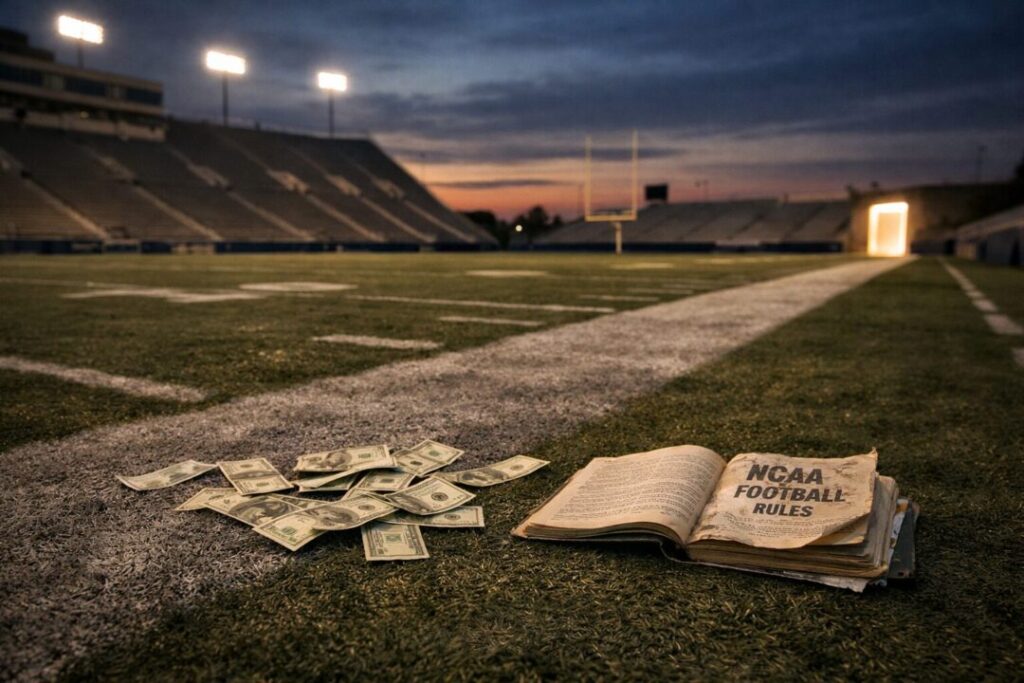
For years, college athletics has been drifting toward a breaking point. What was once a uniquely American institution rooted in school pride, competitive balance, and amateur competition has devolved into something far closer to unlimited, unregulated free agency.
Trump’s executive order is the first serious attempt to restore order, and it couldn’t come soon enough.
At its core, the order recognizes that college sports cannot survive without a centralized governing structure – something that the NCAA has failed to provide and that Congress has failed to construct.
As Trump stated in the order, “the convergence of enormous pressure to win in football and basketball and the loosening, both by litigation and by State legislation, of consistent rules or limits concerning eligibility, transfers, and pay-for-play schemes has created an out-of-control financial arms race.”
That “arms race” is not theoretical – it is already reshaping the landscape in ways that threaten the survival of college athletics as we know it.
Consider the current reality. Following the 2025–2026 season, Iowa State football lost 42 players – nearly half its roster – after head coach Matt Campbell departed for Penn State.
Quarterback TJ Finley is now on his seventh school, a statistic that would have been unthinkable even a decade ago. In college basketball, more than 1,500 Division I players are currently in the transfer portal.
When accounting for graduates and NBA departures, that means over half of all players are effectively in free agency.
This is not stability. It’s not even organized competition. It’s chaos.
Trump’s order directly targets the root causes of this dysfunction. It calls for clear eligibility limits, including a five-year participation window, and structured transfer rules to restore continuity for both athletes and programs.
It also seeks to eliminate the shadow economy of NIL “collectives” by banning improper pay-for-play arrangements and cracking down on “unscrupulous agent conduct.”
Perhaps most importantly, the order brings the federal government into the enforcement picture.
It directs agencies to evaluate whether violations of college sports rules should affect a university’s eligibility for federal grants and contracts, while also empowering the Department of Justice and Federal Trade Commission to take enforcement action.
The need for that kind of decisive action is clear. As Trump noted, one major athletic program closed fiscal year 2025 with $535 million in athletics-related debt, while another sits at $437 million in debt.
These are not sustainable figures, and they underscore a broader trend of universities being forced to divert resources away from education and into an escalating bidding war for talent.
That reality cuts to the heart of why this issue matters beyond sports. College athletics is not just entertainment—it supports more than 500,000 student-athletes and provides nearly $4 billion in scholarships annually.
It fuels local economies, drives school identity, and produces a significant share of America’s Olympic talent. In fact, the collegiate system produced 75 percent of the 2024 U.S. Olympic team.
But without reform, that system is at risk of collapsing under its own weight.
Non-revenue sports – particularly women’s and Olympic programs – are especially vulnerable.
As NIL money and revenue-sharing deals concentrate resources in football and basketball, smaller programs are left fighting for scraps.
Trump’s order explicitly addresses this imbalance, calling for revenue-sharing models that “protect and expand opportunities in women’s and Olympic sports.”
That’s a critical point often overlooked in the broader NIL debate.
What’s being sold as “fairness” for athletes is, in practice, creating a system that benefits a small subset of high-profile players while undermining opportunities for thousands of others.
The NCAA, for its part, has proven incapable of managing this transition. Years of legal defeats and internal indecision have left it effectively powerless, unable to enforce even its own rules.
The result is a vacuum that has been filled by boosters, agents, and loosely regulated collectives operating with little oversight.
Trump’s executive order is an acknowledgment that the status quo is untenable. It also reflects an understanding of the cultural role college sports plays in American life.
Unlike professional leagues, college athletics has always been about more than money. It’s about school loyalty, regional rivalries, and the idea – however imperfect – that the game comes first.
Fans don’t tune in to watch contract negotiations play out in real time. They want to watch competition for the love of competition.
That distinction is exactly what has been eroded in the NIL era.
The order does not eliminate NIL outright, nor should it. Athletes should be able to benefit from their name, image, and likeness.
But there is a difference between endorsement opportunities and a completely unregulated pay-for-play market.
Professional sports leagues operate with salary caps, collective bargaining agreements, and clearly defined rules. College sports, until now, has had none of those guardrails.
Trump’s order also puts pressure on Congress to act. While the executive branch can set standards and enforce certain provisions, a long-term solution will likely require legislation.
The order explicitly calls on lawmakers to move quickly, warning that “further delay is not an option given what is at stake and the turmoil and instability currently facing universities across the nation.”
The early response from the sports world suggests broad recognition of that reality.
Legendary Alabama football coach Nick Saban called the move “critical,” saying, “President Trump’s executive order today is a critical step towards restoring stability in college sports.”
NCAA President Charlie Baker similarly described it as “a significant step forward.”
They’re right. For the first time in years, there is a serious effort to restore structure to a system that has been drifting toward disorder.
College sports needs a reset. Trump’s executive order is exactly that – a decisive intervention aimed at preserving one of America’s most cherished institutions before it’s too late.
Alan Jamison is the pen name of a political writer with extensive experience writing for several notable politicians and news outlets. This article was originally published on 4/9/26 via AMAC.us. The opinions expressed by contributors are their own and do not necessarily represent the views of Nevada News & Views.