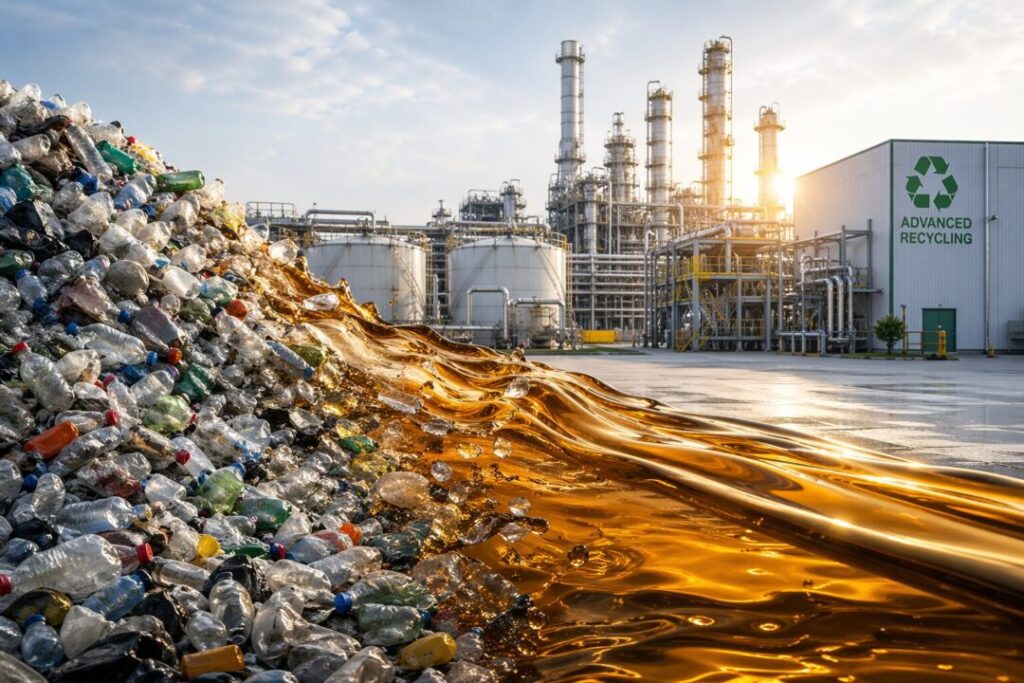
(Lee Zeldin) – Plastic is in practically everything, from packaging to products to clothing and furniture.
It is a cheap, durable technology that improves health and food safety, has made countless products more affordable and accessible, and provides lightweight efficiency that has greatly improved modern infrastructure. Plastic underpins supply chains across health care, automotive, construction, food, and consumer goods, making it an indispensable driver of manufacturing and economic growth.
In 2023, the plastics industry employed more than 660,000 workers across 45 states and Puerto Rico, paying out more than $46 billion in wages in 2023. More than 13,500 plastics facilities operated in nearly every corner of the country, generating $358 billion in gross output, a figure that had grown by more than 26 percent since 2017.
Unfortunately, what makes plastic so useful also makes it persistent, leaving traces in our oceans, soils, and even the air we breathe.
In 2018, the U.S. generated 35.7 million tons of plastic waste, accounting for more than 12 percent of all municipal solid waste. Of that amount, 27 million tons ended up in landfills, where it could sit for centuries without breaking down.
And it is cheaper to make new plastic than it is to produce recycled plastic, which puts a damper on recycling efforts.
However, a promising new technology is changing this trajectory.
Advanced recycling offers something conventional recycling never could — a way to truly undo plastic, breaking it apart piece by piece until nothing remains but the raw materials from which it was originally made.
One of the most significant forms of this technology is pyrolysis, a process that uses high heat in a zero-oxygen environment to chemically dismantle plastic and convert it into pyrolysis oil — a material that is identical, or nearly identical, to oil refined directly from crude.
In other words, plastic isn’t just being reused — it is being unmade and reborn as a valuable raw material all over again.
I saw the potential of this emerging technology in person when I visited ExxonMobil’s Advanced Recycling operations at their Baytown Complex in September.
Exxon has turned 50,000 tons and counting of hard-to-recycle plastic waste — which would have otherwise been incinerated or headed to landfills — into useful raw materials.
Despite being at the forefront of advanced recycling innovation, America risks falling dangerously behind in the race to build it out.
The U.S. currently operates fewer than 10 advanced recycling facilities. Rather than growing, that number is shrinking as closures continue to accelerate.
The world is moving on this, and quickly. Europe, which already has at least twice as many advanced recycling facilities as the U.S., is projected to have 65 by 2030. It is on track to lead the global market in revenue. And the Asia-Pacific region is emerging as the fastest-growing market for advanced recycling technology, with projected revenues of $7.3 billion by 2030.
If America does not invest in scaling this technology now, it stands to lose not just an environmental opportunity, but an enormous economic opportunity as well.
The good news is that the appetite for investment is already here. Nearly 90 potential advanced recycling facilities are ready to be built across the U.S.
The bad news is that they are being held back by regulatory uncertainty. One major problem is the outdated classification of pyrolysis as incineration under the Clean Air Act — a designation that was never designed with this technology in mind and does not reflect what it actually does.
Inconsistent state-level frameworks have further compounded the problem. Only 25 states have advanced recycling-specific regulations, and the remainder default to solid waste classifications that subject the process to unnecessarily burdensome rules.
Clearing these hurdles will allow us to continue to safeguard the environment while ensuring regulations are updated to match the reality of a 21st century technology. That is exactly what the Trump EPA is doing.
As part of our Powering the Great American Comeback initiative, EPA is cutting unnecessary regulatory reporting burdens and delivering the clarity that industry needs to build with confidence.
We are taking a fresh look at the rules governing pyrolysis and other advanced recycling processes and asking whether they are working as intended.
Our offices of Air and Radiation and Chemical Safety and Pollution Prevention are actively engaging with industry stakeholders at every level to chart a clear and constructive path forward.
The results of that work are already taking shape. EPA is currently accepting public comments on a rule that would recognize advanced recycling as manufacturing under the Clean Air Act rather than waste management. That may sound like a small technical change, but it makes an enormous difference.
Under the current rules, advanced recycling facilities face the same restrictions as incinerators and landfills, making them costly and difficult to build. By changing that classification, we would free companies to invest and build with confidence, while still holding them to strong environmental standards.
This common-sense fix could unleash the full potential of advanced recycling in America, turning a promising idea into a booming industry.
Advanced recycling could add more than 173,000 jobs and nearly $13 billion in annual payroll to our economy, delivering on President Trump’s promise to bring good-paying manufacturing jobs back home.
Under Trump, EPA is committed to making America a leader in this emerging technology.
Lee Zeldin is the 17th administrator of the U.S. Environmental Protection Agency. The opinions expressed by contributors are their own and do not necessarily represent the views of Nevada News & Views. This article was originally published via TheHill.com on 4/24/2026.