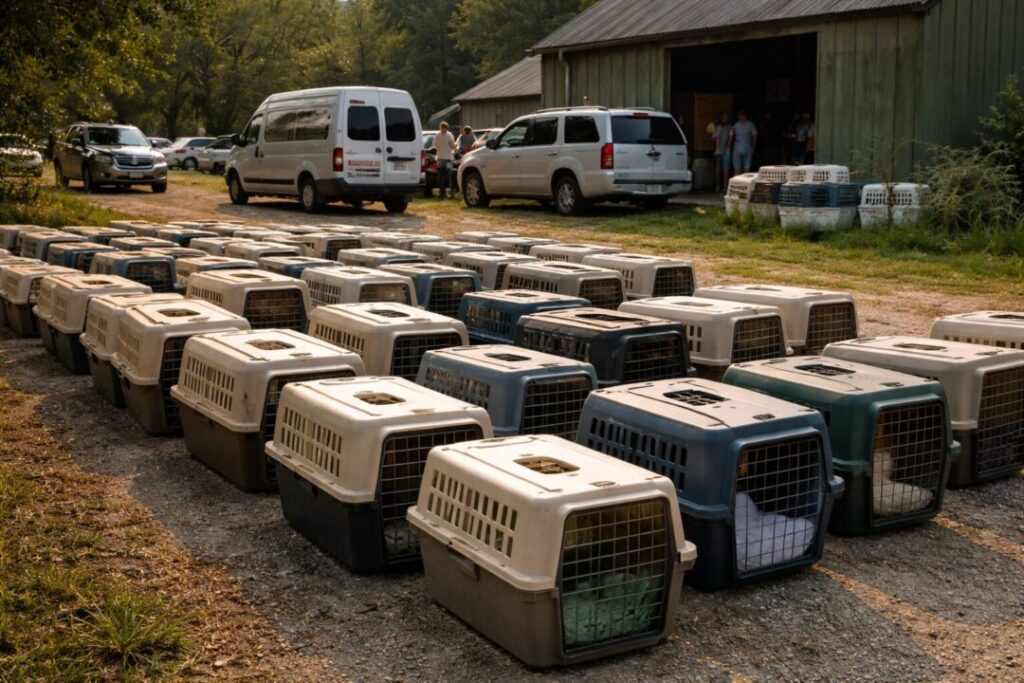
On March 20, 2026, Los Angeles County officials carried out a search warrant at Rock N Pawz, an animal rescue in Lake Hughes.
What they found shocked even experienced investigators.
About 700 animals were removed from the property.
That included roughly 400 dogs and 300 cats, many in need of immediate medical care.
JUST IN: Los Angeles authorities are currently carrying out potentially the largest animal rescue operation in United States history.
L.A. officials are reportedly removing an estimated 700 dogs and cats from a property in Antelope Valley.
According to investigators, the… pic.twitter.com/c6C9yZv99k
— Collin Rugg (@CollinRugg) March 20, 2026
According to Los Angeles County officials, the animals were living in severe overcrowding.
Some were sick. Some were malnourished. Others had clearly gone without basic care for a long time.
Dozens of workers across multiple agencies were brought in to handle the situation. This was not a small operation.
In fact, officials say this could be one of the largest animal welfare seizures in U.S. history.
When “Rescue” Goes Wrong
The rescue was run by Christine De Anda, who has reportedly faced prior violations.
Now, there are growing calls for criminal charges.
But the bigger issue goes beyond one person. Animal welfare experts say cases like this are part of a troubling pattern.
Some groups start out trying to help animals, but over time, things spiral out of control.
A peer-reviewed study published in the journal Psychiatric Services found that animal hoarding is often linked to untreated mental health issues. People believe they’re helping, even when the animals are clearly suffering.
It these cases harder to spot early.
From the outside, it can look like a caring rescue group. Donations come in. Supporters feel good about helping.
But behind the scenes, the situation can be very different.
A Ripple Effect on Shelters
Now comes the next problem.
Where do 700 animals go?
Los Angeles shelters were already full before this happened. Now they are dealing with a sudden surge of animals.
Officials say some of these animals may be at risk of euthanasia if homes cannot be found quickly.
Adoption events are being planned and officials are also asking people to foster animals to ease the pressure.
But this kind of crisis shows how fragile the system really is.
It only takes one bad situation to push everything to the edge.
Why This Matters in Nevada
Clark County has long dealt with its own shelter capacity issues.
The Animal Foundation in Las Vegas has repeatedly reported overcrowding and high intake numbers in recent years.
When shelters get full, tough decisions follow.
And just like in California, Nevada has seen concerns about so-called rescues that are not properly monitored.
Right now, oversight can be uneven. Some groups operate with little scrutiny until something goes wrong.
So how do we make sure these people asking for donations are actually helping animals?
Calls for Accountability
Many experts say the answer is better oversight and accountability.
That does not mean shutting down real rescue groups. Many do great work.
But it does mean stronger checks. Regular inspections. Clear standards.
And real consequences when those standards are ignored.
The opinions expressed by contributors are their own and do not necessarily represent the views of Nevada News & Views. Digital technology was used in the research, writing, and production of this article. Please verify information and consult additional sources as needed.