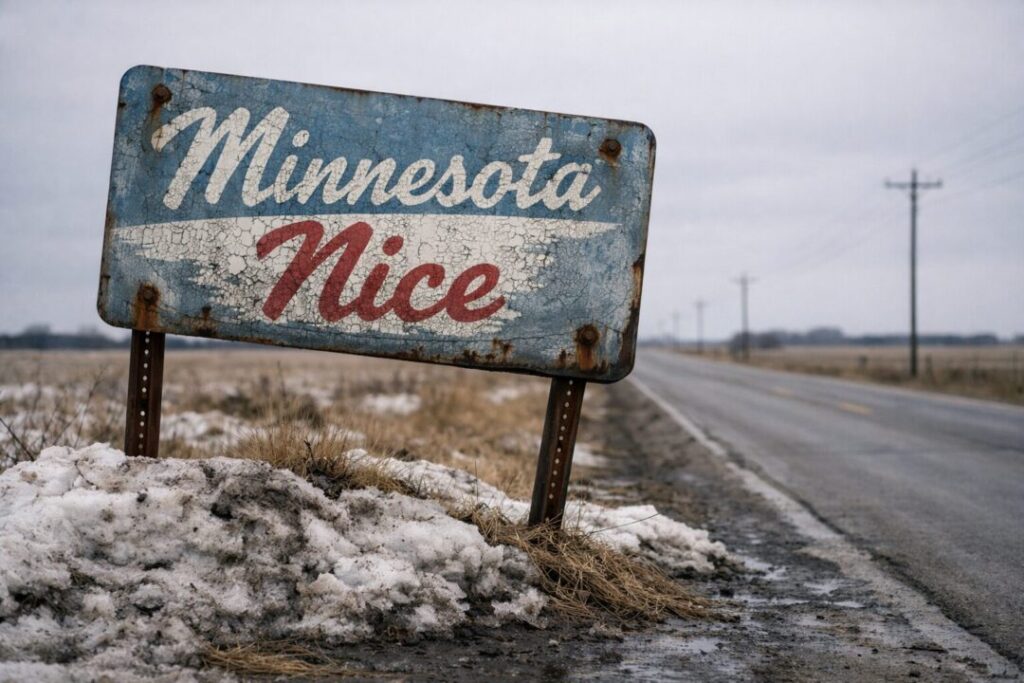
(Herald Boas) – Minnesota’s public image and reputation have suffered grievous blows in recent weeks and months, but the decline has been unfolding for a much longer period.
The origins of the state’s positive image came from its post-World War II liberal politics and its successful new business community.
Former Minneapolis Mayor Hubert Humphrey led a group of the state’s Democrats to form the Democratic-Farmer-Labor Party (DFL) that eliminated the radicals and communists from the pre-war Farmer-Labor Party.
Minnesota produced in addition to Humphrey a number of national liberal figures, including Walter Mondale and Eugene McCarthy, who helped create the natural succession to Franklin Roosevelt’s New Deal coalition which had dominated U.S. politics from 1933 to 1948.
At the same time, Minnesota’s traditional grain, timber, and iron ore business base saw the creation of major new retail, food, and technology corporations such as Target, General Mills, 3M, Control Data, and Medtronic, which rapidly expanded nationally and added white-collar employment in its Minnesota home offices.
At the same time as East Coast and Rust Belt states saw their heavy industry and manufacturing plants decline, resulting in a loss of employment and population, Minnesota saw growth and population increase.
The new and successful corporations, in turn, financed and encouraged local cultural organizations, including theater, music, and literary activity with national reputations beyond what might be expected from a relatively small state.
“Minnesota Nice” became the catchphrase for the state’s liberal economic and cultural boom character.
Humphrey and Mondale became U.S. Vice Presidents and later ran unsuccessfully for president.
Other liberal Minnesota politicians, including McCarthy, Don Fraser, and Martin Sabo, became national figures.
Minnesota musicians such as Bob Dylan and Prince became international cultural icons.
But by the time current Governor Tim Walz was chosen to be Kamala Harris’s vice presidential running mate in 2024, the euphoria of Minnesota Nice had turned into a negative “Naughty” Minnesota.
Walz himself is the personification of the decline of the Gopher State.
The Walz administration raised taxes, promoted questionable liberal welfare policies, imposed a woke educational culture, and discouraged or punished small businesses and the wealthy as more and more successful residents and companies have begun to leave the state for friendlier locations.
Staggering levels of public program fraud have been uncovered, and opponents have charged Walz and DFL Attorney General Keith Ellison with negligence in recognizing and prosecuting the widespread corruption.
Higher taxes produced inevitable outsized state budget surpluses, but Walz and the DFL legislative majorities only raised taxes higher and carelessly spent the surpluses on more pet liberal welfare projects.
Walz’s brief campaign for the vice presidency became a political parody, and the governor became a political joke within the travesty of the Democrats’ hapless presidential campaign.
No Republican has been elected statewide in Minnesota since 2006, but revelations of mismanagement and fraud in state programs have grown so great that the 2026 midterm elections could produce a red wave like the one that occurred in 1978, when a similar DFL domination of statewide elected offices produced a surprise Republican landslide that elected a GOP governor and two GOP U.S. senators.
Tim Walz had announced he would run for re-election this year, but his popularity plummeted so much that he has announced his withdrawal from the race.
DFL U.S. Senator Amy Klobuchar, who had launched an unsuccessful bid for president in 2020, has declared she will run for governor. She is the heavy favorite to win the DFL nomination and will be formidable in November.
But several prominent Republicans have announced for governor, including GOP Speaker of the Minnesota House Lisa Demuth, State Representative Kristin Robbins, and the 2022 GOP gubernatorial nominee, Scott Jensen.
Jensen has since switched to the state auditor’s race. The likely Republican nominee will be Speaker Demuth.
She is currently the underdog in hypothetical general election matchups, but if a GOP landslide occurs in November, she could win.
Incumbent DFL U.S. Senator Tina Smith is not running for re-election this year. Lt. Governor Peggy Flanagan and retiring Congresswoman Angie Craig are the principal DFLers running for the seat.
Flanagan has received the major party leader endorsements so far, but Craig is likely the more formidable DFL nominee in November, based on her political success in the state’s 2nd congressional district.
Flanagan, as part of the Walz administration, could be hurt by the voter backlash to the fraud scandals.
The Republicans also now have a major candidate for that U.S. Senate seat. Well-known sports broadcaster Michele Tafoya has entered the race, and although this is her first run for public office, she has quickly demonstrated her command of the political issues.
The likely 2026 GOP nominee, she could win in November even if there is no landslide.
The political environment in Minnesota this year is similar to those in many other midwestern states.
Voters in the Twin Cities of Minneapolis and St. Paul vote heavily for the DFL. Rural and most small-town voters vote heavily for Republicans. The 4-4 partisan split of the state’s congressional seats reflects this divide.
The key to the election will be the suburbs of the Twin Cities.
In recent years, suburban voters, especially women, have favored the DFL. But in 2026, the GOP could have a respected black woman Speaker of the State House (Demuth) running for governor and a well-known woman media personality (Tafoya) running for U.S. senator.
If the anti-fraud backlash is still in the forefront eight months from now, the conditions for a conservative sweep at the polls could be just right.
The opinions expressed by contributors are their own and do not necessarily represent the views of Nevada News & Views. This article was originally published via AMAC.us on 2/25/26. Herald Boas is a writer for AMAC Newsline.