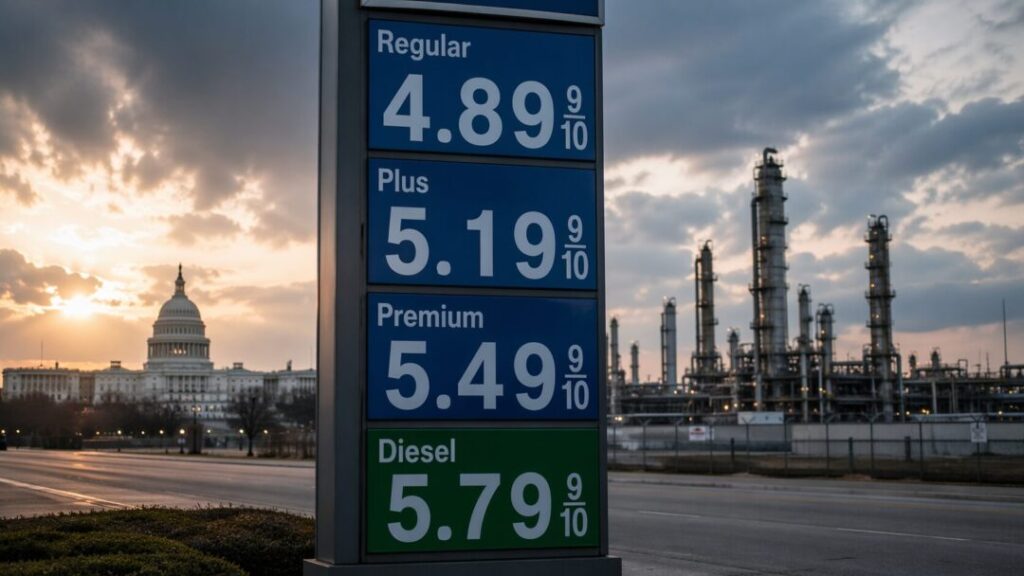
Gas prices are climbing again, and Rep. Dina Titus says President Donald Trump and conflict with Iran are to blame.
Titus posted on X that rising gas prices in Las Vegas are “thanks to [President Trump's] war in Iran.” She shared two photos comparing price increases at a gas station near her district office and blamed the White House.
The U.S. Oil & Gas Association weren't buying it.
Good evening Rep. Titus.
Several of your constituents have asked us to respond to this post.
We refer you to prior our comments to your colleague Rep. Lee. BUT with an additional addendum that others might find interesting.
Roughly 88% of Nevada’s transportation fuels —… https://t.co/2dOXAVKTOy
— US Oil & Gas Association (@US_OGA) April 4, 2026
“Good Evening Rep. Titus…”
In a direct reply on X, the group said several of Titus’s own constituents had asked them to respond to her post.
They argued Nevada’s gas price problem has much deeper roots than one foreign conflict or one month of price changes.
Then they brought up her votes.
The U.S. Oil & Gas Association pointed to Titus’s voting record, listing five votes they say made energy costs worse for consumers.
They cited her opposition to H.R. 1, the Lower Energy Costs Act, which Republicans said would boost domestic oil and gas production and reduce red tape.
They also referenced votes involving methane fees, federal oil and gas leasing, liquefied natural gas exports, and faster pipeline approvals.
Their message to Titus was, in short: if you consistently oppose more drilling, pipelines, leasing, and domestic production, you shouldn't be surprised when energy stays expensive.
The Problem Starts Much Closer to Home
Here’s what many Nevadans don’t realize.
Nevada depends heavily on California for gasoline. Roughly 88% of the state’s transportation fuel comes from California refineries, according to figures cited by energy advocates. In Southern Nevada, nearly 90% of supply reaches Las Vegas through the Calnev Pipeline.
That means what happens in California doesn’t stay in California.
If a refinery shuts down, Nevada feels it.
If regulations raise costs, Nevada feels it.
If supply gets tight, Nevada really feels it.
Imagine your whole neighborhood buying groceries from one store. Then that store cuts hours, raises prices, and locks half the doors.
That’s not a great setup for consumers.
Nevada Has Almost No Backup Plan
Here’s the tougher truth. Nevada has virtually no gasoline refining capacity of its own.
When California sneezes, Nevada catches the flu.
That leaves families in Las Vegas, Reno, Henderson, Mesquite, and everywhere in between paying more just to get to work, school, soccer practice, or the grocery store.
And unlike politicians, the gas pump doesn’t care whose talking points sound better. It just shows the price.
What Titus Supporters Might Say
To be fair, supporters of Titus can argue that global tensions absolutely affect oil markets. They’re right about that.
War scares markets. Traders react. Prices move. No serious person denies that.
But blaming overseas conflict while ignoring Nevada’s dependence on California is like blaming rain for a leaky roof you never fixed.
Both can matter at once.
The Bigger Nevada Lesson
This isn’t really about one tweet or one politician. It’s about our state sitting on shaky ground.
Nevada needs more options. More resilience. More infrastructure. More common sense.
When Nevada isn’t setting the terms, Nevada families pay the price.
If another state's politics can raise our fuel costs overnight, we're not in control of our future. We’re stuck in the back seat.
The opinions expressed by contributors are their own and do not necessarily represent the views of Nevada News & Views. Digital technology was used in the research, writing, and production of this article. Please verify information and consult additional sources as needed.