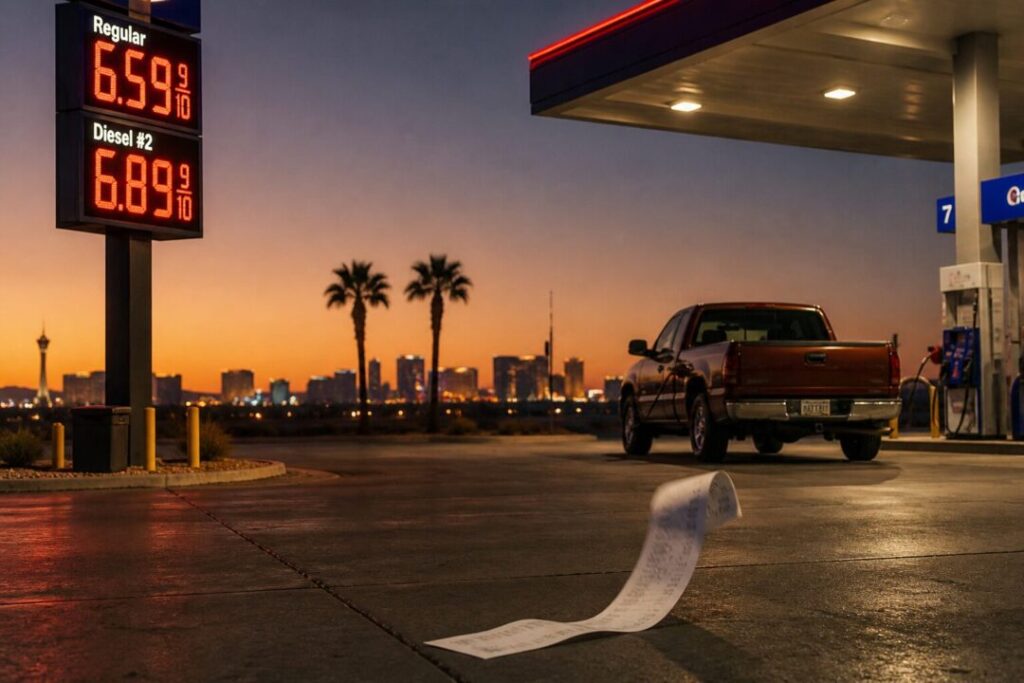
Gas prices go up, and folks start asking the same question.
If America produces so much oil, why are we still paying so much at the pump?
Turns out, the answer isn’t as simple as “drill more.”
According to a recent report from First Trust Economics, oil is priced on a global market, not a local one. That means what happens halfway across the world can hit your wallet here in Nevada almost overnight.
Think of it like groceries. Even if your town grows its own food, prices still rise if there’s a shortage somewhere else. Oil works the same way.
Right now, global tensions, especially around places like the Strait of Hormuz, are tightening supply. That drives up crude oil prices everywhere, including here at home.
And crude oil is what gasoline is made from.
So when crude prices rise, gas prices follow. Simple as that.
Why “Energy Independence” Doesn’t Mean Cheap Gas
You’ve probably heard politicians say America is “energy independent.” That’s partly true.
The U.S. has been a net exporter of petroleum products since 2020. In fact, by 2025, the country was exporting about 10.7 million barrels per day while importing around 7.9 million.
Sounds like we should be in great shape, right?
Not exactly.
Here’s the catch. Not all oil is the same.
American oil production mostly creates what’s called “light sweet crude.” But many U.S. refineries were built decades ago to handle “heavy crude.”
So what happens?
We export a lot of the oil we produce and import the kind our refineries need. Canada alone supplies about 62 percent of U.S. crude imports.
That means we’re tied into the global system whether we like it or not.
A System Built for Global Trade
Gas doesn’t just appear at your local station. It goes through a long process.
Crude oil is pumped, shipped, refined, blended, and transported through pipelines and trucks before it ever reaches your tank.
Along the way, companies are constantly making decisions based on global prices.
If they can sell fuel overseas for more money, they will. That’s how markets work.
And while that system helps keep supply steady, it also means American consumers are exposed to global shocks.
Even in a strong production environment.
What This Means for Nevada Drivers
If you’re filling up in Las Vegas or Reno, you’re feeling the impact of all this.
Nevada doesn’t produce oil. It relies heavily on fuel coming from California refineries and regional supply chains.
That already makes prices higher here than in many other states.
Add global pressure on top of that, and it’s no surprise costs climb fast.
For working families, it’s not just about gas. Higher fuel costs raise the price of groceries, shipping, and just about everything else.
It’s a chain reaction.
What Critics Say
Some critics argue the solution is simple. Produce more oil here at home and cut exports.
Others push for more government control over energy markets.
But the report makes it clear. The system is deeply connected to global trade. Breaking away completely would take years, cost billions, and likely create new problems.
At the end of the day, gas prices aren’t just about what America does.
They’re about what the world does.
And until that changes, every driver in Nevada will keep paying attention to headlines from places thousands of miles away… every time they pull up to the pump.
The opinions expressed by contributors are their own and do not necessarily represent the views of Nevada News & Views. Digital technology was used in the research, writing, and production of this article. Please verify information and consult additional sources as needed.