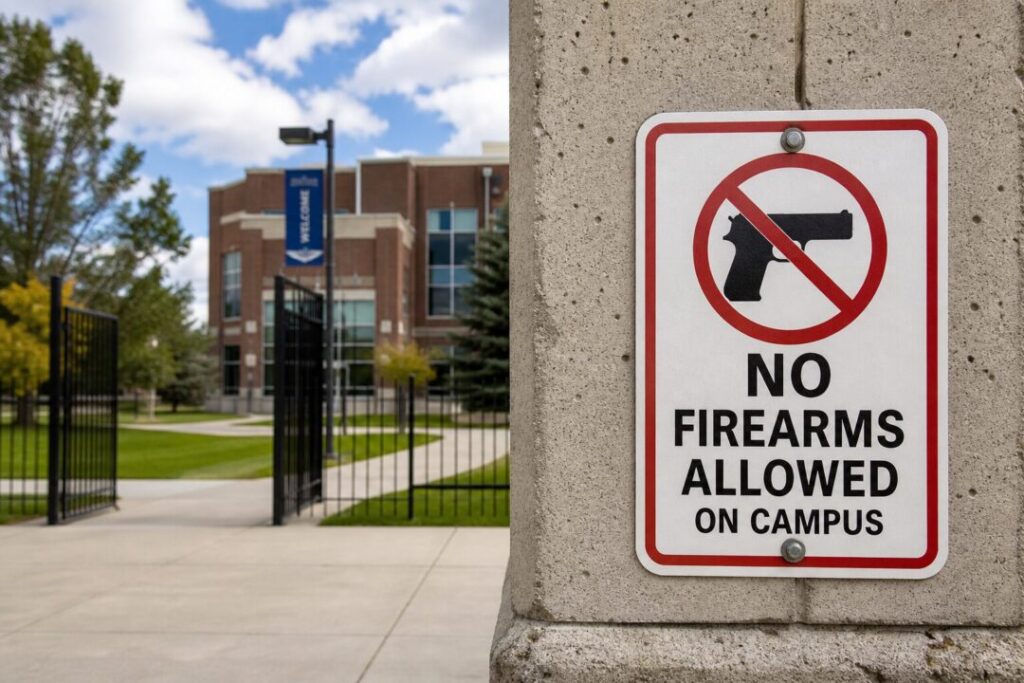
New Hampshire lawmakers are considering a bill that would allow lawful concealed carry on public college campuses.
Supporters say it’s about safety. Opponents say it creates risk. You’ve heard those arguments before.
What’s different now is the focus on “gun-free zones” themselves.
In a recent op-ed, researcher Dr. John Lott and state Rep. Samuel Farrington argue those zones don’t just fail to stop attacks. They may actually attract them.
That makes sense. Attackers often choose places where they expect no one will shoot back.
That idea isn’t coming from guesswork. It comes from the attackers. In multiple cases, mass shooters have said they picked locations where firearms were restricted. Schools. Theaters. Grocery stores.
Places where people would likely be unarmed.
In Buffalo in 2022, the gunman wrote that areas where concealed carry was restricted were “good areas of attack.” In Nashville, police said the Covenant School shooter chose that location in part because security was weaker than at another site.
More victims means more attention, which is ultimately what many of these criminals are after. And that means picking places with less resistance.
That’s where the campus debate shifts.
Opponents focus on what might go wrong if guns are allowed. Accidents. Arguments. Bad decisions.
Supporters ask, where has that actually happened?
Some states have allowed campus carry for years. In some cases, decades. The worst-case scenarios critics warn about are hard to find in the data.
Utah has allowed firearms in dorms since 2004. The predicted problems never showed up.
The same thing has happened with broader concealed carry laws. Each time states expanded carry, critics warned of chaos. Each time, those predictions fell short.
That doesn’t mean there’s no risk. It means the risk may not look the way people expect.
Sarasota County Sheriff Kurt Hoffman didn't dance around the issue; he pointed out that attackers are the ones who choose the time and place, and that law enforcement simply can’t be everywhere to stop them.
That leaves a gap. The question is who fills it.
Supporters say it should be law-abiding citizens who are already allowed to carry elsewhere, while opponents believe fewer guns in shared spaces is the safer path.
Randy Mackie, president of the Nevada Firearms Coalition PAC, a group that advocates for Second Amendment rights here at home, puts it even more bluntly. He calls gun-free zones “hunting preserves for psychotic killers.”
“Gun-free zones only benefit the people who want to kill other people,” Mackie said, warning policymakers to carefully consider this before expanding them.
At its core, here's what the debate comes down to:
Does removing firearms from a location make people safer?
Or does it just change who has them?
Lawmakers in New Hampshire have to answer that now, while other states already have. Some kept campuses gun-free. Others didn’t.
The question is still about safety – but it’s also about assumptions.
Who follows the law.
Who doesn’t.
And what actually deters those who don’t.
The opinions expressed by contributors are their own and do not necessarily represent the views of Nevada News & Views. Digital technology was used in the research, writing, and production of this article. Please verify information and consult additional sources as needed.