It's Called Temporary Protected Status. The Court Finally Enforced the “Temporary” Part.
Thursday morning, the U.S. Supreme Court issued two landmark rulings on immigration. For once, the law actually won.
In back-to-back 6-3 decisions, the Court sided with the Trump administration on two separate immigration fights.
Both rulings were written by Justice Samuel Alito. Both broke along ideological lines. And both sent a message that's been a long time coming: immigration law means what it says.
The first case involved Temporary Protected Status, or TPS. It's a program that lets people from certain countries stay in the U.S. when conditions back home are dangerous.
Countries like Haiti and Syria have been on the list for years. For some people, “temporary” has stretched into decades.
The Trump administration moved to end TPS protections for roughly 350,000 Haitians and 6,000 Syrians.
Lower courts blocked it. Activist judges, as usual, tried to substitute their judgment for the elected executive's.
The Supreme Court said no.
The Court held that the Secretary of Homeland Security has broad authority over TPS decisions, and that federal courts don't get to second-guess those calls based on procedural complaints.
If Congress wanted judges running immigration policy, it would've said so.
The second ruling is just as important, and frankly, just as obvious.
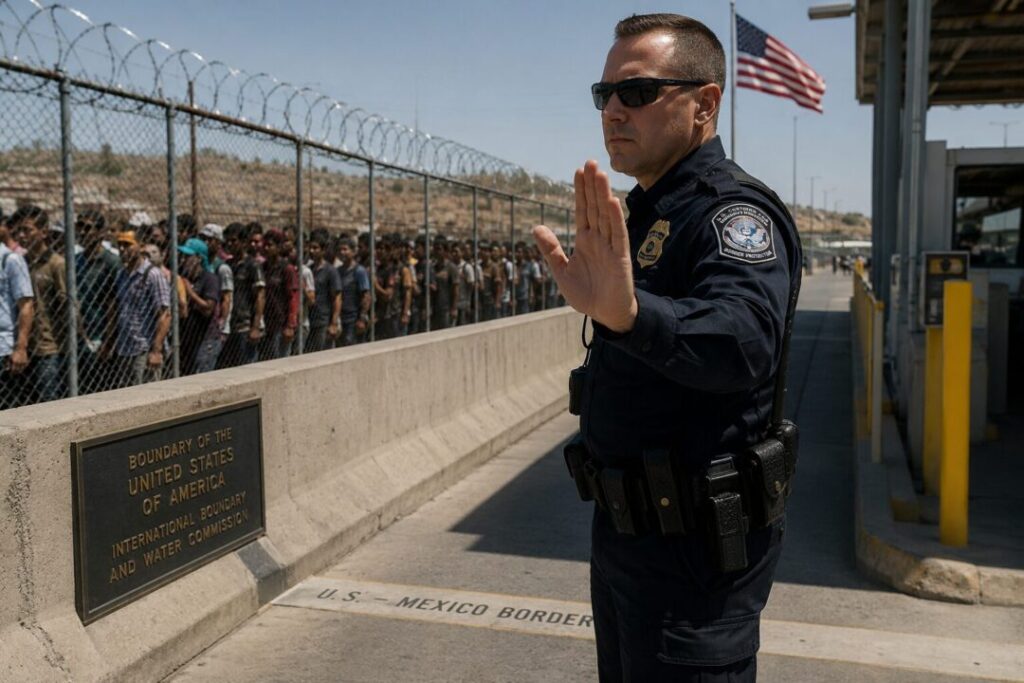
The question was simple: does someone have the right to claim asylum in America if they're still standing in Mexico?
The Court said no. You haven't “arrived” in the United States until you actually cross into the United States.
Alito put it in terms anyone can understand. A guest doesn't “arrive” at your house by knocking on the door and being turned away.
This practice, called “metering,” lets officials limit how many asylum applications get processed at a port of entry each day. Critics called it cruel. Courts had blocked it.
But the Supreme Court said the plain text of the law doesn't give asylum rights to people who've never entered the country.
That's not harsh. That's just reading.
The liberal dissenters, Justices Kagan, Sotomayor, and Jackson, argued these rulings expose people to dangerous conditions and undermine America's humanitarian commitments.
That's a fair thing to care about. But it's not an argument the Supreme Court is authorized to make.
Congress sets immigration law. The executive enforces it. Courts aren't supposed to rewrite either one because they disagree with the outcome.
Here in Nevada, we know what broken immigration enforcement looks like.
We see the strain on public services. We see what happens when laws aren't enforced consistently.
And we've watched for years as courts and bureaucrats found creative ways to block every attempt to restore order at the border.
These rulings don't fix everything. There will be new lawsuits. There will be new attempts to run immigration policy through the courts rather than through Congress.
Advocates are already sharpening their pencils. But for one Thursday morning in June, the rule of law held.
The lesson here isn't about cruelty toward anyone. It's about what happens when a country stops enforcing its own rules.
Laws that aren't enforced aren't really laws. They're suggestions. And America can't be governed by suggestion.
I've been a strong supporter of enforcing our immigration laws from the beginning, not because I don't believe in compassion, but because I do believe in a country where the rules mean something.
Thursday was a good day for that country.
The opinions expressed by contributors are their own and do not necessarily represent the views of Nevada News & Views. Digital technology was used in the research, writing, and production of this article. Please verify information and consult additional sources as needed.