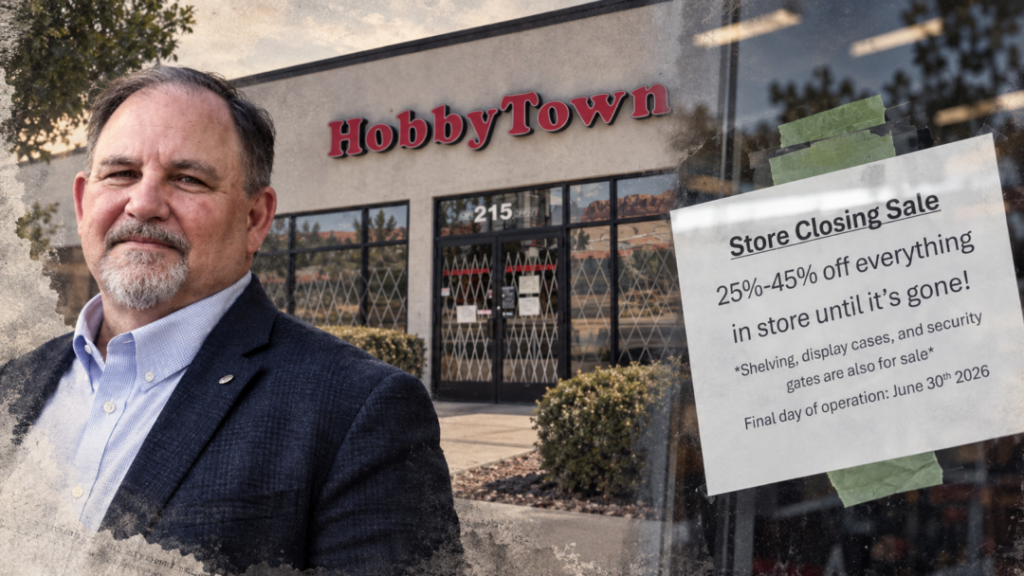
HobbyTown liquidated as more of Flippo's money entered his campaign, while the status of a $68,600 SBA loan remains unknown.
Republican congressional nominee David Flippo’s campaign says he delayed filing his required personal financial disclosure because he was closing an out-of-state business.
That explanation appears to point to HobbyTown St. George, the Utah hobby store operated by Flippo and members of his family.
The closure was not merely a paperwork exercise. In late May, closing and liquidation signs appeared in the store’s windows. The liquidation began as Nevada’s June 9 Republican primary approached, and a sign at the storefront identified June 30 as its final day of operation.
This author posted contemporaneous photos of the closing signs on May 30:
Just to be clear, when @DavidFlippoNV was interviewed two days ago by @MiniRacker, he informed her of his HobbyTown store in St George but forgot to say that it's being liquidated. #NV02 pic.twitter.com/hPmnp2JkDU
— BrutalBrittany💕 (@BrutalBrittany2) May 30, 2026
At nearly the same time, another major infusion of Flippo’s money reached his congressional campaign.
By March 31, Flippo had loaned his principal campaign committee about $1.28 million. By June 30, that committee reported $1.63 million in loans from the candidate, an increase of about $350,000 during the quarter in which HobbyTown closed.
Including $15,000 he loaned his older committee, Federal Election Commission records show $1.645 million in candidate loans across Flippo's two authorized committees.
The filings do not establish that the additional campaign money came from HobbyTown, its inventory or its liquidation. But the timing makes Flippo’s missing financial disclosure more important, not less.
That disclosure would help voters determine what assets Flippo owned, what income or sale proceeds he received, what debts he carried and whether the money supplied to his campaign came from personal funds or another source of credit.
Instead, the campaign has offered an explanation that raises additional questions.
“Mr. Flippo is in the process of closing one of his businesses to focus on serving the people of Northern Nevada, while he moves his other businesses, investments, and landholdings into a blind trust,” campaign treasurer Thomas Datwyler told NOTUS in August.
“That is a complicated process, and his financial disclosure will be filed once that is complete.”
Flippo campaign consultant Rory McShane similarly said the disclosure would be filed “after that process is completed.”
This week, the campaign told 2 News Nevada that Flippo would rather pay the $200 late-filing fee than submit an inaccurate report, characterizing its position as “right and late” rather than “wrong and early.”
But federal disclosures use value ranges, and candidates may amend reports when information changes. Closing a business does not suspend the disclosure requirement.
The Company Behind HobbyTown
Utah business records show Flip’s Family Fun Inc., entity No. 10484414-0142, was created on Aug. 10, 2017. Its stated purpose was “Retail Store — Hobbies.”
David Flippo was listed as president; his wife, Dawn Flippo, as a director and registered agent; and their sons, Ryan and Sean Flippo, as treasurer and secretary, respectively.
A separate assumed-name registration for HobbyTown StGeorge, entity No. 10567635-0151, was created days later.
The corporation was initially associated with 845 South Peachtree Drive in Washington, Utah. A July 17, 2018 filing signed by David Flippo moved the corporation and its officers to 2654 Red Cliffs Drive, Unit E, then the HobbyTown storefront. The store later moved to 215 West St. George Boulevard.
On Aug. 10, 2021, the HobbyTown assumed-name registration was updated with the West St. George Boulevard address and Dawn Flippo as its registered principal.
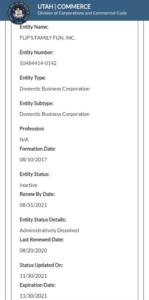
Just 21 days later, the annual renewal for Flip’s Family Fun—the corporation identified as doing business as HobbyTown—came due.
That registration was not maintained. Utah administratively dissolved the corporation on Nov. 30, 2021, less than four months after the related HobbyTown record was updated.
The records do not explain whether another entity assumed control or whether Flip’s Family Fun continued operating despite its inactive status. They also do not document a transfer of the store’s inventory, equipment, lease or accounts to a successor company.
Nevertheless, HobbyTown remained open and continued conducting business for more than four years after Flip’s Family Fun was dissolved.
Flippo’s own 2022 Nevada financial disclosure continued to identify the business as “Flip’s Family Fun Inc. DBA HobbyTown,” even though Utah had already classified the corporation as inactive.
The business was still being presented that way in 2026. In a May 29 profile, The Nevada Independent reported that Flippo owned the HobbyTown location while one of his sons managed its day-to-day operations.
In the same interview, Flippo blamed Congress and COVID-era unemployment policy for the store’s rising labor expenses. He claimed lawmakers had been unable to enact a $15 minimum wage and had instead achieved the same result “through COVID and unemployment.”
“Labor costs went up overnight,” Flippo said. “I was paying seven bucks, now I’m paying 15 to 17 bucks an hour for labor.”
Neither the profile nor the public statements cited in it addressed the fact that the corporation identified with HobbyTown had been dissolved since 2021.
The public records reviewed do not identify what legal entity operated the store between Flip’s Family Fun’s November 2021 dissolution and HobbyTown’s closure.
The storefront nevertheless continued operating until around June 2026.
A Utah State Tax Commission response further complicates the question of who operated it. Asked to identify HobbyTown’s licensed taxpayer from the corporation’s Nov. 30, 2021 dissolution through August 2026—including any termination, transfer or replacement account—the commission produced a nontransferable sales-tax certificate naming Flip’s Family Fun Inc., doing business as HobbyTown St. George.

No record produced identified a successor taxpayer or termination date.
The certificate does not establish that any taxes went unpaid. It does show that, when asked to identify HobbyTown’s licensed taxpayer during the post-dissolution period, Utah produced a certificate naming the dissolved corporation and no record naming a successor.
That unresolved corporate identity matters because Flip’s Family Fun was also the named borrower on two federal pandemic loans—and its assets secured one of them.
Two Federal Pandemic Loans—and a Lien
Flip’s Family Fun received assistance through two federal pandemic programs.
The company received an $18,416 Paycheck Protection Program loan on April 28, 2020. On Aug. 19, 2020, the Small Business Administration approved a COVID Economic Injury Disaster Loan with an original principal balance of $68,600.
Eleven days later, the SBA filed a UCC financing statement identifying Flip’s Family Fun Inc. as the debtor. The filing asserted a security interest in virtually all company assets, including HobbyTown’s inventory, equipment, accounts, deposit accounts and the proceeds from that property.
The financing statement listed an Aug. 30, 2025 lapse date. Its lapse does not establish that the underlying loan was repaid; it indicates that the public filing was not continued. No termination filing located in the public record explains how the debt itself was resolved.
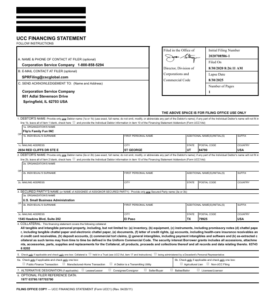
In August 2021, the Flippos updated HobbyTown’s assumed-name registration but did not renew the corporation that had borrowed the federal money and pledged its assets.
That does not prove the EIDL remained unpaid. A financing statement can remain on file after a debt has been satisfied unless the secured party files a termination. But the records reviewed contain no termination statement or other public filing establishing that the obligation had been resolved when the corporation dissolved.
The resulting sequence is unusual: the corporation obtained a federally secured loan, its registration lapsed, the store continued operating for more than four years and the SBA’s financing statement remained on file until 2025.
The records do not identify a successor corporation or document a transfer of the property covered by the SBA filing.
An attempt to determine the loan’s status produced another discrepancy.
SBA Treated a Corporate Records Request as Personal
A Freedom of Information Act request sought records concerning Flip’s Family Fun Inc., the corporation identified as the borrower. It did not request David or Dawn Flippo’s personal financial records.
Michael Lininger, an attorney advisor in the SBA’s Office of Capital Access, said the agency would not release the remaining records without signed authorizations from David and Dawn Flippo, citing FOIA Exemption 6 and the Privacy Act.
That rationale does not fully address the distinction between a person and a corporation.
The SBA’s own privacy guidance says the Privacy Act applies to identifiable records concerning individuals. It also says the agency’s privacy procedures do not cover “a business entity, a corporation, or any entity other than a person.”
A corporate loan file can contain Social Security numbers, personal guarantees, addresses and other information subject to redaction. But the presence of private information does not necessarily make every portion of a corporate record an individual record. FOIA generally requires agencies to release reasonably segregable portions after exempt material has been removed.
The public financing statement identifies Flip’s Family Fun—not David or Dawn Flippo individually—as the debtor. COVID-era EIDL loans of this size generally required business collateral but not a personal guarantee. David and Dawn may nevertheless appear in the loan file as owners, officers or applicants whose personal information may lawfully be redacted.
Loan status is also treated differently depending on how a loan was resolved. The SBA has generally allowed disclosure when a loan is paid in full or charged off while treating the status of active or unresolved loans as confidential commercial information.
In prior litigation, the SBA described “loan status, other than charged-off or paid-in-full,” as generally exempt. A federal court reviewed that policy in litigation over pandemic-loan records.

The agency confirmed that Flip’s Family Fun received the $68,600 EIDL on Aug. 19, 2020, and identified it as Loan No. 6374368202. It did not say whether the loan was active, delinquent, in liquidation, paid in full or charged off.
Nor did it cite the commercial-information exemption normally associated with an unresolved business loan. Instead, it relied on the personal privacy rights of David and Dawn Flippo to withhold records requested about the corporate borrower.
The response does not prove the loan remained unpaid. It also does not establish that the federal obligation was satisfied before HobbyTown closed and its inventory was liquidated.
The public record shows that the SBA’s financing statement outlived the corporation’s active registration. It does not reveal whether the debt did.
Another $350,000 During the Closing Quarter
The physical closure of HobbyTown overlapped with a dramatic increase in Flippo’s campaign loans.
During the first quarter of 2026 alone, Flippo’s principal committee reported $760,000 in new candidate loans, bringing the cumulative amount he had loaned that committee to about $1.28 million by March 31. Those loans accounted for nearly all its reported receipts, as Nevada News & Views previously reported.
Between April and June, he loaned it about $350,000 more. By June 30, the principal committee's candidate-loan total had reached $1.63 million. FEC records also show the two committees have repaid Flippo $41,739.20.
None of those records proves HobbyTown liquidation proceeds funded the loans. No public document establishes such a transfer.
But the closure, liquidation and second infusion of candidate money occurred closely enough together to make the source of the money a legitimate disclosure question.
On July 8, the FEC sent Datwyler a formal request for additional information about the campaign’s April quarterly report. As Nevada News & Views previously reported, the agency directed the committee to correct its candidate-loan totals and explain whether the money came from Flippo’s personal funds or from a bank, brokerage account, credit card, home-equity line or another source of credit.
If a lending institution supplied the money, the campaign was required to identify the lender and disclose the loan terms on Schedule C-1. The response was due Aug. 12.
The FEC inquiry, the unresolved business-loan status and the missing House disclosure are separate matters. But they converge on the same question: Where did the money come from?
The Disclosure Was Due Before the Primary
Flippo changed his candidacy to Nevada’s 2nd Congressional District in April. His personal financial disclosure was due May 15—more than three weeks before the June 9 primary.
House candidates who meet the statutory thresholds must disclose their income sources, assets, liabilities, business positions and certain financial transactions.
As of this week, a search of the House Clerk’s financial-disclosure database did not show a report from Flippo. It also did not show one from his unsuccessful 2024 congressional campaign.
HobbyTown’s 2026 closure cannot explain the missing 2024 report. Nor does it explain why the 2026 disclosure was not filed by May 15, before the closing signs appeared.
The campaign told KOLO on Sept. 9 that Flippo had filed an extension. When the station asked for a copy, it did not receive the paperwork.
Campaign Legal Center says the deadline could have been extended by no more than 90 days, placing the latest possible deadline in mid-August. The organization filed a complaint with the House Ethics Committee on Sept. 11.
This week, 2 News Nevada reported that the campaign had not filed an extension and planned to pay the late fee.
By then, the original deadline, the maximum extension period and the primary had passed.
Nevada News & Views sought comment from Flippo’s campaign and campaign manager Rory McShane, providing them an opportunity to respond to questions about the entity that operated HobbyTown after 2021, the status of the SBA loan and whether any proceeds from the store’s liquidation funded Flippo’s campaign loans. Neither responded by the publication deadline.
The disclosure is not a technicality in a campaign financed so heavily by the candidate. It could identify Flippo’s ownership interests, business positions and income connected to Flip’s Family Fun or any successor HobbyTown operator, along with any reportable personal liabilities associated with the business. It could also help voters evaluate whether the reported campaign loans were consistent with his disclosed finances.
Moving assets into a blind trust would not eliminate the obligation to disclose financial interests held during the reporting period.
A Campaign Built Around Personal Values
On Thursday, The Washington Post reported that Flippo had repeatedly claimed to have received a Bronze Star “for valor,” although his award did not include the “V” device denoting valor in combat.
The claim appeared in a 2023 campaign video and resurfaced in at least two fundraising solicitations this year.
After The Post contacted the campaign, the video was deleted. Flippo called the original claim an “honest mistake,” while McShane blamed the more recent solicitations on a copywriter’s use of old talking points.
That response makes the campaign’s appeal to personal values especially relevant.
In a Reno Gazette Journal interview with former Nevada legislator Pat Hickey, Flippo said that “basic Christian values guide my moral character and integrity and service.”
“You may not agree with everyone, but you should treat them fairly,” he said. “It’s something the military taught me as a commander.”
Promoting the interview Thursday, Flippo wrote:
“I’m a constitutional, free-market conservative. I believe that your family knows how to spend your paycheck better than D.C.”
Voters are not asking Flippo to justify how his family spends its money. They are asking him to account for two pools of money that now overlap in the public timeline.
The first is more than $1.6 million he reported loaning to his campaign without filing the disclosure that would identify his income sources, business interests, assets and debts.
The second is $87,016 in federal pandemic assistance received by Flip’s Family Fun before its dissolution—including a $68,600 SBA loan secured by the company’s business assets.
The public record does not show whether that loan was repaid, charged off or active when HobbyTown closed. It does not identify who owned the inventory sold during the liquidation or explain what happened to assets once covered by the SBA filing.
Fairness and integrity are demonstrated by whether candidates provide the information necessary to account for money they seek, receive and control—including money originating with federal taxpayers.
The available records do not prove that Flippo’s campaign loans came from HobbyTown, its closing sale or assets associated with Flip’s Family Fun. They do not prove that federal pandemic funds were diverted to political use.
They do show why the questions cannot be dismissed as unfinished bookkeeping.
A corporation received federal assistance, allowed its registration to lapse and continued operating for more than four years without a publicly identified successor. The store then liquidated as another major infusion of candidate money entered Flippo’s campaign, while the status of the federal loan and the source of his campaign loans remained undisclosed.
That is not an accusation. It is the financial account voters are still waiting to receive.
The opinions expressed by contributors are their own and do not necessarily represent the views of Nevada News & Views. This article was written with the assistance of AI.