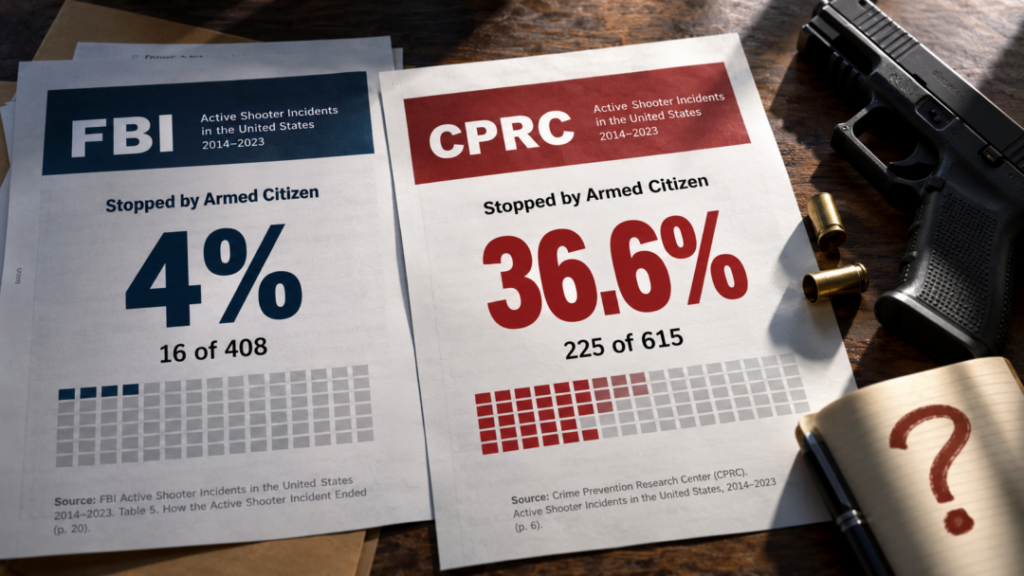
How often does an armed citizen stop an active shooter?
You would think that would be an easy question to answer. It isn’t.
The FBI has studied active-shooter attacks for years. So has Dr. John R. Lott Jr. and the Crime Prevention Research Center, which he heads.
Their numbers aren’t even close.
For the years 2014 through 2025, Lott says the FBI identified 408 active-shooter incidents. According to his count of the FBI reports, armed citizens stopped 16 of them, or about 4 percent.¹
The Crime Prevention Research Center came up with a very different answer.
It identified 615 active-shooter incidents during the same period and says armed citizens stopped 225 of them. That’s 36.6 percent.²
So how do you get from about 4 percent to almost 37 percent?
I wanted to know.
First, the FBI does try to find cases it may have missed.
In a review covering 2000 through 2019, the FBI went back through federal, state and local police records, along with news reports and other public information.
It found 28 additional active-shooter incidents that had not been counted before.³
The FBI also acknowledged that there still could be cases it had not found. Lott says there are quite a few.
CPRC has published a list of cases it believes the FBI either missed or classified incorrectly.⁴
Some are hard to dismiss.
One happened in Conyers, Georgia, in 2015. Jeffrey Pitts walked into a liquor store and opened fire. He killed the store manager and a customer.
Another customer, Todd Scott, dropped to the floor, drew his own handgun and fired back. Pitts fled.
Rockdale County Sheriff Eric Levett later said he believed Scott’s actions saved lives. Surveillance video showed Pitts firing at people until Scott began shooting back.⁵
Pitts did not die from Scott’s gunfire. After fleeing the store, he went home, shot and wounded both of his parents, and exchanged gunfire with a sheriff’s deputy.
The Georgia Bureau of Investigation later determined that Pitts died from a self-inflicted gunshot wound to the head.⁵
Published reporting says the FBI later acknowledged that the liquor-store attack met its active shooter definition but had been missed.⁶
That’s a pretty good example of how a case can fall through the cracks.
But not every disagreement between Lott and the FBI is that simple.
Take the 2019 shooting at West Freeway Church of Christ in Texas.
Jack Wilson had only seconds to act. From across the church, down the aisle, he fired a quick, single head shot from his pistol that killed the attacker.⁷
Wilson wasn’t a police officer. He was an unpaid volunteer who headed his church’s security team. Texas later gave him its highest civilian award for heroism.⁸
The FBI counts Wilson as “security.” Lott counts him as an armed private citizen.⁹
I think Dr. Lott has the better argument.
A man doesn’t become a cop because he volunteers to help protect his church. He has no general police powers and no general duty to act as a law-enforcement officer.
The FBI, however, defines security broadly enough to include employees or volunteers who protect a building or property even though they have no sworn police authority.¹⁰
Same man. Same gun. Same shooting. Different label. And that label changes the statistics.
Other cases are muddy as well. Some of the shootings Lott includes began as domestic disputes, arguments, retaliation or some other crime.
The FBI excludes some incidents like that from its active-shooter reports.¹¹
Suppose a man shoots his wife at her workplace and then turns his gun toward other people. Is that still a domestic shooting? Or has it become an active-shooter attack?
That’s not always an easy call. But how you answer it affects the final numbers.
CPRC says it found 615 active-shooter incidents, compared with the FBI’s 408. That’s a difference of 207 shootings.
Lott says the FBI missed some cases and classified others incorrectly. His organization publishes its case list. Other people can check his work.⁴
Here’s what we do know.
Armed citizens stop active shooters. Both the FBI and Lott document cases where it happened.
We also know the FBI has missed qualifying cases. Its own later review found incidents that had not been counted earlier.³
And Lott and CPRC have identified still more cases that deserve a close look.
The harder question is how those cases should be counted.
- Is an armed church volunteer an armed citizen or security?
- When does a domestic shooting become an active-shooter attack?
- What if an armed citizen engages the shooter but police fire the final shot?
- What if the shooter runs when a citizen starts shooting back?
Those aren’t academic questions. They change the numbers.
I’m not prepared to say the correct answer is 4 percent. I’m not prepared to say it’s 36.6 percent either.
But I am prepared to say this:
The FBI’s published numbers don’t appear to tell the whole story.
Lott has produced evidence worth examining, and some of his criticism appears justified.
When two serious efforts to count the same thing come up with numbers this far apart, somebody ought to find out why.
We’re working on it.
Source Notes
- John R. Lott Jr. and Crime Prevention Research Center, analysis of FBI active-shooter reports for 2014–2025. CPRC reports that FBI reports identified 408 incidents and recognized armed-citizen intervention in 16, or approximately 3.9 percent.
- Crime Prevention Research Center, “Massive Errors in FBI’s Active Shooting Reports from 2014–2025 Regarding Cases Where Civilians Stop Attacks,” September 2026. CPRC reports 615 incidents and 225 stopped by armed citizens, or 36.6 percent.
- Federal Bureau of Investigation, Active Shooter Incidents 20-Year Review, 2000–2019. The FBI conducted a retrospective search of law-enforcement records and open sources and identified 28 additional incidents. The FBI cautioned that additional qualifying incidents could remain unidentified.
- Crime Prevention Research Center, “Updated: Cases that the FBI Missed Where Legally Armed Citizens Have Stopped Active Shooter Incidents,” September 28, 2025.
- Contemporary reporting on the May 31, 2015, Conyers, Georgia, liquor-store shooting, including statements from Rockdale County Sheriff Eric Levett and findings of the Georgia Bureau of Investigation.
- Reporting on the FBI’s subsequent acknowledgment that the 2015 Conyers incident met its active-shooter criteria but had not been included in its original count.
- Contemporary reporting and video of the December 29, 2019, West Freeway Church of Christ shooting, White Settlement, Texas. Jack Wilson fired one shot that struck attacker Keith Kinnunen in the head and ended the attack within seconds.
- State of Texas and contemporary reporting concerning the Governor’s Medal of Courage awarded to Jack Wilson, the state’s highest civilian award for heroism.
- Federal Bureau of Investigation, Active Shooter Incidents in the United States in 2019; Crime Prevention Research Center analysis of armed-citizen interventions.
- Federal Bureau of Investigation, Active Shooter Incidents in the United States in 2025, glossary and methodology. The FBI’s reporting category for security personnel includes employees or volunteers protecting a building or property who do not possess sworn law-enforcement authority.
- Federal Bureau of Investigation, active-shooter methodology and exclusions. FBI reports exclude certain shootings associated with other criminal activity, including some domestic, gang-related and drug-related incidents.
Randy Mackie is a former Delaware police sergeant who served in patrol, supervision and administration and as a firearms instructor and armorer. He is President of the Nevada Firearms Coalition PAC and Vice President of the Nevada Firearms Coalition’s Legislative Division. He writes regularly on firearms, self-defense and Second Amendment issues, and whatever else strikes his fancy.
The opinions expressed by contributors are their own and do not necessarily represent the views of Nevada News & Views. Digital technology may have been used in the research, writing, or production of this article. Please verify information and consult additional sources as needed.