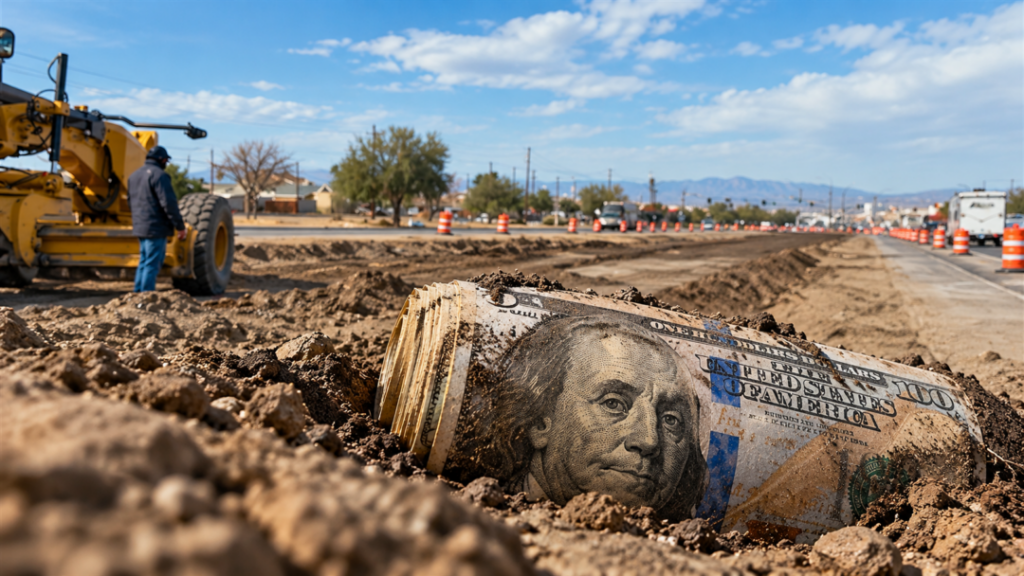
For two years, Henderson drivers have lived with fewer lanes, longer waits at traffic lights, and a long line of orange cones along Boulder Highway.
Mayor Michelle Romero describes the Reimagine Boulder Highway project as a success that remains on schedule and on budget.
Her challenger in the November 3 general election, former police chief Hollie Chadwick, has raised doubts.
Residents are left in the middle, trying to understand what is happening with one of the largest public-works projects in the city’s recent history.
The numbers
In 2020, the Regional Transportation Commission (RTC) published a plan for Boulder Highway.
It priced the “complete streets” work (sidewalks, lighting, traffic signals and protected bike space) at $85–90 million.
That figure covered the entire 15-mile highway, from Wagonwheel Drive to Charleston Boulevard. The center bus lanes were priced separately, at about $40 million.
Henderson is rebuilding about half of that highway, roughly 7.5 miles, and building the bus lanes at the same time.
When the City Council approved the construction contracts in July 2024, the budget was about $173 million.
In 2026 it rose to $185.9 million after the RTC added 17 more bus shelters and related work.
A fairer comparison looks only at Henderson’s stretch.
The 2020 plan priced everything Henderson is now building, including streets, bus lanes and stations, at roughly $70 to $78 million in 2020 dollars.
Today’s price is about two and a half times that.
The numbers are not a perfect match, since the 2020 plan left out the buses themselves, but the gap is large either way.
City officials say the latest increase of about $12 million is covered by RTC funds, not Henderson’s general fund, and that the project will still finish in August 2027.
Those statements may prove accurate. The difficulty is that I have not seen a clear, step-by-step public account of how the cost moved from 2020 to today.
Why did the first number come in so low?
The 2020 document was a planning study, not construction drawings.
Planning estimates are usually stated in the dollars of the year they are written, and they rarely include years of rising prices before work begins.
The study itself shows several gaps.
It assumed only half of the underground utility lines in the way would need to be moved in the first phase.
It listed as unresolved who would pay to relocate utilities, and who would pay for a concrete flood-control box under the median.
And it left out the cost of buses.
The study did not hide these points. But a resident who saw only the headline number would not have known that costs were likely to climb.
A clearer warning that the figure was a rough starting point would have been fair to the public, and might have softened today’s sticker shock.
Did the traffic study prove the plan works?
In July 2024, City Engineer Steven Conner told the City Council that traffic modeling for the final design showed delays in 2040 would be “very similar” to today, even with fewer lanes on the northern part of Henderson’s stretch and expected growth along the corridor.
The city’s explanation is that shorter crossings will let traffic signals work more efficiently. That argument is reasonable.
But that modeling has not, to my knowledge, been released.
Residents cannot see its growth assumptions or its results at busy intersections.
The public 2020 study is no substitute.
It admits that its traffic forecast did not account for new development along the corridor or for more people riding buses. It also found “limited capacity” northbound between Water Street and Gibson Road by 2040.
The same study said that current land development and expected ridership did not yet justify high-capacity transit. The new bus lanes are meant to change that by drawing development and riders to the corridor.
That is a bet with public money, and voters deserve to see the numbers behind it.
The cost to neighbors
The bill is not paid only in tax dollars.
In March, FOX5 reported that the general manager of Sunset Tavern said foot traffic there has fallen 30 percent since construction began in July 2024.
One business is not a survey, but it shows why the city should measure what construction is costing the people who work along this road. Watch the FOX5 You Tube Video here: https://www.youtube.com/watch?v=ZVCVIQdACwU
What residents deserve to see
Four items would let ordinary residents judge the project for themselves:
- A clear cost history, from the 2020 planning figures through the 2024 construction budget to today’s $185.9 million, with a plain explanation of what was added at each step.
- The 2024 design-phase traffic analysis, or at least its key tables and assumptions.
- The ridership forecast for the new center bus lanes.
- A realistic public timeline for when the heaviest construction impacts will end.
These are basic accountability questions, not political attacks.
Nevada’s public-records law (NRS 239) allows any resident to request these documents from the City of Henderson and the RTC.
The city’s side deserves a hearing too.
Mayor Romero has said her critics are misleading residents and that Public Works staff have given accurate, up-to-date information.
The simplest way to settle the argument is to release the documents.
Safety is the reason, and it is a good one
We all want a safer Boulder Highway.
About a quarter of Henderson’s traffic deaths over a six-year span happened on this road, and the new lighting, shorter crossings, protected bike lanes and center bus lane address real problems.
But residents who have endured two years of disruption deserve evidence, not just assurances, that the higher cost was justified and that traffic will be manageable when the work is done.
Transparency is not a partisan demand.
It is the only practical way for Henderson voters to decide whether this project is worth what it costs.
The opinions expressed by contributors are their own and do not necessarily represent the views of Nevada News & Views. Digital technology may have been used in the research, writing, or production of this article. Please verify information and consult additional sources as needed.