It Will Finally Let It Work the Way It’s Supposed To
I invested in Contio.ai.
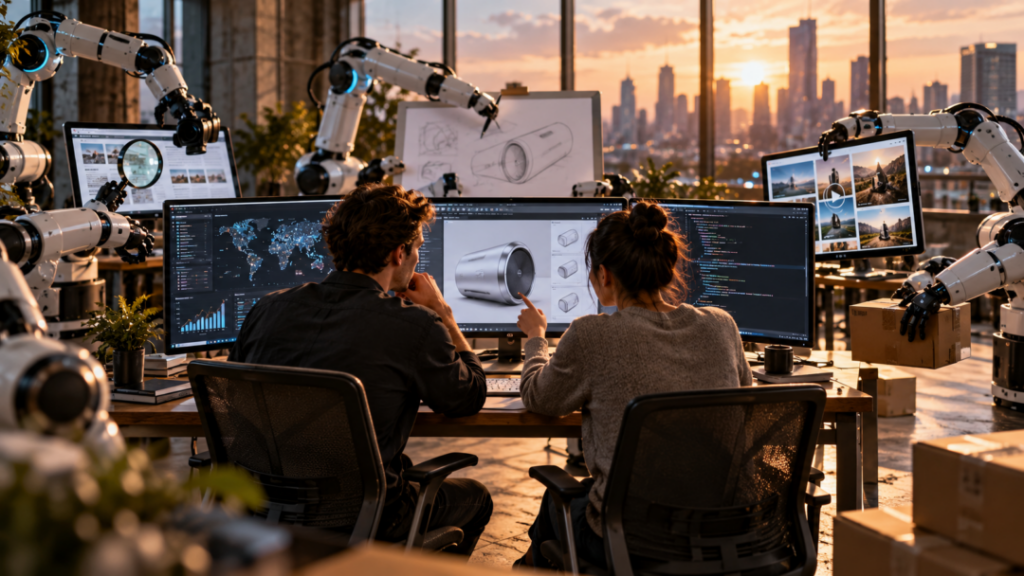
The pitch is simple: a two-person team plus a suite of AI agents can run what used to take an entire company, from market research to engineering to design to sales.
A commenter under a tweet about that kind of model wrote something that stuck with me:
“If that’s the model, I’m not sure if capitalism as we know it survives. The whole purpose of corporations was to create large pools of capital and labor. If labor is unnecessary and capital is easily and cheaply available, capitalism is probably not optimal.”
It’s a serious point, and it deserves a serious answer, because a lot of people believe some version of it.
It’s also wrong, and the reason it’s wrong tells you a lot about what capitalism actually is.
Capitalism Isn’t Corporations
Capitalism isn’t about big corporations controlling resources and making outsize profits.
It’s about private property rights.
Individuals and companies own resources and earn a return from that ownership. Anyone can start a business and compete.
Businesses innovate, hire, fire, evolve, and work to satisfy their customers.
Prices aren’t set by a panel of experts or a government agency.
Supply and demand set them, and the market reacts when they change.
If you do a good job, you make a profit. If you don’t, you lose money and eventually fail.
Failure is essential.
Without it, nobody has a reason to innovate.
Owners decide what to do with their profits: reinvest them, pay dividends to shareholders, or hold them.
Every transaction is voluntary. Both sides enter it because it makes them better off.
You could grow apples in your backyard, but it’s a lot easier to buy them at the store.
The corporation is just one way of organizing that activity. It isn’t capitalism itself.
Why Firms Exist in the First Place
In 1937, Ronald Coase, who later won a Nobel Prize while at the University of Chicago, asked a simple question.
His answer was transaction costs.
Finding people, negotiating, monitoring, and enforcing agreements is expensive.
When it’s cheaper to do those things inside one organization, under one manager, firms get bigger.
When it’s cheaper to do them through the market, firms get smaller.
AI collapses both kinds of costs at once.
It lowers the cost of coordinating work inside a company, and it lowers the cost of finding, vetting, and contracting with people outside one.
Coase’s framework predicts more firms, smaller firms, more entry and more competition.
The two-person company isn’t the end of capitalism. It’s what capitalism looks like when the friction disappears.
What About the Workers?
This is the commenter’s real worry, and it’s fair.
If two people can do what 200 used to do, what happens to the other 198?
There are two answers.
First, when capital and routine labor both get cheap, the returns go to whatever is still scarce: judgment, taste, trust, relationships, distribution, and the ability to spot a problem worth solving.
Those things are spread far more widely across the population than access to a large pool of capital ever was.
The barrier to owning a business, rather than working for one, is dropping fast.
Second, we’ve been here before.
Tractors put nearly the entire farm workforce out of work. Spreadsheets were supposed to end accounting.
Every wave of automation has destroyed tasks and created new ones nobody predicted.
That isn’t a law of nature, and the transition can be painful.
But betting against human ingenuity has been a losing trade for 250 years.
Why AI Makes Capitalism Work Better
Things happen faster.
Decisions that took weeks now take hours, and markets adjust more quickly.
Things get cheaper.
AI and robotics are lowering production costs in factories, restaurants, and mines. Autonomous haul trucks already run in major mines. AI-discovered drug candidates are already in human trials.
Niches open up.
Plenty of markets were too small to serve because the cost of acquiring customers was higher than what the market could pay.
AI changes that math, and small companies can now go after customers big companies ignored.
One caution. The foundation-model layer of AI is extraordinarily capital-intensive and concentrated in a handful of firms.
The application layer is wide open.
If you care about competition, which is where the cheap startups live, keep an eye on the gatekeepers.
Who’s Actually Threatening Capitalism?
The bigger threat isn’t AI.
It’s the instinct, now present in both parties, that government should pick winners: industrial policy, tariffs as economic planning, the state taking equity stakes in private companies, and proposals to manage AI from Washington before anyone knows what it will become.
People are drifting toward socialism partly because they think capitalism means a few giant corporations.
AI could be the strongest argument we’ve had in decades that it doesn’t.
It means anyone with an idea and a laptop can compete.
Let the competition play out.
This article was originally published via JeffreyCarter.substack.com on 10/24/2026. The opinions expressed by contributors are their own and do not necessarily represent the views of Nevada News & Views. Digital technology may have been used in the research, writing, or production of this article. Please verify information and consult additional sources as needed.