
A new national report proves what Boulder City already knew. This fight crosses every party line there is.
Republicans are running on it. Democrats are running on it. In some states, both parties are scared of it at the same time.
I called the data center issue Nevada's new political flashpoint back in June.
As I've reported on this, some conservatives pushed back, believing that it's a Sierra Club type environmentalist issue, the kind of thing only the left gets worked up about.
Read our prior coverage:
From Reno to Boulder City, Data Centers Are Nevada's New Political Flashpoint
Here's the problem with that theory: Boulder City is a conservative stronghold.
It is not Berkeley. It is not some coastal college town.
It is a small, historically Republican community full of retirees and working families who generally do not show up at city council meetings to protest for no reason. When a town like that gathers thousands of signatures and packs the council chamber, that is not a leftist tantrum.
That is a temperature check. And the reading came back hot.
What The Numbers Actually Show
Now, a June poll from the Yale Program on Climate Communication found that 58 percent of registered voters oppose data center construction happening near them.
That includes 53 percent of conservative Republicans. It also includes 74 percent of liberal Democrats.
Those two groups rarely agree on much of anything. They agree on this.
Sure, here's the version with the links kept in:
Republicans Are Leading This, Not Just Reacting To It
In Michigan, Republican state senators Jon Bumstead, Jim Runestad, and Ruth Johnson stood on the Capitol steps with Democrats and local officials to demand a statewide data center moratorium.
Republican gubernatorial candidate Perry Johnson joined the rally too. Republican state Rep. Joseph Fox called data centers a “politically unifying” issue at that same rally.
In Arizona, after backlash against proposed projects in Tucson, Chandler, and Marana, Republican legislative leaders negotiated a three-year pause on data center tax incentives alongside Democratic Governor Katie Hobbs.
Good Jobs First, a nonpartisan research group, documented data center moratorium bills filed in at least a dozen states this year, including Georgia, South Carolina, and Oklahoma, all states with Republican-controlled legislatures.
That is not a fringe Republican position anymore. Those are sitting state senators and Republican-run legislatures acting because their own voters demanded it.
The Scale Nationwide
More than 300 cities, towns, and counties have already passed bans or moratoriums on massive data center projects.
Data Center Watch counted 75 major projects, worth more than $130 billion combined, that got delayed or canceled in just the first three months of 2026. That roughly matches everything that got scrapped in all of 2025 combined.
New York's Democratic governor, Kathy Hochul, just signed the nation's first statewide moratorium.
Voters in Monterey Park, California passed a permanent ban at the ballot box.
In deep red west Texas, a market expected to overtake northern Virginia as the world's biggest data center hub by 2030, Republican-led protest groups are forming in Lubbock, and some organizers say they may sit out voting for their own governor over it.
That is not a partisan map. That is a map of ordinary people who feel like nobody asked them first.
Boulder City Is Exhibit A
Nevada readers do not need a national report to understand this. Boulder City has been living it. 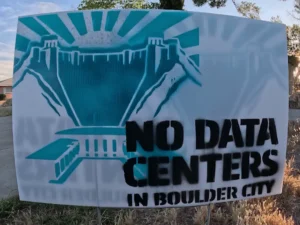
Residents gathered more than 4,600 signatures against a proposed data center. The city's own planning commission voted nearly unanimously against the project.
And then a Bureau of Land Management right-of-way grant let the developer build on adjacent federal land anyway after the original application was pulled.
That is a private developer routing around a small town's elected government, and a federal agency in Washington finishing the job.
If you believe in limited government and local control, that ought to bother you no matter which party you vote for.
I made this point in an earlier piece, and it is worth repeating. Congressional hopeful Carrie Buck had a free layup on this one.
Federal overreach, steamrolling a small town's own elected government, is about as easy a shot as a conservative candidate gets. She did not take it.
Read More:
OPINION: Carrie Buck Had A Free Layup In Boulder City. She Didn't Take The Shot.
So far, the loudest Nevada voice on this fight has been her opponent Dina Titus, not any Republican. That is a missed opportunity, and not a partisan one.
The Other Side
Not everyone agrees the backlash is fair. Industry supporters argue data centers bring jobs, tax revenue, and investment that small towns badly need.
Boulder City's own staff estimated a lease deal could have brought in $2.3 million a year in taxes and fees.
Some Republican officials, including Texas Governor Greg Abbott, are not trying to stop the buildout entirely. They are trying to make sure it does not raise ordinary people's power bills.
That is a real distinction worth remembering before anyone paints this as a simple stop everything movement.
Where This Goes Next
This fight is only getting louder heading into the midterms.
Organizer Amy Kremer, a Tea Party Veteran, ran 142 coordinated protests across 42 states in a single day this month, declaring :
“We The People deserve a voice before massive data centers are…” built without one.
This mantra reflects what is happening in Boulder City.
Today was incredible!
142 protests. 42 states. One message: ONE NATION UNITED AGAINST DATA CENTERS!
Communities across America showed up today for a National Day of Protest Against AI Data Centers to say that We The People deserve a voice before massive data centers are… pic.twitter.com/TwE7oRjR6V
— Kylie Jane Kremer (@KylieJaneKremer) July 18, 2026
Expect more of that between now and November, and expect candidates in both parties to keep scrambling to catch up.
What Conservatives Can Do
Show up to your town's planning meetings. Push for local control over land use decisions instead of letting federal agencies override small towns.
And keep asking why the loudest voice on an issue like this in Nevada's 1st District has not been a conservative one, yet.
This is not a red issue or a blue issue. It is a “who gets to decide” issue. Boulder City is already raising that question. The rest of the country is just catching up.
The opinions expressed by contributors are their own and do not necessarily represent the views of Nevada News & Views. This article was written with the assistance of AI. Please verify information and consult additional sources as needed.