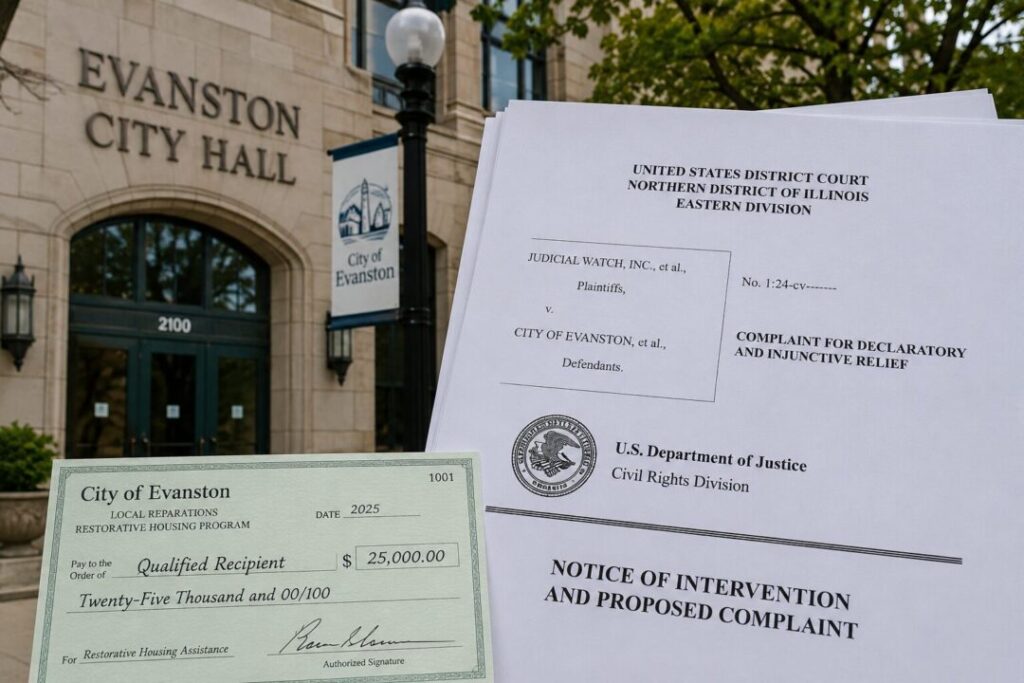
Evanston, Illinois handed out $25,000 checks to people based on their race. The Justice Department has showed up to explain why that's a problem.
Evanston’s “first in the nation” reparations program is discriminatory and illegal. @CivilRights sued the city today challenging the program. ⁰⁰Other cities are on notice: discriminate against residents — you’ll hear from us!https://t.co/1KgfQM02l1
— AAGHarmeetDhillon (@AAGDhillon) June 16, 2026
Today, the DOJ's Civil Rights Division moved to intervene in an existing federal lawsuit challenging Evanston's “Local Reparations Restorative Housing Program.”
The program gives $25,000 in cash or housing assistance to black residents who lived in the city between 1919 and 1969, or their children, grandchildren, and great-grandchildren.
No other races qualify. The city has paid out over $5 million so far and plans to keep going.
The DOJ's proposed complaint says it's race discrimination. Plain and simple.
What the Program Actually Does
To qualify, you need to be black and have an ancestor who lived in Evanston during that 50-year window. That's it.
The city doesn't require proof that you or your family were ever discriminated against. It doesn't require that you lived there. The program covers two categories: black Evanston residents from 1919 to 1969, and their direct descendants.
Non-black descendants of people who lived in Evanston during the same period get nothing.
Some of them sued in 2024. Six descendants of Evanston residents filed a class action lawsuit alleging the program's race-based eligibility requirement violates the Equal Protection Clause.
The city tried to get the case thrown out. A federal judge rejected that attempt in March 2026, ruling that the plaintiffs have standing to pursue their constitutional claims. Now the DOJ is piling on.
What the DOJ Said
Assistant AG Harmeet Dhillon said: “Under the pretext of paying reparations for events more than 100 years ago, the City of Evanston has chosen to distribute millions of dollars in cash and housing benefits to people because of the color of their skin… It is race discrimination, pure and simple. And it is illegal.”
U.S. Attorney Andrew Boutros added that the Constitution requires government to treat citizens as individuals, not members of a racial class, and that handing out public money based on ancestry “establishes the very hierarchy the Equal Protection Clause was designed to dismantle.”
The DOJ's complaint alleges violations of both the Fourteenth Amendment's Equal Protection Clause and the Fair Housing Act.
Evanston's Defense Doesn't Hold Up
The city has called the program a remedy for documented housing discrimination from that era.
Redlining was real. Nobody disputes that.
But the DOJ's complaint points out something the city can't answer: the city has not required any evidence that recipients or their ancestors actually experienced discrimination when they lived in Evanston. Race alone is the qualifier.
The city also refused to cooperate when the DOJ opened its investigation in March 2026. Intervening in the lawsuit was the next step.
Why It Matters Beyond Evanston
Evanston's program was one of the first local reparations programs in the United States, and other cities have watched it as a potential model. Chicago has been moving toward its own program.
If Evanston loses in federal court, that model collapses.
The Supreme Court's 2023 ruling against race-based admissions at Harvard and UNC didn't stop cities from trying this.
The DOJ stepping in suggests the federal government isn't going to let reparations programs quietly spread while the courts catch up.
Judicial Watch, which originally filed the lawsuit, summed up their thoughts in one sentence: “The Justice Department is right to join our fight against Evanston's blatantly unconstitutional reparations scheme.”
Other cities were watching Evanston as a model. They should keep watching.
(Alts: “Chicago's $150 million deficit and a reparations plan. Pick one.” / “The Constitution didn't take a break for 100 years. Neither did the Equal Protection Clause.” / “Evanston called it reparations. The DOJ calls it racial discrimination. A federal judge will settle it.” / “Other cities were watching Evanston as a model. They're still watching.”)