Tick Tock: Nevada's New 60-Day Clock Could Kill Legitimate Election Complaints
Back in February, Nevada's Secretary of State quietly filed a new regulation.
It didn't make headlines. It didn't spark much debate. But election integrity advocates who've been fighting for independent voter file reviews are taking a close look – and they don't love what they see.
The regulation is called R031-25. It was filed February 27, 2026, and it rewrites the rules for how Nevadans can file complaints about election law violations.
On the surface, it sounds like a step forward.
Before this regulation, the process for filing an election complaint with the Secretary of State was basically: put it in writing and sign your name.
That was it. No formal timeline. No defined investigation process. No clear rules for how complaints get resolved.
R031-25 fills in those blanks. And some of what it adds is legitimate housekeeping.
But some of it isn't.
The 60-Day Clock Is a Problem
Here's the part that should bother you most on a practical level.
Under this new regulation, if you believe an election law violation has occurred, you've got 60 days to file your complaint.
The clock starts ticking from when the violation happened – or from when you “should have known” about it.
That second part is the trap.
Election integrity problems don't always show up fast. Voter roll irregularities, discrepancies in post-election data, slow-walked public records – these things take time to piece together.
If a clever attorney argues you “should have known” earlier than you actually did, your complaint could be thrown out before anyone even looks at it.
Sixty days sounds reasonable. In practice, it's a weapon.
The “Uncooperative” Escape Hatch
The regulation also allows complaints to be dismissed if the person filing them is deemed “uncooperative.”
Now, the regulation ties that word to two specific statutes – one covering obstruction of public officers, the other covering battery.
On paper, that just means don't threaten or assault state employees. Fair enough.
But “obstruction” is a slippery word.
A determined bureaucrat could stretch that definition in ways that conveniently shut down a complaint that's getting uncomfortable.
The Biggest Problem Nobody's Talking About
Here's what should be the headline all by itself.
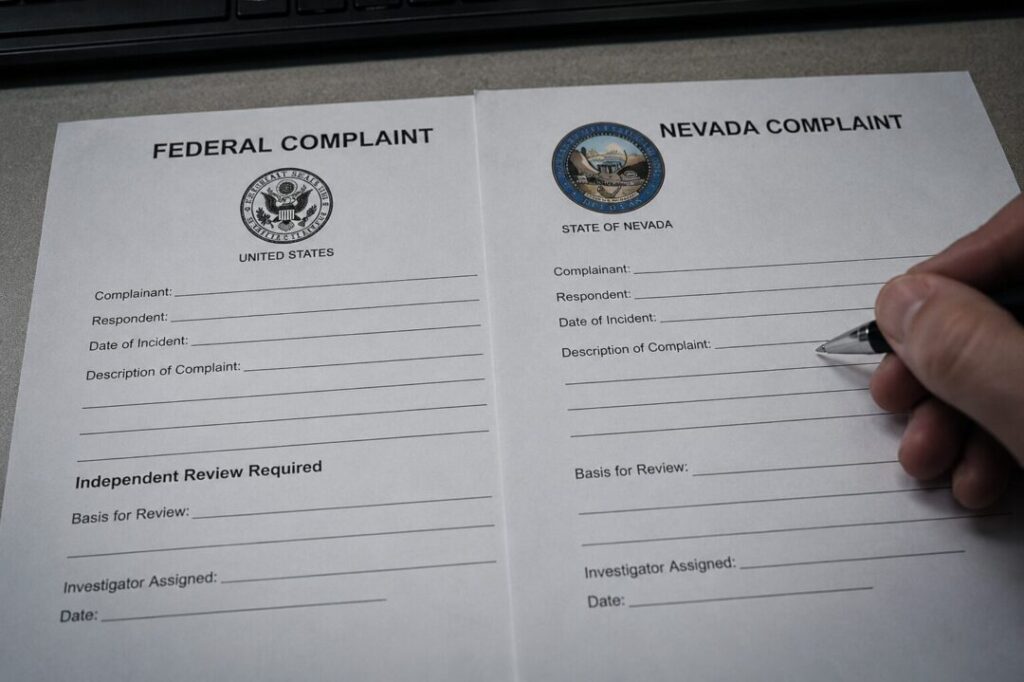
Under Section 9 of this regulation, if someone files a complaint against the Secretary of State himself for a federal election law violation, an independent designee is required to handle the investigation. The SOS can't investigate himself in that case.
But for the new broader category of state election law complaints? There's no such protection. Zero.
That means if someone files a complaint alleging the Secretary of State violated Nevada election law, the Secretary of State's office investigates it.
His people. His process. His determination.
That's not accountability. That's a closed loop.
What They Got Right – Sort Of
To be fair, the regulation does give complainants something new.
Final determinations on state election law complaints can now be appealed to court under NRS 233B.130. That's a real appeal right that didn't clearly exist before.
But that same “final order” status also makes it harder to challenge dismissals on procedural grounds.
It cuts both ways, and not always in favor of the person filing the complaint.
So What Does This Mean?
Nevada has an ongoing fight over election integrity.
The Secretary of State's office has resisted independent reviews of voter rolls. Complaints from outside groups have gone nowhere.
And now the office has written the rulebook for how future complaints get handled – with itself as investigator, judge, and gatekeeper.
The regulation may not be corrupt on its face. But it's built for control. And in Nevada, that matters.
The opinions expressed by contributors are their own and do not necessarily represent the views of Nevada News & Views. Digital technology was used in the research, writing, and production of this article. Please verify information and consult additional sources as needed.