The System Behind Reno’s Land Use Power Play
(Michael Leonard) – When data, donor lists, client rosters, and fundraiser invitations are examined, what emerges is a system of political actions designed to control land use.
A system that connects:
- development capital
- legal strategy
- and political influence
And at the center of that system sits the ecosystem around Gordon Garrett and the law firm Lewis Roca.
I. The Illusion of the Individual
At first glance, you might assume Gordon Garrett is a political donor.
He isn’t, at least not in any meaningful financial sense.
His direct contributions total roughly $1,200 across a handful of small donations.
That is negligible. But it hides something.
But dig deeper, and the real numbers appear:
- 1,467 contributions
- $1.33 million total given
- Spanning nearly two decades
- Almost entirely cash contributions
That money does not come from Garrett personally. It flows through the Lewis Roca ecosystem that he controls, under multiple firm-name variations and entities.
This is the first key insight:
Garrett is not the financier. He is the operator inside a much larger machine.
II. The Client List: A Map of Dependence on Government Power
The second piece of the puzzle is the firm’s client list.
It is not random. It is not as diverse as most law firm portfolios.
It is concentrated.
Overwhelmingly, these clients fall into one category:
Entities that require government approval to exist.
The Core Client Types
1. Large-scale developers
- Lennar Homes
- Panattoni Development
- Lyon Living
- S3 Development
2. Local Reno development players
- Dermody Properties
- Manzanita Properties
- Tanamera Development
- Reno Land Inc
3. High-impact redevelopment projects
- Jacobs Entertainment (Neon Line)
- CAI Investments
- Oppio Ranches
4. Commercial and mixed-use operators
- Whitney Peak Hotel
- Maverik
- Petco
5. The supporting build ecosystem
- TSK Architects
- Vertical Framing
What They All Have in Common
None of these businesses operates freely.
Their success depends on:
- zoning approvals
- zoning variances
- planning commission decisions
- City Council votes
- on redevelopment incentives (including TIFs)
Without government permission, these projects cannot move forward.
This is not incidental. This is structural.
III. The Donation Pattern: Access
Now on to the $1.3 million donation history.
At first glance, it looks bipartisan. It is.
But that is not neutrality. It is a strategy.
Where the Money Goes
The largest recipients include:
- Assembly Democratic Caucus
- Nevada Senate Democrats
- Senate Republican Leadership Conference
- Assembly Republican Caucus PAC
And individual leadership figures like:
- Jason Frierson
- Nicole Cannizzaro
- Steve Yeager
- Aaron Ford
This is not a list of ideological allies.
It is a list of power centers.
The Pattern
Four defining characteristics emerge:
1. Bipartisan coverage
- Ensures relevance regardless of who holds power
2. Leadership targeting
- Focus on those who control agendas and outcomes
3. Election-cycle timing
- Peaks in high-stakes years (2012, 2018, 2020, 2022)
4. Repetition over time
- Median contribution: $650
- Not large one-time bets—continuous presence
What This Really Is
This is not a donation as an expression. It is a donation to infrastructure.
A system designed to maintain access across shifting political terrain.
|
|
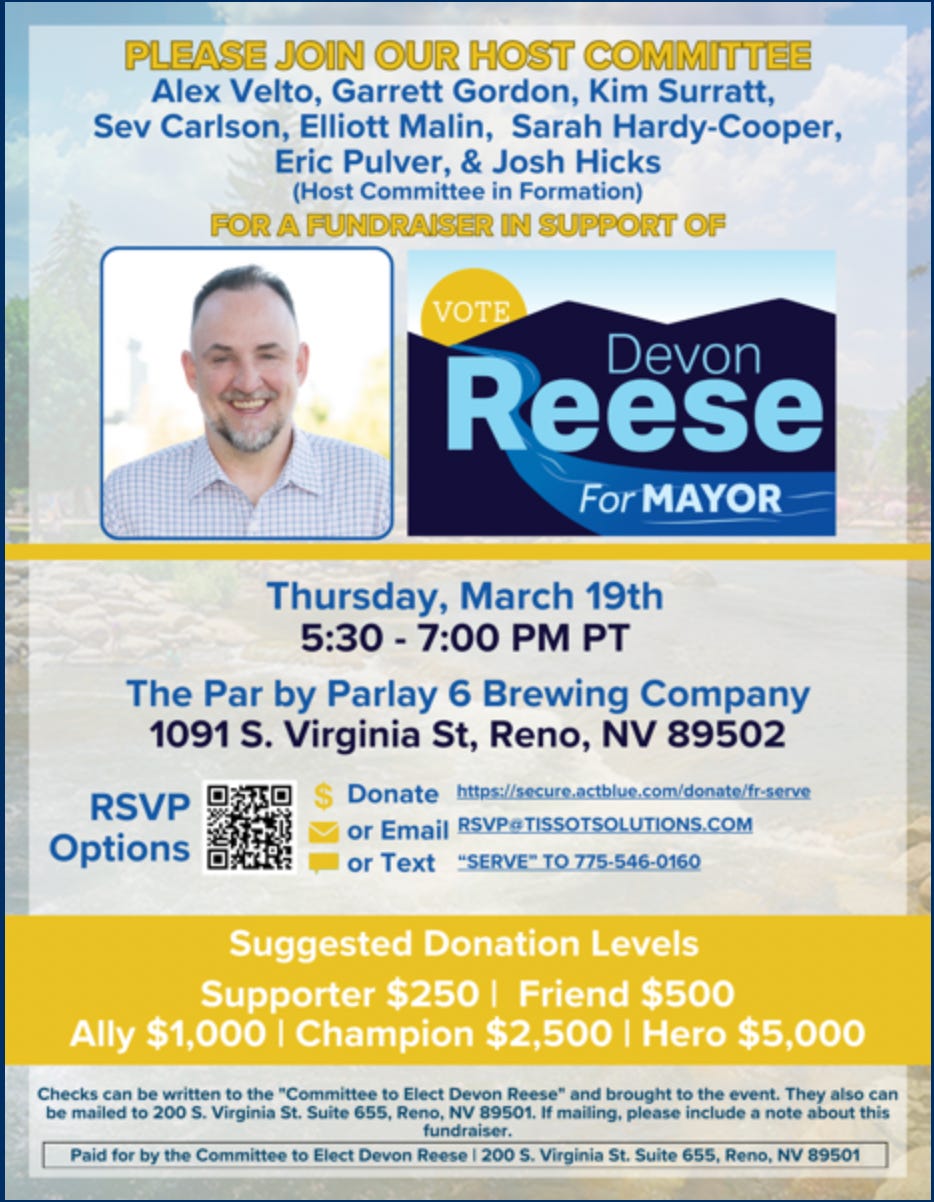
IV. The Critical Link: Devon Reese
Now the system becomes local.
Devon Reese is not just another candidate.
He sits in a position where decisions are made that directly affect:
- land use
- redevelopment
- zoning
- incentives
In other words:
He operates inside the same approval system that Lewis Roca’s clients depend on.
V. The Overlap: Where the Lines Cross
This is where pattern becomes structure.
From the data, several direct overlaps appear between:
- Lewis Roca clients (or their principals)
- donors to Devon Reese
Confirmed Matches
Sunny Hills Ranchos
- Lewis Roca client
- Reese donor: $2,000
Jacobs Entertainment (via Jeffrey Jacobs)
- Major client
- Reese donor: $2,500
Broader Sector Overlap
Additional Reese donors include:
- Onda Housing Group
- Keystone MF Holdco
- Elm Estate
- Park Real Estate entities
- Grand Sierra Resort
These are not random contributors.
They belong to the same class:
Real estate, development, and land-use dependent capital
What This Means
This is no longer abstract alignment.
It is a direct overlap:
The same type of entities represented by Lewis Roca
Are you funding a key local decision-maker
VI. The Fundraiser: Where Relationships Emerge
Then comes the clearest signal.
Gordon Garrett serves on the host committee for a Devon Reese fundraiser.
This matters more than any donation.
Because Garrett:
- does not give significant money personally
- is not broadly political in public
Yet he shows up here.
What That Signals
This is not ideological support.
This is proximity.
It indicates:
- relationship access
- alignment with a decision-maker
- participation in a network, not a campaign
The Structure of the Event
The fundraiser itself reinforces the pattern:
- Entry point: $250
- Top tier: $5,000
- No grassroots pricing
- No policy messaging
This is not a voter event.
It is a donor-network consolidation event.
VII. The System (Now Fully Visible)
Put the pieces together:
Layer 1: Capital
Developers, landholders, and investors (the client list)
Layer 2: Legal Operator
Lewis Roca (navigating approvals and entitlements)
Layer 3: Political Power
Elected officials: Devon Reese (controlling approvals)
The Connections
- Donations maintain relationships
- Fundraisers reinforce proximity
- Legal work advances projects
The Key Insight
The donation network is the political shadow of the development pipeline.
VIII. What This Is and What It Is Not
Let’s be precise.
This dataset shows:
- alignment
- structure
- incentive patterns
It does not show:
- illegality
- quid pro quo
- any specific improper act
But it does show something else:
A system where economic interests, legal strategy, and political access move in coordination.
IX. The Real Story
This is not about Gordon Garrett as an individual.
It is not about one fundraiser.
It is not even about one candidate.
It is about how power operates in a city where:
- development drives growth
- approvals determine outcomes
- and relationships shape the path between the two
Final Takeaway
If you strip away the names, the firms, and the campaigns, what remains is simple:
Those who need permission invest in proximity to those who grant it.
And once you see that pattern, you realize how Reno works.
The opinions expressed by contributors are their own and do not necessarily represent the views of Nevada News & Views. This article was originally published via MikesRenoReport.com on 4/6/26.