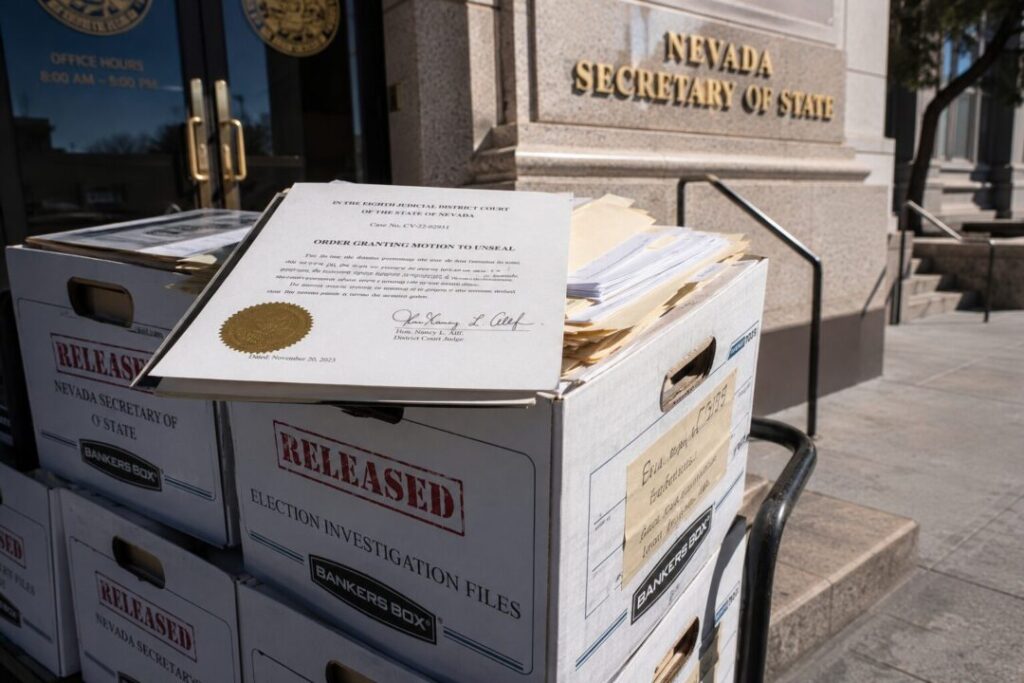
Court Orders Aguilar to Explain Hidden Election Documents
Government transparency isn't a partisan issue. At least it shouldn't be.
When citizens ask to see public records, the law says government agencies are supposed to provide them. That's the foundation of accountability.
Now a Nevada judge has ruled that Secretary of State Cisco Aguilar's office must turn over additional election-related records and explain why some documents were withheld from the public.
The ruling came from First Judicial District Court Judge Jason Woodbury in Carson City after a lengthy public records dispute involving election integrity records requested by Chuck Muth, president of Citizen Outreach Foundation and founder of the “Pigpen Project.”
At the center of the case was an investigation involving voter registration and voting activity connected to Charles Walter Spillers Jr. and Debra Louise Adams during Nevada's 2022 general election.
Muth sought records related to the investigation and later challenged the Secretary of State's responses under Nevada's Public Records Act.
The court found that the Secretary of State's office failed to fully interpret the original records request and improperly limited its search to a single election violation report rather than the broader investigation connected to that report.
As a result, Judge Woodbury ordered the Secretary of State's office to search for and produce additional records tied to the voting and voter registration investigation.
The ruling also addressed another issue that often frustrates citizens seeking public records.
Government agencies frequently claim attorney-client privilege when withholding documents.
While the court agreed that the Secretary of State could invoke attorney-client privilege, it ruled that simply claiming privilege wasn't enough. The office must either provide redacted versions of withheld records or produce a privilege log describing what was withheld and why.
That's significant because privilege logs give citizens and courts a way to evaluate whether confidentiality claims are legitimate rather than simply taking the government's word for it.
Not every claim brought by the petitioner succeeded.
The court rejected arguments that the Secretary of State's office violated the law through the length of time it took to respond to the requests.
The judge noted that election-related public records requests had increased substantially and that staffing limitations, legal reviews, and election workloads contributed to the delays.
The court also upheld the office's decision to redact personal information such as Social Security numbers, driver's license numbers, birthdays, phone numbers, residential addresses, and other private identifying information.
Critics of election integrity investigations often argue that such requests place unnecessary burdens on election officials.
Supporters counter that public confidence in elections depends on transparency and that government agencies should welcome scrutiny rather than resist it.
In this case, the judge appeared to strike a middle ground.
The court protected legitimate privacy interests while also reaffirming that public agencies can't narrowly interpret requests or hide behind broad confidentiality claims without providing adequate explanations.
For Nevadans, the ruling serves as a reminder that the Public Records Act exists for a reason. Government officials work for the public. Public records belong to the public.
And when questions arise, transparency is usually the best answer.
The opinions expressed by contributors are their own and do not necessarily represent the views of Nevada News & Views. Digital technology was used in the research, writing, and production of this article. Please verify information and consult additional sources as needed.