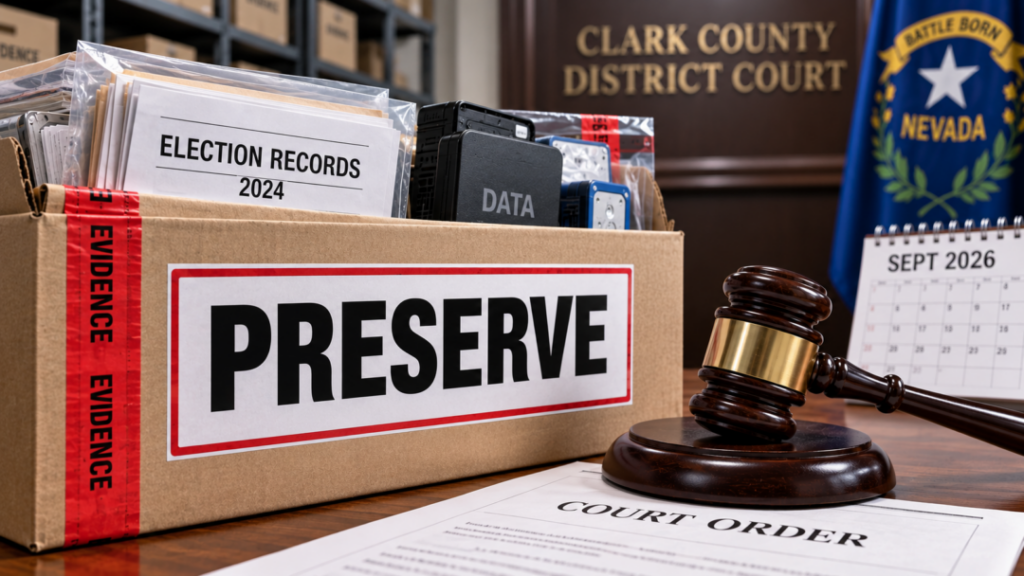
Something important happened in Clark County District Court 8 this week.
Pastor Andy Thompson, a Las Vegas resident, has been an ardent supported of election integrity in our state and has actively filed lawsuits against the Nevada Secretary of State’s office in the last few years.
Here is a summary of what transpired and how it has led to the September 1, 2026 decision in court:
- Nov 19, 2024, Pastor Thompson filed a contest over evidence of fraud in the 2024 general election.
- May 1, 2025, in a court hearing, Counsel for the Secretary of State (SOS) understood the evidence was at risk and instructed the SOS to not push out machine updates. Judge Reynolds discussed a bond in order to secure the machines to prevent loss acknowledging about the data that, “once it's gone… it's gone.”
- July 10, 2025, SOS declared to Mr. Thompson that because Judge Reynolds had not entered a stay as the case went up on appeal that they would proceed to instruct 15 counties to proceed with machine updates from July 21-September 30, 2025.
- July 15 2025, Thompson sued in federal court
- July 24, 2026 Thompson sued the SOS, Clark County, Washoe County and Nye County over their rejection of a direct effort on July 3, 2026 to honor a litigation hold that Mr. Thompson sent to them all.
- September 1, 2026 Judge Wiese granted the Motion for Preliminary Injunction in full, including relief requiring counties to produce a log of any data destroyed since November 5, 2024. The order also specified that all data must be preserved through March 2, 2027.
What does the law say?
The law is clear: NRS 293.391 specifies the 22-month legal deadline that records must be kept.
That’s for BOTH electronic and paper records.
Incidentally, the records were set to be destroyed by the end of this week – the 22-month deadline: September 5, 2026
Mr. Thompson commented as follows on the September 1, 2026 injunction:
CASE UPDATE: A COURT FINALLY SAID PRESERVE THE EVIDENCE
Case A-26-952192-C seeking to stop counties from destroying the rest of the 2024 election records.
In 2025, while litigation concerning the 2024 General Election was already pending, the Secretary of State authorized voting-system updates known to destroy election data.
With the remaining 2024 election records approaching their ordinary destruction period, I returned to court seeking one basic safeguard: stop destroying evidence.
On September 1, District Court Judge Jerry Wiese granted my request for a preliminary injunction preserving the 2024 General Election records at issue, State counsel for Secretary of State Aguilar, was ordered to prepare the written order.
This ruling does not decide what the records ultimately prove, nor does it presently authorize their inspection.
This order prevents the evidence from disappearing before the courts can decide the pending cases alleging massive election fraud in the 2024 General Election.
The judge appeared genuinely disturbed at the lack of preservation to date. He repeatedly questioned why the Nevada Supreme Court refused to address preservation.
When Respondents claimed this case was duplicative, he read the Nevada Supreme Court’s order himself and demonstrated that it did not materially decide preservation. He then pressed counsel to explain how keeping the records would harm the counties.
After hearing arguments about statutory destruction and possible storage costs, and even a claim that storing records creates risk of them being damaged, he returned to the obvious reality: if the records are destroyed, I cannot meaningfully litigate without them.
His conclusion was direct: “Let’s preserve them.”
A status check is scheduled in six months for March 2, 2027, when the Court will consider whether continued preservation remains appropriate.
This is a limited but deeply consequential victory.
Evidence already lost cannot be restored, but the remaining record will not now disappear merely because ordinary destruction dates arrive before the Nevada Supreme Court and the Ninth Circuit rule on the cases there.
For the first time, a court has squarely addressed the preservation question and answered it as the integrity of the judicial process requires: preserve the evidence first, then decide what it proves.
The opinions expressed by contributors are their own and do not necessarily represent the views of Nevada News & Views. Digital technology may have been used in the research, writing, or production of this article. Please verify information and consult additional sources as needed.