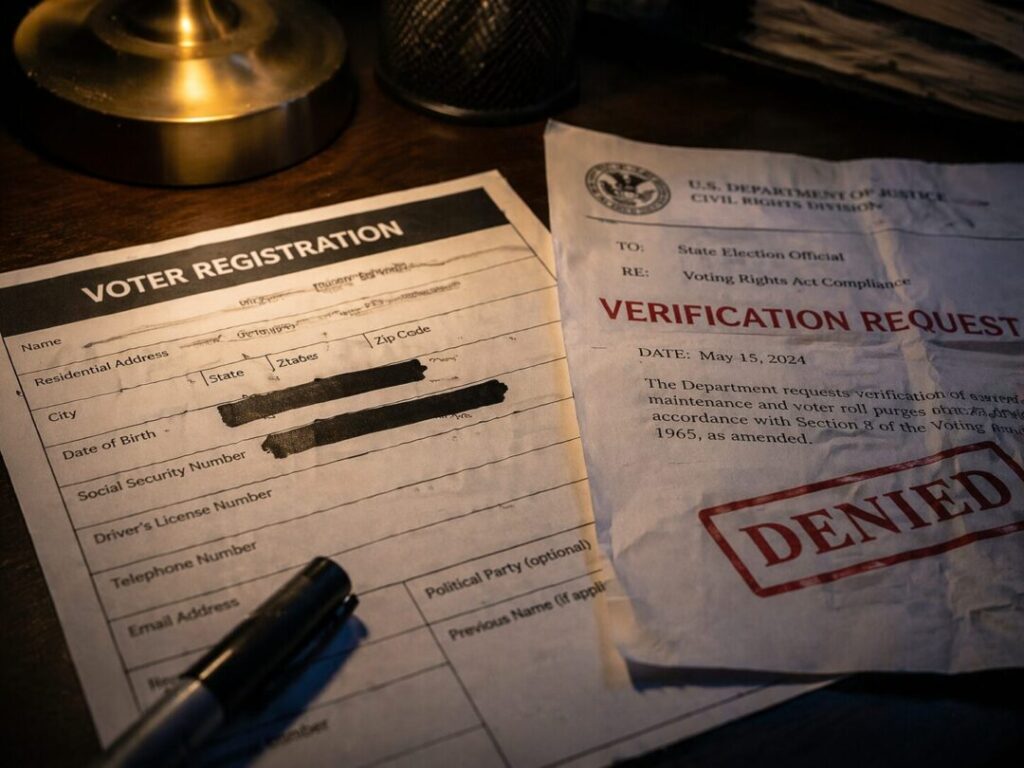
If the federal government issues Social Security numbers, shouldn’t it be allowed to check if they’re being used properly?
That simple question is at the center of a growing fight between states and the Department of Justice over access to voter registration data.
Right now, many states are refusing to give the federal government full, unredacted voter files.
That includes key details like dates of birth, driver’s license numbers, and partial Social Security numbers.
Instead, states are offering limited, redacted versions of voter rolls. These are the same lists campaigns and political groups can buy.
They include names, addresses, and party affiliation. But they leave out the sensitive data that would actually allow for deeper verification.
And that’s the problem.
The DOJ says it needs that full data to make sure states are keeping their voter rolls accurate, as required under federal law like the National Voter Registration Act and the Help America Vote Act.
In plain terms, they want to check if people on the rolls are eligible to vote. That includes comparing voter data against federal databases.
For example, matching records with Social Security and immigration systems to flag potential non-citizens or duplicate registrations.
Critics say that goes too far. They argue it risks privacy and opens the door to federal overreach. Some federal judges have agreed.
A judge in California recently blocked the DOJ from forcing the state to hand over its full voter file, citing privacy concerns. But here’s what often gets left out of that argument.
The federal government isn’t asking for random personal data. It’s asking to verify records tied directly to federal systems.
Social Security numbers are issued by the federal government. Immigration status is tracked by the federal government.
If there’s anyone who should be able to confirm whether that information is valid, it’s the same government that created it.
Think of it like this: If your bank issued you a debit card, would it be “overreach” for the bank to check if that card is being used fraudulently?
Of course not. It’s basic accountability.
The same principle applies here. Clean voter rolls are not about politics. They’re about trust. And trust only works when the system can verify itself.
Now, to be fair, states do have a point about privacy.
No one wants sensitive personal data floating around or being misused. And election systems are primarily run by the states, not Washington.
But that doesn’t mean the answer is to slam the door entirely. There’s a middle ground.
States could allow controlled, secure access to unredacted data for verification purposes only. No public release. No political use. Just audit and validation.
Instead, what we’re seeing is a blanket refusal. And that raises a bigger question.
If the voter rolls are clean, why not prove it?
Here in Nevada, this debate hits close to home.
The state has faced ongoing questions about voter list maintenance, especially with population movement and mail-in voting expansions.
Keeping those rolls accurate is not optional. It’s essential. Because even small errors can add up.
Duplicate registrations. Outdated records. Ineligible voters left on the rolls. None of that inspires confidence, especially in close elections.
At the end of the day, this isn’t really about federal power versus state power. It’s about whether we’re serious about election integrity.
You can’t demand trust from voters while blocking the tools needed to verify the system.
And when the same government that issues the identification numbers is told it can’t check them, that doesn’t sound like protecting privacy.
It sounds like dodging the one thing every honest system should welcome: being checked. You know, that old “trust, but verify” thing.
The opinions expressed by contributors are their own and do not necessarily represent the views of Nevada News & Views. Digital technology was used in the research, writing, and production of this article. Please verify information and consult additional sources as needed.