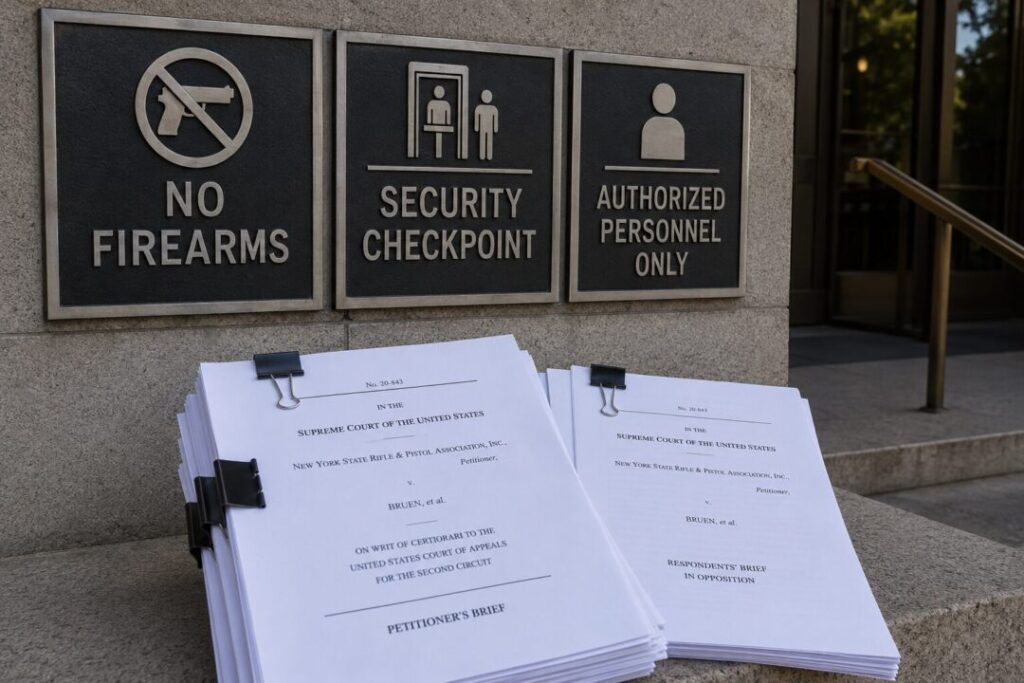
Many gun owners don’t realize that in New York State Rifle & Pistol Association, Inc. v. Bruen (2022), the Supreme Court issued a landmark 6–3 ruling that fundamentally reshaped Second Amendment jurisprudence, and will continue to do so into the future.
Justice Clarence Thomas wrote the majority opinion, holding that New York’s “proper-cause” requirement for concealed-carry licenses violated the Fourteenth Amendment by infringing on the Second Amendment rights of law-abiding citizens.
Two petitioners, Robert Nash and Brandon Koch, challenged the state’s regime after being denied unrestricted carry permits because they could not demonstrate a special threat to their safety beyond that of the general public.
The decision’s most consequential element was its rejection of the “two-step” framework lower courts had employed since Heller (2008).
That approach first asked whether conduct fell within the Second Amendment’s scope, then applied means-end scrutiny to balance government interests against individual rights.
Justice Thomas categorically rejected this second step, arguing that constitutional text does not permit judges to weigh policy costs and benefits against enumerated rights. He emphasized that the Second Amendment itself represents “the very product of an interest-balancing by the people,” making judicial deference to legislative safety determinations inappropriate in this context.
Instead, the Court established a new originalist standard: modern firearm regulations must be consistent with the nation’s historical tradition of gun regulation as understood at ratification (1791) and incorporation through the Fourteenth Amendment (1868).
When the plain text covers an individual’s conduct, the burden shifts to the government to demonstrate that any restriction has a historical analogue. Mere existence of some historical laws is insufficient; they must represent a genuine tradition of regulation.
Applying this test, the Court found New York failed to justify its proper-cause requirement. The word “bear” naturally encompasses public carry, and handguns are weapons in common use.
Respondents cited English common law, colonial statutes, and 19th-century surety laws, but the Court systematically dismissed each.
Pre-founding English history was deemed inapplicable to American understandings. Colonial laws prohibited only bearing arms to spread terror or using dangerous weapons, not ordinary public carry by law-abiding citizens. Surety statutes required posting bond only after specific accusations of intent to harm—fundamentally different from New York’s pre-emptive denial based on lacking special need. Late-19th-century territorial bans were isolated outliers, rarely reviewed and short-lived.
Critically, the Court found no American tradition requiring law-abiding citizens to prove special self-defense needs distinct from the general community.
The decision declared the Second Amendment is not a “second-class right,” paralleling speech and assembly protections where no special need must be shown.
By preventing ordinary citizens from carrying handguns publicly, New York violated incorporated Fourteenth Amendment rights.
This ruling significantly altered how all states evaluate firearm regulations, triggering challenges to similar restrictive licensing schemes nationwide and establishing precedent that continues shaping Second Amendment litigation.
With the new historical analog standard in the Bruen decision, every state and U. S. possession over-night became shall-issue for concealed carry permits.
While some states were quick to adjust to the new legal standard, some, like California, Hawaii, Massachusetts, New York, and New Jersey, promptly passed so-called “sensitive areas” laws where concealed carry of pistols was banned.
Such laws were quickly challenged, and several Supreme Court decisions to be handed down this month will show just how serious SCOTUS is about honoring their own precedent.
We are starting to see federal district courts over-turning gun restrictions for lack of a historical precedent from the Founding or the 14th Amendment eras. Look for more gun control laws to be overturned as more lawsuits against them work their way through the court systems.
Likely candidates for over-turning are the ‘sensitive places” areas in states mentioned above; Red Flag laws; bans on so-called high-capacity magazines, those holding more than 10 rounds; and so-called “gun free zones,” (really legalized hunting preserves for psychotic killers) all of which have no precedent from 1791 or 1868.
The opinions expressed by contributors are their own and do not necessarily represent the views of Nevada News & Views.