
As we previously reported, right before the Super Bowl, Nevada gaming regulators obtained court orders blocking Polymarket and other prediction markets from operating during Super Bowl week. As we reported at Nevada News & Views, state officials warned these unregulated betting sites threatened Nevada’s gaming industry.
Then the Super Bowl proved them right.
Nevada sportsbooks took in only $133.8 million in wagers — the lowest handle since 2016. Meanwhile, prediction markets like Kalshi reported more than $500 million in Super Bowl trading volume.
Titus Introduces Legislation to Ban Sports Contracts
Nevada regulators sounded the alarm. The damage happened anyway. Now, Democrat Congresswoman Dina Titus is moving with a legislative solution.
Right after the Super Bowl, Titus introduced the Fair Markets and Sports Integrity Act. The legislation would change the Commodity Exchange Act to stop prediction market companies from offering sports betting contracts.
“These prediction markets are rapidly expanding around the world without the same guardrails that apply to licensed, regulated gaming operators,” Titus said.
“Consumers deserve transparency, accountability, and protections against predatory practices.”
When you bet at a Nevada casino, those businesses follow strict rules. They check for problem gambling. They prevent money laundering. They verify your age. They pay taxes that support schools and roads.
Prediction markets skip all that by claiming the federal CFTC should regulate them instead of state gaming boards.
Why This Matters to Nevada
Gaming generated $1 billion for Nevada’s general fund in fiscal 2024. That’s 17 percent of the entire budget. When prediction markets steal betting dollars, Nevada loses tax revenue and casino jobs.
Titus represents CD1, which includes the heart of Las Vegas and the Strip. Her district is the gaming capital of America.
“Sports event contracts create a backdoor mechanism to offer sports betting in states that have not authorized it,” Titus said.
The Conservative Case for State Regulation
This isn’t about creating new regulations. It’s about preventing federal overreach. The Supreme Court ruled in 2018 that states have the right to regulate sports betting within their borders. That’s federalism working correctly.
But prediction markets claim federal jurisdiction through the CFTC. They’re using that federal agency to bypass state laws. Nevada spent years building a regulated gaming industry with proper safeguards. Prediction markets are trampling on state decisions.
Meanwhile, Buck Tells Nevadans Not to Bet on the Super Bowl
While Titus addresses threats to Nevada’s biggest industry, her Republican challenger Carrie Buck posted something remarkable on social media.
“Instead of betting on the Super Bowl this year, bet on a sure winner!” Buck wrote, directing people to donate to her campaign.
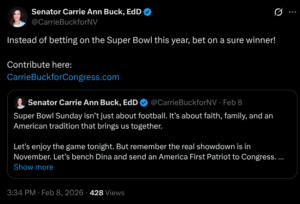
Read that again. A candidate for Congress in Nevada’s most gaming-dependent district told people not to bet on the Super Bowl. She said this while Nevada casinos were experiencing their worst Super Bowl betting numbers in a decade. While prediction markets were stealing half a billion dollars from Nevada’s gaming industry.
The timing couldn’t be worse. The message couldn’t be more tone-deaf.
Buck also posted this week about attending a Nevada school choice fair two weeks ago. School choice is a legitimate conservative priority. But Buck is running for Congress, not re-election to the state senate. School choice is primarily a state issue, where she could accomplish more by staying in the legislature.
What Happens Next
Titus’s bill faces an uphill battle in a Republican-controlled Congress. But she’s making a strong case. Gaming industry groups across the country oppose prediction markets. So do state regulators in Nevada, New Jersey, Maryland, and other states.
The bill has bipartisan appeal in gaming states. Representatives from states with major casino industries have reason to support it. For conservatives who believe in federalism, this legislation protects state sovereignty against federal overreach.
The Contrast
The irony here is almost too perfect.
Nevada regulators warned prediction markets would hurt the gaming industry. We reported it. The Super Bowl proved them right with the worst betting numbers in a decade. Titus immediately introduced legislation to protect Nevada jobs.
Buck told people not to bet on the Super Bowl. In Nevada. In a gaming-dependent district. While casinos were bleeding revenue to prediction markets.
That’s not just missing the point. That’s not understanding your district at all.
Look, you don’t have to like Dina Titus’s politics to recognize a smart political move. She saw an opening. Nevada sportsbooks just posted their worst Super Bowl numbers in a decade. Prediction markets are the obvious culprit. The gaming industry is furious. So she introduces a bill that directly addresses their number one concern.
That’s basic representation. She’s protecting the biggest industry in her district. She’s defending Nevada jobs against federal overreach. She’s giving her constituents what they actually need from a member of Congress.
Meanwhile, Buck is telling constituents not to gamble and posting about school choice events from two weeks ago. She’s running a state senate campaign for a congressional seat.
She seems aloof to the fact that CD1 isn’t Henderson suburbs – it’s the heart of Las Vegas where people’s paychecks depend on tourists betting on sports. The gaming industry notices these things. So do the workers whose jobs hang in the balance.
Buck better wake up to what district she’s actually running in.
The opinions expressed by contributors are their own and do not necessarily represent the views of Nevada News & Views. This article was written with the assistance of AI. Please verify information and consult additional sources as needed.