Most of us never think twice when we pass a bus on the highway.
We assume the person behind the wheel knows the rules, understands the signs, and can safely get passengers from Point A to Point B.
But yet another horrific crash, this time in Virginia, has many Americans asking whether that’s always true.
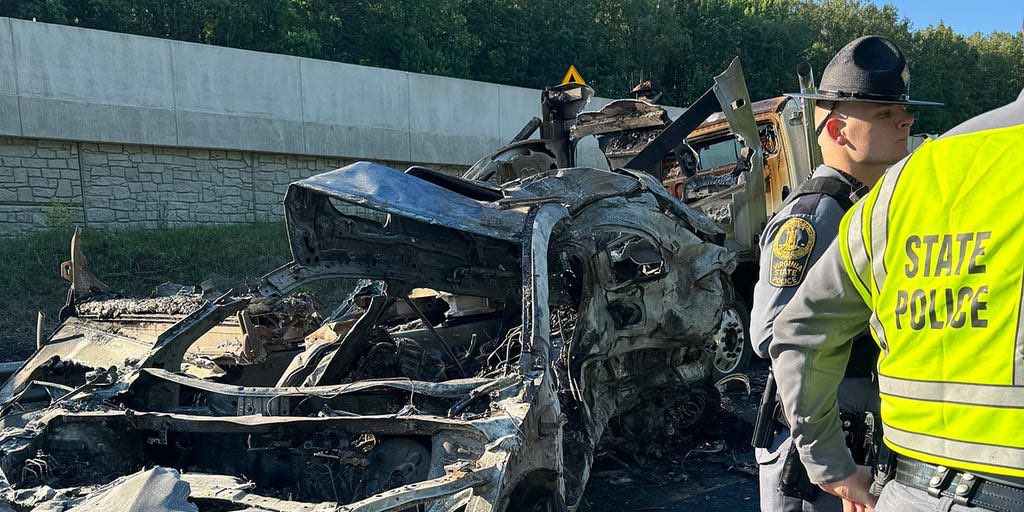
On May 30, a charter bus traveling on Interstate 95 near Richmond plowed into a stopped SUV in a construction zone, according to Virginia State Police. The collision triggered a chain-reaction wreck involving multiple vehicles.
Five people were killed.
This is the car of an entire family that was ki11ed after a bus driver drove into the back of a stopped car.
The driver, Jing S. Dong, 48, of Staten Island, New York, is a Chinese born naturalized citizen who doesn’t read or speak English.
He attained his commercial driver’s… pic.twitter.com/AaQ8ZiwuZr
— Kentucky Girl (@Notwokenow) May 30, 2026
Among the victims was a Massachusetts family of four. Their vehicle caught fire after the impact and they were trapped inside.
The bus driver, 48-year-old Jing S. Dong of Staten Island, New York, survived. Authorities have charged him with two counts of involuntary manslaughter, and investigators say additional charges could be filed as the investigation continues.
According to multiple reports, Dong does not speak or read English.
Yet he obtained a New York commercial driver’s license just two years ago and was legally operating a passenger bus on one of America’s busiest highways.
BREAKING: Transportation Secretary Sean Duffy reveals that the bus driver who caused a crash on I-95 in Virginia that killed five people, including a little boy, is a naturalized U.S. citizen who was born in China, doesn’t speak English, and was given a CDL by New York in 2024. https://t.co/GbaxYDvwhS
— Bill Melugin (@BillMelugin_) May 29, 2026
More Than Just Another Traffic Accident
Construction zones can be confusing even for experienced drivers. Lanes shift, speed limits change, and traffic suddenly slows or stops.
Anyone who’s driven through road construction on Interstate 15 between Las Vegas and California knows exactly what that’s like.
Investigators have not officially said whether language barriers contributed to this crash. That’s important to remember. At the moment, nobody knows exactly what happened inside that bus cab in the seconds before impact.
Still, the situation has renewed concerns about how commercial drivers are tested and licensed.
A Common-Sense Question
Federal regulations have long required commercial drivers to have enough English proficiency to read road signs, communicate with police officers, respond to emergencies, and complete required paperwork.
Most Americans probably assume that requirement is strictly enforced everywhere.
The reality isn’t so simple.
States administer CDL testing, and critics say enforcement of language requirements can vary. Drivers may satisfy state licensing standards while still lacking the English skills needed to safely navigate America’s highways.
If a driver is responsible for a 40,000-pound bus filled with passengers, shouldn’t that driver be able to read every warning sign, detour notice, and emergency instruction encountered along the way?
Critics Push Back
Not everyone agrees with tightening language standards.
Critics argue that millions of immigrants work safely in transportation-related jobs and that language ability alone doesn’t determine whether someone is a safe driver. They also caution against drawing conclusions before investigators complete their work.
Good policy should be based on facts, not assumptions.
But a commercial driver who can’t read road signs, emergency warnings, or construction instructions presents an obvious safety concern. That’s not an assumption.
The real question is whether that concern contributed to this crash.
Why This Matters in Nevada
Nevadans have a stake in this discussion. Every day, thousands of commercial trucks and passenger buses travel I-15, I-80, and U.S. 95. Tourists, school groups, church groups, sports teams, and families all share those roads.
Nobody climbing aboard a bus asks whether the driver can read the road signs. They assume the answer is yes.
That’s why this issue has struck such a nerve across the country.
For the family members grieving loved ones in Massachusetts, policy debates and regulatory reviews offer little comfort today.
A family of four burned to death in their vehicle.
If that doesn’t prompt a serious look at how commercial drivers are licensed, what will?
The opinions expressed by contributors are their own and do not necessarily represent the views of Nevada News & Views. Digital technology was used in the research, writing, and production of this article. Please verify information and consult additional sources as needed.