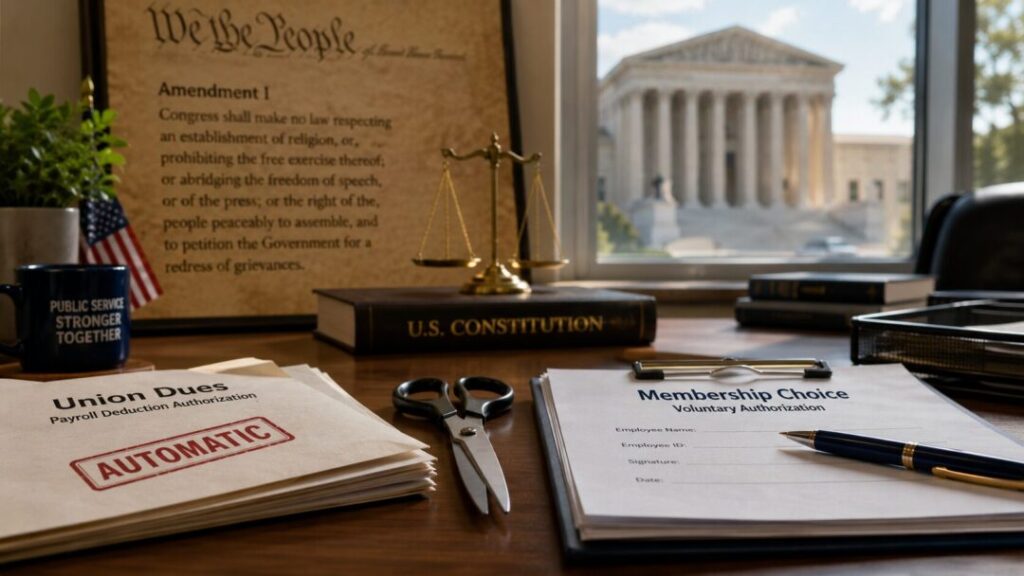
(Aaron Withe) – Last month, we marked eight years since the Supreme Court ruled in Janus v. AFSCME that public employees cannot be forced to pay union dues as a condition of keeping their jobs. Until then, those dues had been mandatory for millions of government workers.
What’s more, most of them never learned that Janus had changed that, until organizations like mine started telling them.
The 2018 ruling was decided 5-4. The majority held that compelling a public employee to subsidize a union’s speech — speech he may deeply oppose — violates the First Amendment.
For workers who had spent years funding ideological messaging and political activity they disagreed with, it was long overdue.
So, what has changed since? More than unions want to admit, but also less than workers deserve.
As of 2023, as many as 1.2 million public employees had either cancelled or declined union membership who otherwise would have been forced to join prior to Janus. That represents a cut of roughly $720 million per year in union revenue nationwide.
Between 2017 and 2022, the American Federation of State, County and Municipal Employees’ active dues-paying membership fell from about 1.26 million to roughly 1.05 million workers — a loss of more than 200,000, or 16 percent. The Service Employees International Union and National Education Association saw comparable double-digit membership losses over the same period.
The financial toll has compounded: The National Education Association’s headquarters dues revenue fell from $370 million in fiscal 2017 to an inflation-adjusted $310 million five years later — a decline in real terms of about 16 percent.
Nationally, Bureau of Labor Statistics data show public-sector union density slid from 33.9 percent in 2018 to 32.2 percent in 2024, before edging back up to 32.9 percent last year.
States that gave workers more direct control over their own dues saw the effect even more clearly.
After Florida ended government payroll deduction of union dues in 2023, the Florida Education Association lost more than 20,000 members in a single school year.
When workers must actively choose to pay, rather than having dues quietly deducted by default, a meaningful share of them chooses not to.
That is the real story of the Janus era: not collapse, but choice. Once workers had a real choice, hundreds of thousands of them took it.
But the unions have not accepted their verdict gracefully. They responded on multiple fronts.
They lobbied legislatures in at least 14 states to gain greater access to employees’ personal contact information (Commonwealth Foundation), tightening their grip on who gets to reach workers in the first place.
They also pushed legislation engineering an asymmetry between joining and leaving: Washington’s HB 1575, for instance, let unions sign workers up for dues deduction in writing, electronically, or by recorded phone call, while permitting cancellation only in writing.
And, more troubling still, they began passing laws to silence outside organizations that inform workers about their rights.
That information gap is real and well-documented. One survey found that 52 percent of teachers did not know they could leave their union without paying a fee. Unions have little incentive to correct that misapprehension. Increasingly, they are working to make sure no one else does either.
Oregon went first. Its new law, which took effect in January, allows civil penalties of $6,250 per communication against any group accused of “impersonating” a labor organization. My organization, the Freedom Foundation, is challenging that law in federal court.
New York is poised to follow, with legislation giving Attorney General Letitia James (D) power to fine organizations $1,000 per communication under similarly vague “impersonation” language currently awaiting Gov. Kathy Hochul’s (D) signature.
In New York alone, roughly 7,500 public employees have already used the Freedom Foundation’s materials to cancel their union membership — precisely the activity the new law is designed to stop. Comparable legislation was considered and nearly adopted in Hawaii this year.
These laws all follow the same playbook: define worker outreach broadly enough that any communication about Janus rights could trigger legal action and crippling fines and penalties.
These aren’t consumer-protection laws — they are prior restraints on free speech that unions don’t want public employees to hear.
Here is what a fully realized Janus world looks like: Unions that have to earn their membership every year and compete for dues by actually serving workers. It would mean they could no longer survive on revenue extracted from people who never chose their representation in the first place.
That’s not a threat to organized labor — it is a standard that every other institution in American life already has to meet.
Workers deserve the same accountability from the organizations that claim to represent them. The First Amendment made that possible eight years ago.
The opinions expressed by contributors are their own and do not necessarily represent the views of Nevada News & Views. Aaron Withe is CEO of the Freedom Foundation. This article was originally published via TheHill.com on 7/6/2026.