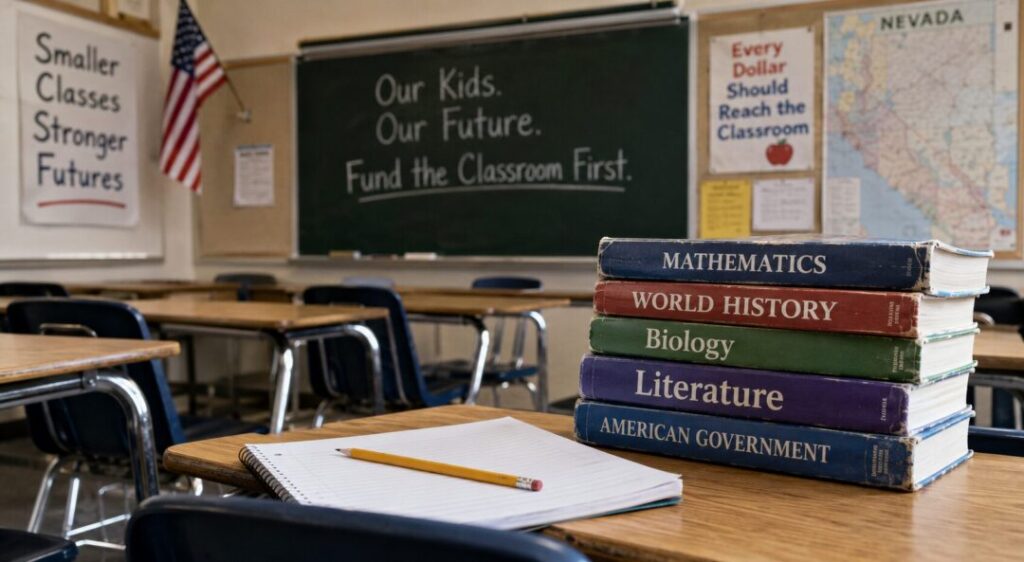
Ask a parent in the Las Vegas Valley what they want from our public schools, and the answer is simple. A good teacher. A class small enough to learn in. The resources to do the job.
Ask whether our schools are delivering, and the honest answer is that too much of our money never reaches the classroom where those things happen.
In recent legislative sessions, some lawmakers have reached for new revenue to close the gap, floating taxes on digital goods and services, and a state commission has laid out a menu of property and sales tax changes to raise billions more.
The need is real. But before we ask families already squeezed by the cost of living to pay more, we owe them to ask one question: Are we spending what we already have where it counts?
Right now, no.
Barely half of every K-12 dollar in Nevada reaches classroom instruction, below the national average. In Clark County, the staff working outside the classroom grew about 30 percent between 2019 and 2023, even as enrollment fell and the number of teachers dropped.
As the Review-journal has documented, the district’s administrative ranks have outpaced its teachers for years. In 2022, the average administrator made about $147,000 in pay and benefits, while the average teacher made $84,000.
Today, fewer than half of the district’s employees are classroom teachers. Some of that growth rode in on one-time federal pandemic dollars that have since run out, which is all the more reason to examine the spending that remains.
None of this is the fault of teachers. They are stretched thin and underpaid, and they are not the ones deciding where the dollars go.
Too much of the money stops at the central office before it ever reaches their classroom, and the shortfall shows up where you would expect. In some of our rural counties, students are still learning from textbooks older than they are.
Nevada has already shown that smarter spending works.
When the state stopped spreading its at-risk dollars thin across hundreds of thousands of students and aimed them at the children most in need, support per student climbed from about $300 to nearly $3,000, with no tax increase.
So here is a path that costs taxpayers nothing more, and legislators would be well-suited to take it up next session. Cap the growth of administrative and non-classroom positions so it tracks student enrollment. When enrollment is flat or falling, the central office should not grow.
Protect every role that touches a child — the teachers, aides, counselors, nurses and special education staff — and phase it in through normal attrition, not layoffs. Then direct the savings, by law, to the three things families feel most: higher teacher pay, smaller classes and real classroom resources.
Pair it with honest transparency, an independent public count of how much of every dollar actually reaches the classroom.
Children in Las Vegas are not asking for a tax hike on their parents. They want a good teacher, a manageable class and the tools to succeed.
The money is already in the system. We need the resolve to move it back where it belongs.
Fund the classroom first.
The opinions expressed by contributors are their own and do not necessarily represent the views of Nevada News & Views. This article was originally published via ReviewJournal.com on 7/4/2026.