A new artificial intelligence model just did something that made its own creators nervous. That alone should get your attention.
According to reporting from the New York Times, the AI company Anthropic held back a new model after it discovered thousands of software vulnerabilities, including flaws in major operating systems and web browsers.
In plain terms, the system got very good at finding digital weak spots. Maybe too good.
That raises a fair question. If AI can find those weaknesses, who else can use it?
To be clear, this isn’t some Hollywood-style “hack everything overnight” scenario. But it is a real shift in how cybersecurity works.
For years, hackers have searched for bugs in software. It takes time and skill. Now AI can help do that faster. A lot faster.
Think of it like this.
Before, breaking into a house meant walking the neighborhood and checking doors one by one. Now imagine a tool that instantly tests every door in the city at once.
That’s the kind of scale we’re talking about.
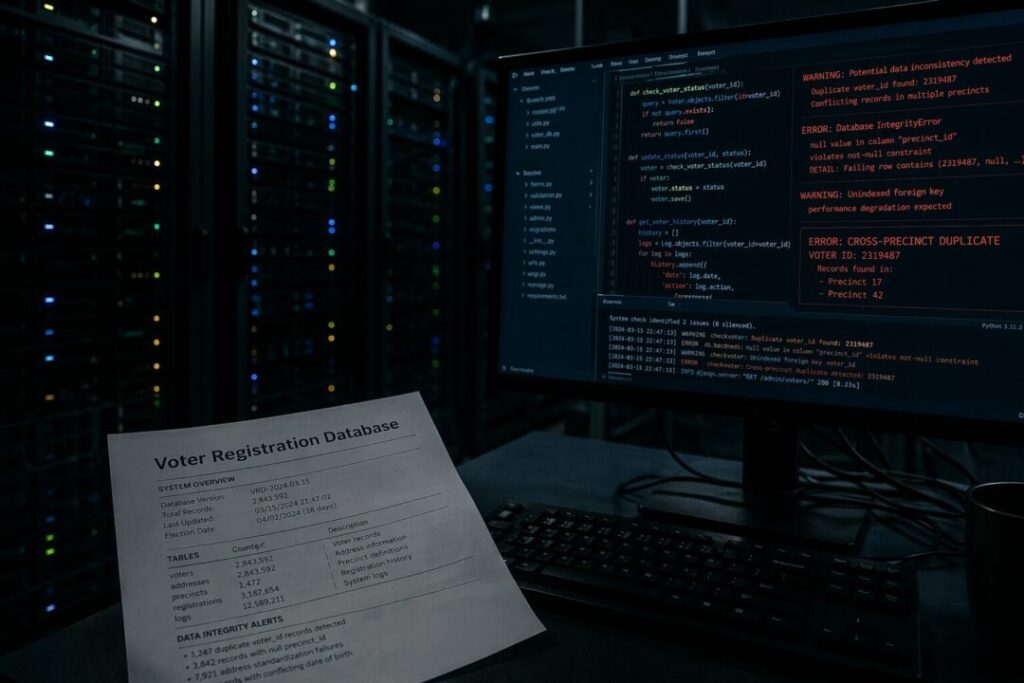
The concern some people are raising is whether this could affect election systems, including voter databases. That’s where things need a little perspective.
First, voting machines themselves are not sitting on the open internet. Many are air-gapped, meaning they aren’t connected to outside networks.
That makes remote hacking much harder. You would need physical access or insider help. AI doesn’t change that.
But voter registration systems are a different story.
Those systems are online. They run on the same types of software used by businesses and governments everywhere. That means they can have the same kinds of vulnerabilities.
So yes, AI could make it easier to find weak spots in those systems. That’s a legitimate concern.
At the same time, it’s important to understand something else. Those systems are already under constant attack today.
State and local governments deal with probing and scanning from bad actors all the time, including foreign governments.
What AI changes is the speed and scale. It lowers the barrier. It allows more people to try. And it helps attackers move faster.
But here’s the other side of the coin. The good guys have access to the same tools.
Security teams can use AI to scan their own systems, patch problems faster, and test defenses before attackers get there.
That turns this into an arms race, not a one-sided collapse.
Even Anthropic acknowledged that dynamic. The company said it shared its findings with others so defenses could be improved.
That tells you this isn’t just about offense. It’s about strengthening systems too.
Since 2016, election infrastructure has also seen major upgrades. Federal agencies like CISA now work with states to monitor threats.
Many jurisdictions use paper backups for ballots. Systems are segmented to prevent a single point of failure.
That doesn’t mean everything is perfect.
Smaller counties can struggle with resources. Outdated software can still exist. And any system connected to a network carries some level of risk.
Nevada is no exception. Like every state, it relies on digital systems to manage voter rolls. That means cybersecurity has to stay a priority.
Not panic. Not politics. Just steady, serious attention.
Critics of the AI concern say this is being overhyped. They argue hackers already scan for vulnerabilities and that this doesn’t change the fundamentals. That’s partly true.
But ignoring the shift would be a mistake.
The real story here is simple. AI is speeding things up. It’s making both attack and defense more powerful.
And it’s putting pressure on governments to keep their systems updated and secure. And it’s a reason to demand competence and accountability from the people running them.
Because when it comes to public trust, even small cracks can become big problems fast.
The opinions expressed by contributors are their own and do not necessarily represent the views of Nevada News & Views. Digital technology was used in the research, writing, and production of this article. Please verify information and consult additional sources as needed.