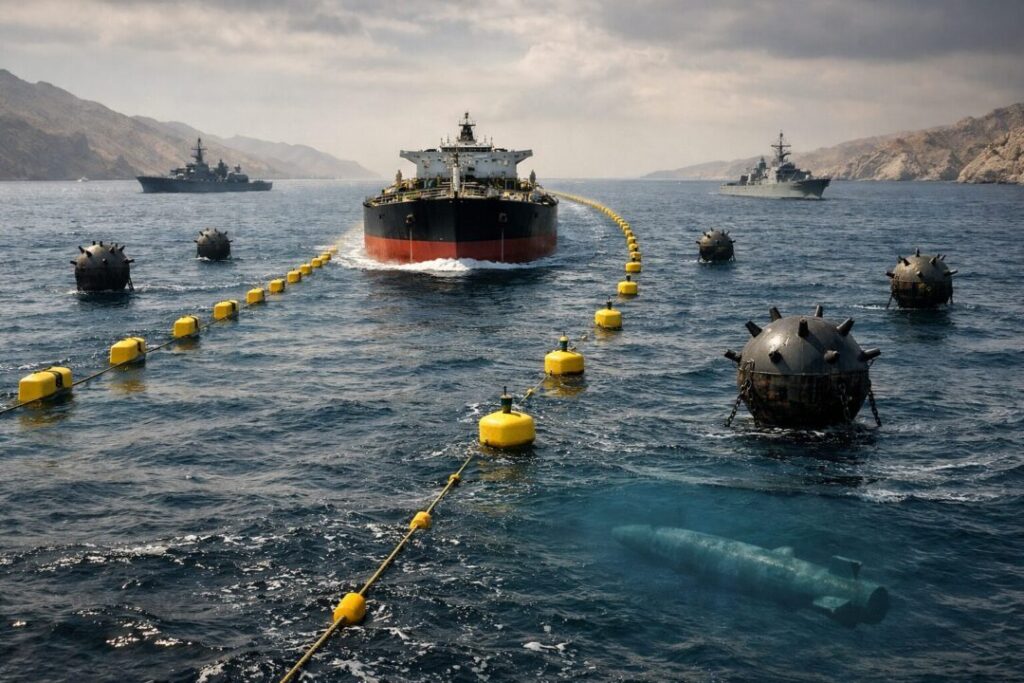
On April 11, U.S. Central Command said U.S. forces have started preparing to clear sea mines from the Strait of Hormuz.
It’s one of the most important shipping routes on Earth.
Two Navy destroyers, the USS Frank E. Peterson (DDG 121) and the USS Michael Murphy (DDG 112), are already in the area.
More help is coming, including underwater drones that can hunt down and remove mines without putting sailors directly in harm’s way.
So what’s the big deal?
Picture a two-lane road that carries a huge chunk of the world’s oil. Now imagine someone tossing spikes all over it.
That’s pretty much what we’re talking about.
The Strait of Hormuz handles about 20% of the world’s oil supply, according to the U.S. Energy Information Administration.
When that flow gets threatened, prices don’t just creep up. They jump. Fast.
Gas prices. Groceries. Airline tickets. Even the cost of getting across town.
It all connects.
If oil slows down, everything that depends on transportation gets more expensive. And that’s… pretty much everything.
Now zoom in on Nevada. We’re especially vulnerable.
Nevada doesn’t produce its own oil.
Most of our gasoline comes from California, which already deals with refinery closures and strict environmental rules.
So when global supply gets shaky, we don’t have much cushion.
Prices at the pump jump almost overnight, and everyone’s left asking “What just happened?”
Sometimes the answer is thousands of miles away.
In this case, it involves Iran’s Islamic Revolutionary Guards Corps, which U.S. officials say laid the mines.
The goal now is to clear them and make sure ships can move safely again.
Admiral Brad Cooper of CENTCOM put it this way:
“Today, we began the process of establishing a new passage and we will share this safe pathway with the maritime industry soon to encourage the free flow of commerce.”
Keep the lanes open. Keep goods moving. Keep prices from spiking even higher.
Simple idea. High stakes.
Now, not everyone is cheering this on.
Some critics worry that more U.S. military activity in the region could escalate tensions with Iran.
They argue diplomacy should lead, not warships.
That concern isn’t crazy. Nobody wants a bigger conflict. But there’s another side to it.
If a major trade route can be threatened without a response, what happens next time? Or the time after that?
At some point, someone has to step in and say no.
That’s what this mission is about.
It’s not just military muscle. It’s also about sending a message.
You don’t get to choke off global trade and expect the world to shrug.
Meanwhile, there’s a quieter part of this story that matters too.
Technology.
The U.S. is using underwater drones to help clear the mines.
That means fewer sailors in danger and a faster, safer cleanup process.
It’s a reminder that modern warfare isn’t just boots on the ground anymore. It’s machines, data, and precision.
Still, the bottom line hasn’t changed.
If that narrow strip of water stays open, the global economy keeps moving.
If it doesn’t, things get expensive. Real fast.
The opinions expressed by contributors are their own and do not necessarily represent the views of Nevada News & Views. Digital technology was used in the research, writing, and production of this article. Please verify information and consult additional sources as needed.