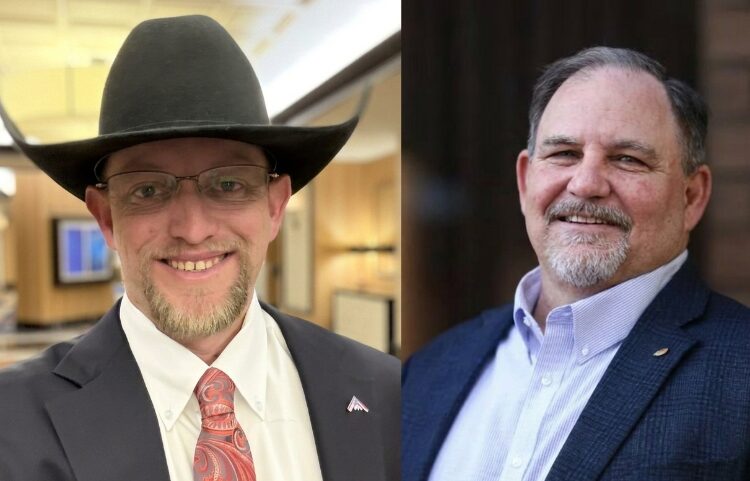
New records show Flippo registered to vote at the same Reno address his campaign was paying $10,600 to rent.
The Nevada’s 2nd Congressional District race got a lot more complicated this week.
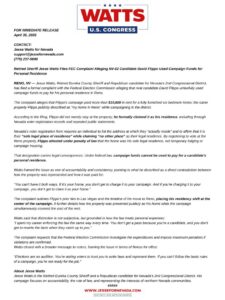
Retired Eureka County Sheriff Jesse Watts has filed a formal complaint with the Federal Election Commission alleging that rival candidate David Flippo used campaign money to pay for his personal home in Reno, underpinned by our original reporting at NN&V.
Read our prior reporting:
NV-02’s David Flippo Is Either a Liar or a Fraud — The Only Question Is Which One
Now, new voter registration records are adding fresh fuel to the fire.
What the FEC Complaint Says
Watts filed the complaint on April 30, 2026, accusing Flippo’s campaign of making more than $10,600 in rent payments on a fully furnished six-bedroom home in Reno. The payments — totaling $10,686.04 — went to Blue Sierra Realty Nevada and were listed in FEC filings simply as “RENT.”
Under federal law, that’s a problem. Campaign funds cannot be used to pay for a candidate’s personal residence. It doesn’t matter how you dress it up, the law is the law.
Watts put it plainly:
“You can’t have it both ways. If it’s your home, you don’t get to charge it to your campaign. And if you’re charging it to your campaign, you don’t get to claim it as your home.”
Voter Records Tell the Story
Here’s where it gets interesting. Flippo didn’t just rent that Reno house. He registered to vote there.
Nevada’s voter registration form requires signers to declare, under penalty of perjury, that the address listed :
“is my sole legal place of residence and I claim no other place as my legal residence.”
Giving false information on that form is a felony.
Public records show that as recently as March 9, 2026, Flippo was still registered to vote at his address in Clark County — the same address where his wife and daughter-in-law remain registered. His registration later turned up in Washoe County at the very property his campaign was paying for.
That creates a direct legal conflict. If the Reno house is his legal residence — as his voter registration attests — then the campaign payments for that property are prohibited personal expenditures under federal law. There’s no middle ground.
His Own Words
The complaint doesn’t rely on guesswork.
It points to Flippo’s own statements. On April 1, 2026, Flippo was asked directly at a Washoe County Republican Assembly endorsement interview where his house was.
This audio clip was taken on April 1, 2026 during #NV02 candidate David Flippo’s endorsement interview with the Washoe County Republican Assembly.
I have transcribed it.
Do you want to know more about David’s Reno Home™? I’ve got the scoop. pic.twitter.com/LZM2wMq1mQ
— BrutalBrittany💕 (@BrutalBrittany2) April 27, 2026
He answered: “Right here in Reno.”
Asked when he bought it, he said: “This week.”
When pressed, he added: “Yeah, I’m —we’re moving up here.”
Then, on April 26, Flippo hosted a campaign event billed as a “Cookout at Lt. Colonel’s House” at the same property. More than 100 people attended.
Afterward, Flippo posted on social media:
“Yesterday’s meet and greet at my home in Reno was incredible.”
Watts wasn’t impressed.:
“I spent my career enforcing the law the same way every time. You don’t get a pass because you’re a candidate, and you don’t get to rewrite the facts when they catch up to you.”
Why This Matters to Conservatives
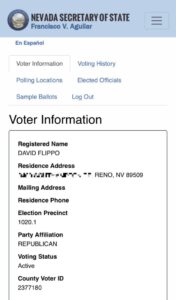
Flippo’s voter registration, street address censored
Conservatives care deeply about accountability and the rule of law. These aren’t just abstract values. They are the foundation of representative government.
When a candidate uses donor money to pay personal living expenses, that’s not just a campaign finance violation. It’s a breach of trust to the voters.
The carpetbagger question has followed Flippo since he switched from running in CD4 — which covers Las Vegas — to CD2, which covers Reno, Sparks, Carson City, and rural northern Nevada. The FEC complaint now ties that residency question directly to dollars and documents.
Watts summed it up this way:
“Elections are an audition. You’re asking voters to trust you to write laws and represent them. If you can’t follow the basic rules of a campaign, you’re not ready for the job.”
What Happens Next
The complaint asks the FEC to investigate and impose maximum penalties if violations are confirmed.
The two-track system — civil vs. criminal:
FECA creates a clear divide between non-willful violations — which are handled exclusively by the FEC as civil matters — and knowing and willful violations involving $2,000 or more, which are subject to both FEC civil enforcement and criminal prosecution by the Justice Department.
Civil penalties (FEC track): As noted earlier, the civil penalty for personal use violations is the greater of $55,000 or 1,000% of the amount involved for knowing and willful violations. On $10,686, that’s potentially over $106,000 in civil fines alone.
Criminal penalties (DOJ track): Prison sentences for criminal violations of FECA range from one to five years per individual offense, along with significant fines. In civil cases, penalties can include fines, restitution, and being barred from engaging in campaign-related activities.
The referral process: The FEC investigates and makes a probable cause finding. If it finds the violation was knowing and willful, the Commission votes to refer the matter to the Department of Justice. DOJ then decides whether to prosecute criminally. That’s the pathway to potential prison time.
There’s one important thing to know about the process. By law, FEC investigations are confidential until they’re closed. The commission won’t confirm or deny anything while a case is active.
The evidence here is unusually straightforward. Flippo’s own sworn voter registration puts him at the address his campaign was paying for. His own words and his own social media posts call it his home. The complaint doesn’t require a lot of connecting dots. The dots connected themselves.
As the legal scrutiny mounts, a bigger political question looms. Flippo has collected endorsements in his bid for NV-02.
The question now is whether those backers will stand publicly behind a candidate operating under a federal complaint — one supported by his own sworn statements, voter registration, and social media posts. Endorsements are easy to give. They’re a lot harder to defend when the receipts are this hard to ignore.
With the Nevada primary just weeks away on June 9, 2026, the timing is significant. Voters in CD2 will have to decide whether this matters to them before they cast a ballot.
And pay close attention to how Flippo responds — or doesn’t — in the days ahead.
Read the full FEC Complaint here: Flippo FEC Complaint (as filed)
View Exhibit Compendium: Watts v Flippo_Exhibits.docx
The opinions expressed by contributors are their own and do not necessarily represent the views of Nevada News & Views. This article was written with the assistance of AI. Please verify information and consult additional sources as needed.