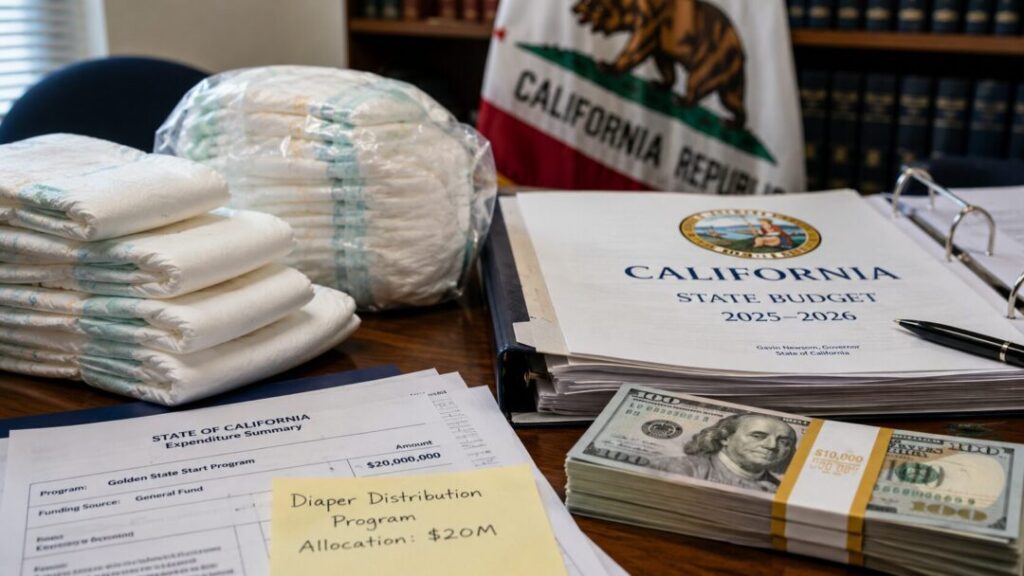
Californians Are Paying for More Than Just Diapers
California Gov. Gavin Newsom facing criticism over a new taxpayer-funded diaper program that critics say looks a lot more like political favoritism than public service.
The controversy started after users on X highlighted connections between Newsom, his wife Jennifer Siebel Newsom, and the nonprofit selected to help run California’s new “Golden State Start” initiative.
Gavin Newscum’s diaper fraud just keeps getting worse…
Both co-CEO’s of baby2baby have deep ties to Newsom, his wife, and all the Democrat and Hollywood elites
Newscum is taking our tax dollars and just redistributing it to his pals.
It’s one big club. https://t.co/vRQPGCbedF
— Libs of TikTok (@libsoftiktok) May 11, 2026
Starting in summer 2026, participating hospitals in California will reportedly hand out free diaper kits to new parents. The state plans to distribute around 40 million diapers total, with each newborn family receiving about 400 diapers.
Anyone who’s raised kids knows diapers aren’t cheap. Supporters say the program could ease financial stress for low-income families during those first exhausting weeks after bringing a baby home.
And honestly, most people probably wouldn’t object to helping struggling parents.
But the problem isn’t the diapers. It’s where the money is going.
California’s Insider Network Strikes Again
According to critics, California is spending roughly $20 million taxpayer dollars on the program through the nonprofit Baby2Baby, whose leadership appears deeply connected to Newsom’s political and social circle.
One of Baby2Baby’s co-CEOs, Norah Weinstein, reportedly serves on the board of Jennifer Siebel Newsom’s California Partners Project.
The organization’s other co-CEO, Kelly Sawyer Patricof, is married to Hollywood producer Jamie Patricof, who has longstanding ties to Newsom and Democrat political networks.
Now maybe that’s all just one giant coincidence.
Maybe.
But after years of watching insider deals, sweetheart contracts, and politically connected nonprofits benefit from government spending, many Americans aren’t giving politicians the benefit of the doubt anymore.
Maybe voters would be less skeptical if this kind of thing didn’t happen so often.
Wait Until You Hear What These Diapers Cost
Based on the reported numbers, California may end up paying around 50 cents per diaper.
Some consumers online quickly noted that bulk retailers like Costco often sell diapers at lower per-unit prices.
In other words, taxpayers could be paying premium prices while politically connected organizations handle distribution.
Again.
Sound Familiar, Nevada?
California has spent years perfecting this model: grow government, funnel money through connected organizations, and call it compassion.
Nevada should be careful before following the same road.
We’re already seeing politicians here push California-style spending programs, subsidies, handouts, and government expansion schemes. Big programs. Bigger budgets.
This time, they promise, things will be different. Then taxpayers get the invoice while insiders keep cashing checks.
Another Side to the Debate
Supporters of the program argue the diaper kits are about more than raw diaper costs alone.
Hospital distribution, packaging, staffing, outreach, and support services all add expenses beyond simply buying a giant pallet at Costco. That’s easy enough to understand.
Still, critics say the bigger issue isn’t the diapers themselves.
It’s whether politically connected organizations should be the ones benefiting from taxpayer-funded programs in the first place.
Voters Aren’t Blind to This Anymore
Public trust matters. Especially when taxpayer dollars are involved.
Most Nevada families don’t have lobbyists, political connections, or nonprofit boards packed with powerful friends.
They work. They budget. They pay taxes.
And they’re getting tired of watching government programs circle back toward the same politically connected people over and over again.
Maybe the diaper program truly helps struggling families.
But taxpayers still deserve to know whether it's compassion driving these programs, or political favoritism.
The opinions expressed by contributors are their own and do not necessarily represent the views of Nevada News & Views. Digital technology was used in the research, writing, and production of this article. Please verify information and consult additional sources as needed.