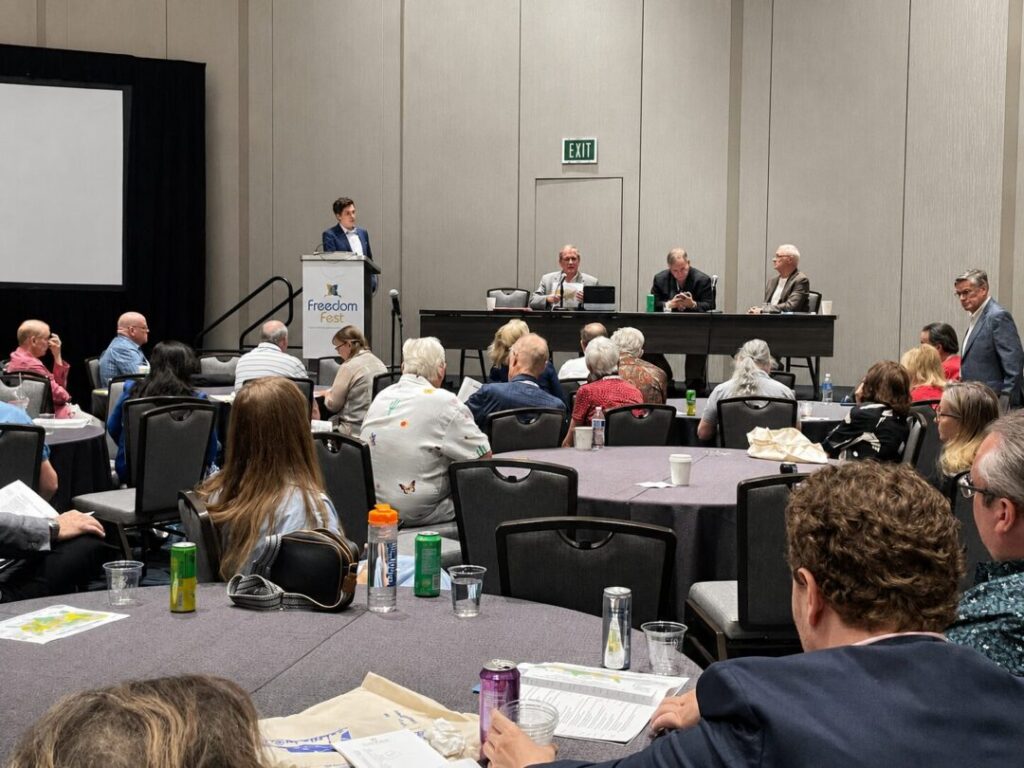
FreedomFest turns 24 this year. The four-day conference, founded by economist Mark Skousen back in 2002, runs Wednesday through Saturday at the Caesars Forum Conference Center.
This year’s theme was “Think Independent,” and organizers pulled in more than 2,500 attendees from across the country for what they bill as a mix of economics, politics, film and culture, six pavilions, six stages, one big argument for liberty.
One of the best conversations happened at the “Political Roundtable” session in the Jefferson Salon, moderated by Joshua Philipp, senior investigative reporter for The Epoch Times and host of “The Josh Philipp Show” and “Crossroads.”
Philipp kept three guys talking who’ve spent a combined century in the trenches of American conservative politics.
And whether they meant to or not, they laid out a pretty complete playbook for how Republicans can win – and how they keep shooting themselves in the foot.

Speakers chat with audience at close of panel
The Socialism Question
The panel kicked off with the question everybody in politics is asking right now: why is a new brand of socialism suddenly winning elections, from New York City to college towns everywhere?
The answer the panel landed on wasn’t that voters are falling in love with socialism. They’re falling for whoever talks about what they actually care about. Shocking.
Democratic socialists talk about the cost of living nonstop. Too many Republicans are still handing out ten-point policy platforms instead of talking to people the way people actually talk to each other.
That set up the rest of the hour.
Grover Norquist’s Chart: 62 Years of Proof
Grover Norquist, founder and president of Americans for Tax Reform, and the man behind the Taxpayer Protection Pledge signed by thousands of Republican officeholders nationwide, brought a chart.
From 1932 to 1994, Republicans controlled both the House and Senate for exactly two years out of 62. Two.
Then, in 1994, Republican candidates started signing a pledge never to raise taxes, the same pledge Norquist helped build to get Ronald Reagan’s 1986 tax reforms across the finish line.
Since then, Republicans have held the House and Senate for 18 years to the Democrats’ six.
“Once Republicans became the party that would not raise your taxes, they won three times more often,” Norquist told the room.
He didn’t stop at history.
Norquist walked through the current map of state tax policy: eight states with zero income tax, sixteen states now on a flat tax (up from eight just eight years ago), and a growing list of Republican-run states moving to phase out their income tax entirely.
A flat tax is hard to raise and easy to cut. States that adopt one almost never go back.

Chuck Muth: The Turnout Problem
Citizen Outreach and Nevada News & Views founder Chuck Muth used his time on the panel to make a point Nevada Republicans need tattooed on their foreheads: the party doesn’t have a persuasion problem. It has a turnout problem.
Muth pointed to Adam Laxalt’s 2022 U.S. Senate loss, decided by fewer than 8,000 votes. In that same election, more than 180,000 registered Republicans in Nevada simply didn’t vote.
“We don’t need to register any more Republicans to win these races,” Muth said. “We’ve got to figure out how to get already registered Republicans to actually show up and vote.”
It’s the same math driving low-turnout socialist wins in places like New York City, Muth argued, just running in reverse.
When only a sliver of eligible voters shows up, whichever side actually shows up wins. Democratic socialists have figured that out.
Too many Republican campaigns still haven’t.
Muth also fielded a question on artificial intelligence in campaigns, and his advice cut against how most consultants use it. Don’t ask a chatbot to “write a speech for this candidate,” he said. That’s backwards, and it’s why AI-written material sounds like generic pablum.
Write for the voter, not the consultant. Write on what the voter cares about, what the voter gets – not about the candidate’s 7 step plan to regulatory reform.
Campaigns that make that shift, he said, “will win a heck of a lot more races.”
John Fund: A Warning To The Right
John Fund, the longtime National Review columnist and former Wall Street Journal editorial board member FreedomFest calls “The Watchdog of Power,” spent his time on the panel looking inward.
He warned that decades of neglecting civics and history education have left a generation with little grounding in why free markets and limited government work in the first place, a gap the socialist left has been happy to fill.
Fund also flagged a fight brewing inside the conservative coalition itself, cautioning that some rising voices in the movement are drifting toward bigger, more activist government under the banner of populism.
Fund’s message to the room was blunt: a candidate saying the right things, flattering the base, and getting the nod from party leadership isn’t the same as that candidate actually being right on the issues.
“We don’t have to accept everything a candidate says at face value,” Fund said, “just because they say the right things and placate us and tell us we’re the future.”
Republicans, he argued, have to “support what is right, not have a philosophy of ‘our leader, right or left.'”
Fund made clear he sees a “titanic struggle” coming for the direction of the party, and his advice was to judge candidates on the policy, not on who anointed them.
From the Panel to the Politicians
This panel boiled down to a point that Nevada Republicans would do well to remember heading into the 2026 general election: Republicans lose ground every time they let comfort, habit, or star power substitute for the actual argument.
None of this requires anything exotic.
Cut taxes and mean it.
Find the Republicans who already agree with you and get them to the polls.
Talk to voters like people, not audiences.
It’s not a complicated playbook. It’s just one Nevada Republicans, and Republicans everywhere, keep failing to run.
The opinions expressed by contributors are their own and do not necessarily represent the views of Nevada News & Views. Digital technology was used in the research, writing, and production of this article. Please verify information and consult additional sources as needed.