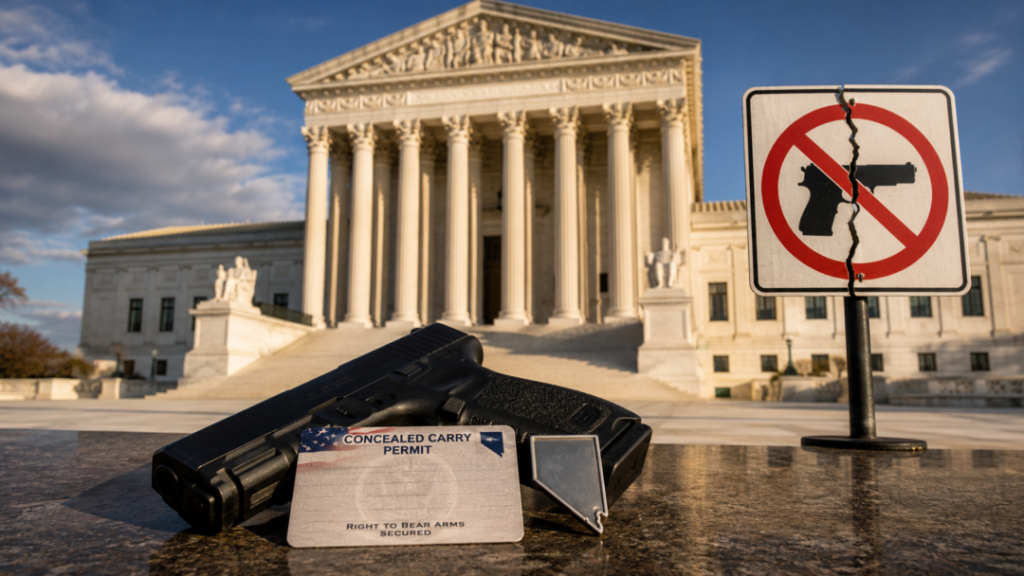
The United States Supreme Court handed gun owners an important victory on June 25, 2026, in Wolford v. Lopez. The case came out of Hawaii, but Nevadans should pay attention because it reversed a decision of the Ninth Circuit Court of Appeals, the same federal circuit that covers Nevada.
After the Supreme Court’s 2022 decision in New York State Rifle & Pistol Association v. Bruen recognized the right of ordinary, law-abiding citizens to carry handguns outside the home for self-defense, Hawaii changed tactics. It adopted a rule that prohibited licensed carriers from entering private property open to the public unless the owner gave express permission.
In plain English, a permit holder could not legally enter an ordinary store, restaurant, gas station, or similar business while armed unless the proprietor first said guns were welcome.
This arrangement was sometimes called a “vampire rule”: A legally armed citizen could not enter without being specifically invited.
It turned the traditional rule on its head. Ordinarily, a business open to the public permits people to enter unless the owner tells them otherwise.
Hawaii singled out licensed gun carriers and presumed them forbidden everywhere unless someone with authority expressly admitted them.
By a 6-3 vote, the Supreme Court said no. Justice Samuel Alito wrote for the Court, joined by Chief Justice John Roberts and Justices Clarence Thomas, Neil Gorsuch, Brett Kavanaugh, and Amy Coney Barrett. The Court held that Hawaii’s rule violated the Second and Fourteenth Amendments. (1)
Why Hawaii’s Rule Failed
Under Bruen, when a law restricts conduct covered by the plain text of the Second Amendment, the government must show that its restriction is consistent with this nation’s historical tradition of firearms regulation.
Hawaii tried to rely on old laws dealing mainly with armed trespass and poaching on private land. The Court found that comparison unconvincing.
Secretly and peaceably carrying a concealed handgun into a grocery store for self-defense is not the same thing as entering somebody’s enclosed land to shoot and steal his game.
Hawaii also relied on an 1865 Louisiana law that was part of the post-Civil War Black Codes. Those laws were used to disarm newly freed black citizens and leave them vulnerable to attack.
The Court properly refused to treat that shameful law as evidence of a legitimate American tradition limiting the right to bear arms.
I’m not making this up: The State of Hawaii actually offered a Black Code as support for a modern gun restriction. It did not go well.
The Court also rejected the idea that local attitudes can change the meaning of a constitutional right.
The Second Amendment does not mean one thing in Nevada and something weaker in Hawaii, California, New York, or New Jersey.
The Bill of Rights sets a national constitutional floor that state politicians may not vote away.
What the Decision Does—and Does Not—Do
Wolford protects licensed carriers from a state-created presumption that every private business open to the public is automatically a gun-free zone unless it affirmatively opts in. It does not abolish private property rights. A business owner may still prohibit firearms on the owner’s property, subject to the law of that state.
Nor did the Court erase every law governing sensitive places. The decision addressed Hawaii’s default rule for private property open to the public, not every restriction that Hawaii or another state has enacted.
The ruling does not make an immediate, dramatic change to ordinary Nevada carry law because Nevada did not have Hawaii’s backward default rule. Its importance to us is broader.
The Supreme Court reversed our own Ninth Circuit and again instructed lower courts that the Second Amendment is a real constitutional right, not a second-class suggestion that judges may balance away whenever a state invokes “public safety.”
If Nevada politicians ever try the same trick, Wolford will be waiting for them.
Gun-control advocates often respond to a court loss by replacing the invalid law with a different restriction designed to reach much the same result. Hawaii tried that after Bruen.
Wolford tells governments that changing the label does not cure the constitutional problem. A state cannot recognize the right to carry on paper and then make its lawful exercise practically impossible during the course of an ordinary day.
That is a solid result for the Second Amendment, for lawful concealed carriers, and for every American who believes constitutional rights should mean the same thing in all fifty states.
1 Supreme Court of the United States, Wolford v. Lopez, No. 24-1046, decided June 25, 2026, https://www.law.cornell.edu/supremecourt/text/24-1046; official case docket, https://www.supremecourt.gov/search.aspx?filename=%2Fdocket%2Fdocketfiles%2Fhtml%2Fpublic%2F24-1046.html (accessed August 18, 2026). This article provides general legal information, not legal advice; firearms laws and property rules vary by jurisdiction and can change. The opinions expressed by contributors are their own and do not necessarily represent the views of Nevada News & Views. Digital technology may have been used in the research, writing, or production of this article. Please verify information and consult additional sources as needed.