DHS to DOJ: Investigate This “Voter List Maintenance” Group.
You’ve probably never heard of ERIC. But it might have your driver’s license number, your Social Security number, and your voting history sitting in a database somewhere.
Homeland Security Secretary Markwayne Mullin just sent a letter to Attorney General Todd Blanche. He’s asking DOJ to review two big problems his department found.
Both involve election security. Both should worry you.
The first problem is barcodes and QR codes on ballots.
Federal law says voting machines must produce a paper record humans can actually read and audit. Mullin says some systems strip the human-readable text away and just leave the barcode.
That means a hacker could change your vote by messing with the code, not the printed words, and nobody would catch it in an audit.
The second problem is bigger, and it’s where ERIC comes in.
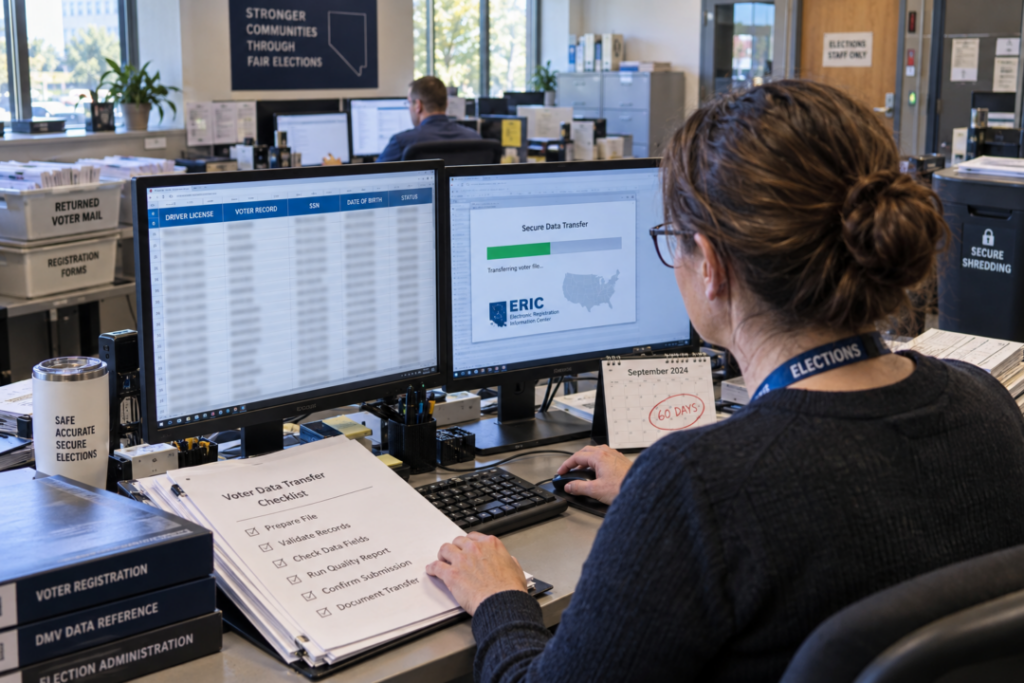
ERIC stands for the Electronic Registration Information Center. It was created by Pew Charitable Trusts. It’s marketed as a tool that helps states clean up voter rolls.
In reality, Mullin’s letter says states hand ERIC sensitive DMV data, including Social Security numbers and driver’s license numbers, for people who never even signed up to vote.
Here’s the kicker: The ERIC model contract requires states to share this data every 60 days. But ERIC only uses it to build reports once or twice a year.
Why collect it constantly if you only need it twice a year?
It gets worse.
Before 2020, ERIC shared that protected data with the Center for Election Innovation and Research.
CEIR got over $70 million from a Chan Zuckerberg (Facebook’s Mark Zuckerberg organization) nonprofit. That money helped fund state election offices willing to hand over private data.
This is the same kind of Zuckerberg-funded election activity Nevadans have heard about before, just with a new name and a new angle.
The letter lays out real consequences.
In 2022, Colorado’s Secretary of State sent voter registration invitations to 30,000 non-citizens because of an ERIC list.
In Georgia, federal analysts found more than 42,000 dead people still on the voter rolls, even though Georgia has shared data with ERIC since 2019.
And in Washington State, a citizen found hundreds of abandoned ballots next to a dumpster at a commercial mailbox business, right alongside ERIC voter registration postcards mailed to that same address.
None of this happened by accident.
By the way, Nevada was one of the founding members in 2012 when ERIC first got established.
ERIC currently has around 30 member states. All of them pay an annual membership fee as well as data usage costs. Funded by the taxpayers, of course.
Mullin’s letter notes the ERIC contract flatly bans states from sharing citizenship information.
So the very data that would stop a non-citizen from getting registered is the one thing ERIC won’t let states disclose.
This isn’t a partisan complaint. It’s a Cabinet secretary flagging a legal and security problem to the nation’s top law enforcement officer, in writing, with sourced footnotes.
Nevada voters should be paying attention.
Voter roll integrity isn’t some inside-the-beltway Washington, DC fight. It’s about whether the list of registered voters in your own county actually reflects real, eligible, living Nevadans.
When a private nonprofit is handling your DMV data on a 60-day cycle with almost no oversight, that’s not voter list maintenance. That’s a privacy problem wearing a good-government mask.
DOJ now has the referral. The question is whether anyone acts on it.
The opinions expressed by contributors are their own and do not necessarily represent the views of Nevada News & Views. Digital technology may have been used in the research, writing, or production of this article. Please verify information and consult additional sources as needed.