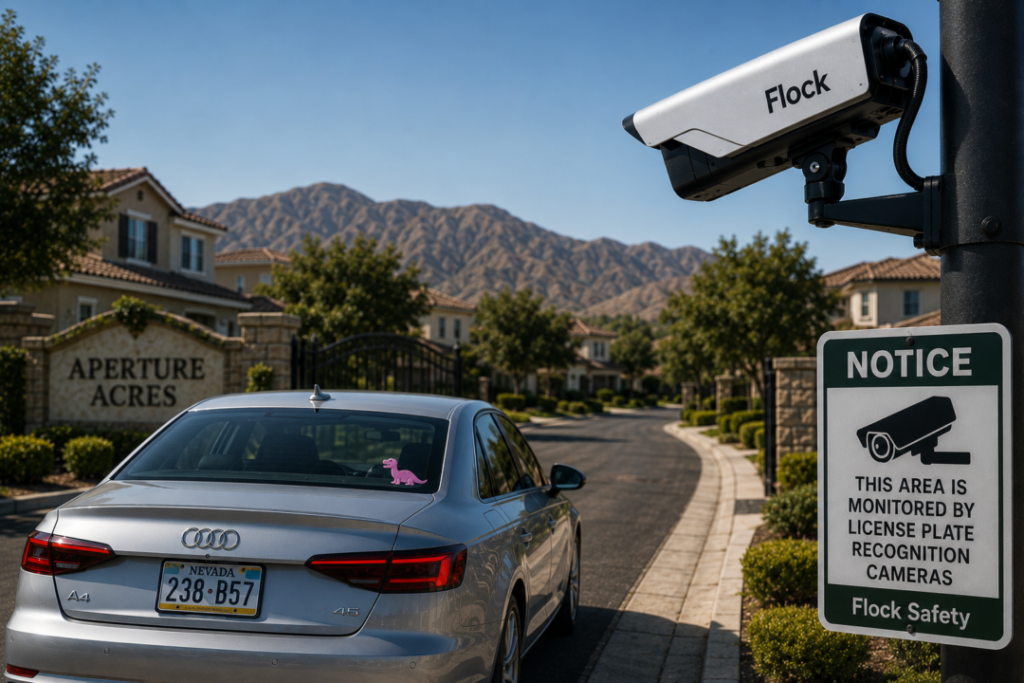
(A. Rudowsky) – Privacy advocates are increasingly concerned about License Plate Reader (LPR) cameras that are posted throughout all cities in the U.S.
The Flock company is one of the main suppliers of these cameras to local governments nationwide, including the Las Vegas Metropolitan Police Department.
Their website states: “Flock builds technology that helps communities deter crime, respond to emergencies, and investigate safety incidents. We believe communities shouldn't have to choose between public safety and privacy”
Explosive Growth
The network of these cameras has grown exponentially.
It has gotten so concerning that there now is a crowd-sourced website called deflock.org that shows the Flock camera network on a U.S. map.
Any volunteer can document and upload the location of a Flock camera in their neighborhood.
The map shows that thousands and thousands of these cameras are installed in America.
Privacy advocates are very concerned because there are reports of mis-use of this technology: wrongful stops, false identification and violations of civil liberties.
That includes police and government officials abusing their newfound powers to surveil and track citizens' movements.
And concerns go beyond the Flock company's capabilities.
The Pink Dinosaur Sticker
Greg Datum lives in Aperture Acres, a pristine community where the lawns are manicured to the millimeter and the suburban homes all line the streets in their HOA-approved shades of white.
At 7:00 a.m Greg backs his 2026 Silver Audi out of the garage. By 7:05, as he pulls past the community entrance, his license plate, car model, insurance status and every unique marker are instantaneously flagged and uploaded into the Flock data system.
The camera was even able to zoom in on the pink dinosaur sticker his daughter stuck on the dashboard.
The company that makes this all possible: The Flock Company.
At the vanguard of this “dystopian renaissance” is the Flock company, a private data company, that is building a nationwide network of high definition, cloud connected watch towers marketed to catch criminals.
Flock collects License Plate Reader (LPR) data. Information collected by or stored in the LPR system includes the following:
- License plate image
- Vehicle image
- Vehicle characteristics (e.g. color, make)
- License plate number
- License plate state
- Date
- Time
- Camera location
Privacy advocates contend that in America your license plate is fundamental to your identity and should be guarded and kept confidential.
Questions we don't have an answer to:
- How exposed is this data in Flock's vast tracking data base?
- How long does this data remain in the system?
- Who has access to the data?
- What types of reporting exists?
In the Hands of the Wrong Government or the Wrong People…
As with many technologies created to serve the interest of society, its true purpose can metastasize into something far more over-reaching.
It is not farfetched to imagine how combining the LPR data with the citizen's smartphone and social media data, your every move is tracked: while taking a quick trip to the grocery store you phone can share your route, your bluetooth data, your scrolling history, and your shopping lists.
The same linguistic grift that turns war into “peace” or mass layoffs into “right-sizing”, this intrusive data-harvesting network is sold to the public as a “crime deterrent.”
The camera is less a guardian designed to serve and more an open-air digital cage with the purpose of monitoring and influencing the lives of every free citizen.
It exists not just to protect but to monetize and monitor Greg's every micro-movement.
This represents a fundamental shift from crime prevention to behavioral compliance. Traditional policing is reactive.
A system like Flock is always “on” and proactive in the most chilling sense it seeks to anticipate, catalog and ultimately help shape behavior.
The data generated is not evidence for a courtroom; it is raw material for a creating scenarios to force compliance.
What About Nevada?
Ben Horowitz, co-founder of venture capital firm Andreessen Horowitz, has donated over $7.6 million to the Las Vegas Metropolitan Police Department.
The donation was for Flock Safety license plate readers and Skydio drones.
Critics argue this bypassed public oversight and competitive bidding.
Nevadans did not have a vote or a town hall on whether this intrusive technology is wanted by Nevadans.
The NV legislature did not get involved in these decisions. Maybe they should have.
Residents and municipalities pay for access to a database that grows richer with every innocent trip to the grocery store.
We Need Regulation to Guard US Citizens' Privacy and Their 4th Amendment Rights
Hearing the uproar and concerns from US Citizens, Flock's chief executive recently announced new oversight measures to protect privacy.
But critics call the pledge a ruse a designed to preempt regulation while the cameras keep rolling.
Without independent auditors, enforceable limits on data retention, or restrictions on sharing information with police and insurers, the promise of self-regulation is no regulation at all.
The central question is no longer whether Flock will voluntarily add safeguards.
It is who watches the watchers?
Can a private corporation that controls the camera network, stores the data, and profits from access be trusted to police itself?
The privatization and over-integration of surveillance doesn't create safety or ease. It creates a reality where citizens' everyday lives are under constant observation.
This is a violation of every American' Fourth Amendment Right under the United States Constitution.
In Summary
The freedom of movement, expression, deviation of behavior, buying habits can be watched live, observed, categorized through flocks database to determine societal conformity, deviation can be considered suspicious behavior.
Greg was not speeding. He was not running a stop sign.
His only offense was leaving his home at a predictable hour in a recognizable car with a child's sticker on the dash, a perfectly mundane act that the system logged, timestamped, geolocated, and cross-referenced with millions of other perfectly mundane acts. In this architecture of control, the goal is not to catch a criminal in the act but to ensure that no act ever goes unseen.
The mere possibility of being watched becomes a mechanism for behavioral compliance, a silent command to never deviate from an invisible script.
The pink dinosaur sticker was never a threat. It was just a tidbit of metadata to be sold, stored, and perhaps one day used to infer something about Greg's parenting, his schedule, his reliability, his compliance.
The public square becomes a space of silent, recorded transactions rather than free human interaction.
The hyper-reality sets in: we begin to behave as if we are always on camera – because we are.
This is not the world most of us want to live in!
Mrs. A. Rudowsky was born and raised in Nevada. Her professional background includes Bachelor and Master Degrees in Public Health, specializing in Environmental Hygiene. She spent time in Ohio and returned to Las Vegas 11 years ago. The opinions expressed by contributors are their own and do not necessarily represent the views of Nevada News & Views. Digital technology may have been used in the research, writing, or production of this article. Please verify information and consult additional sources as needed.