When you think of a Google project, you probably think search engines, smartphones, or maybe self-driving cars.
Mosquitoes? Probably not.
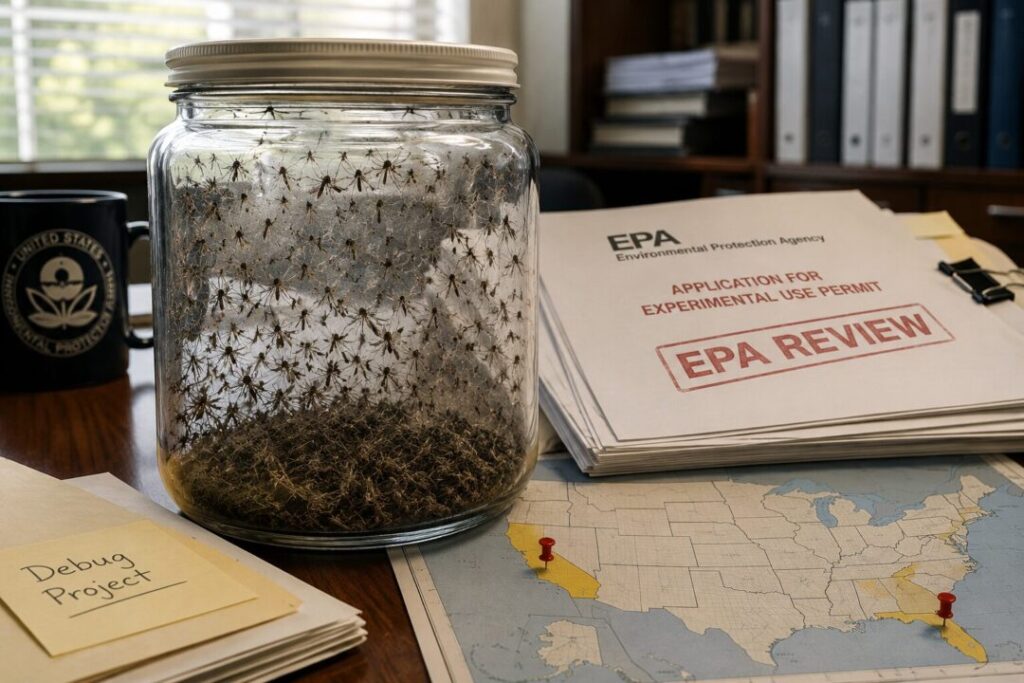
The Environmental Protection Agency is currently reviewing a proposal from Verily, a life sciences company owned by Google's parent company, Alphabet, that would allow the release of up to 32 million lab-raised mosquitoes in parts of California and Florida.
That's a lot of mosquitoes. Naturally, people have some questions.
I want everyone to stop and ask what interest Google has in releasing mosquitoes. They’re a tech company. Not an environmental group. Not a non-profit. Not a government. A tech company. Just like Bill Gates, I don’t want them anywhere near our wildlife or nature. CC: @LeeMZeldin https://t.co/WBLDDvOY0I
— Robby Starbuck (@robbystarbuck) May 31, 2026
What's the Plan?
The project, called Debug, would release male Culex mosquitoes carrying a naturally occurring bacteria known as Wolbachia. The idea is that when the bacteria-carrying males mate with wild female mosquitoes, the eggs don't hatch.
Fewer eggs means fewer mosquitoes. Fewer mosquitoes means fewer opportunities for diseases like West Nile virus to spread.
And before anyone starts scratching imaginary bug bites, there's one important detail: Male mosquitoes don't bite.
Supporters say this is a smarter alternative to spraying large areas with pesticides.
Where The Doubts Come From
Part of it is the scale.
We're not talking about a few hundred mosquitoes. We're talking about 32 million of them.
Verily points to earlier field trials that reportedly reduced target mosquito populations by more than 90 percent. Supporters say this is the kind of innovation needed to fight mosquito-borne diseases without relying as heavily on chemical pesticides.
But not everyone is convinced. History is full of examples where experts were confident a solution would solve a problem, only to create another one nobody saw coming.
That's especially true when governments and large institutions try to alter complex natural systems.
Mosquito populations, food chains, ecosystems, and disease patterns don't always behave the way people expect them to.
Critics aren't necessarily arguing that the science is fake or that the goal is bad. But many are questioning why a company best known through its connection to Google is involved in environmental control at all.
For many Americans, the mosquitoes aren't really the main concern. They're more worried about a growing trend of powerful corporations and government agencies working together on projects that directly affect the public.
A lot of people have become more skeptical of those partnerships in recent years. Americans have become a lot less willing to take, “Don't worry, we've got this,” as a complete answer.
As a result, projects that might have generated little attention a decade ago now face much tougher scrutiny.
The EPA Is Taking Comments
For now, no final decision has been made. The EPA is reviewing the application under docket EPA-HQ-OPP-2025-3951, and public comments remain open through June 5.
People get a chance to look at the proposal, ask questions, raise concerns, and weigh the potential benefits against the potential risks.
Whether you're for it or against it, more public discussion is usually better than less.
What About Nevada?
The proposal only covers parts of California and Florida, but Nevadans have their own reasons to pay attention.
Southern Nevada deals with mosquito control every year, especially during monsoon season when standing water becomes a breeding ground.
Local agencies already work to limit mosquito populations and reduce the spread of West Nile virus. There's no indication Nevada is next in line for a Verily project.
But if California and Florida see good results, it's probably only a matter of time before the idea starts popping up in other places.
The Real Debate
Supporters see an innovative way to fight disease without relying as heavily on chemicals.
Critics see another large-scale experiment being rolled out by powerful institutions that haven't exactly earned universal confidence in recent years.
Reasonable people can disagree about the answer. But it's probably fair for the public to ask a few extra questions.
After all, once the mosquitoes are out, there's no putting them back in the bottle.
The opinions expressed by contributors are their own and do not necessarily represent the views of Nevada News & Views. Digital technology was used in the research, writing, and production of this article. Please verify information and consult additional sources as needed.