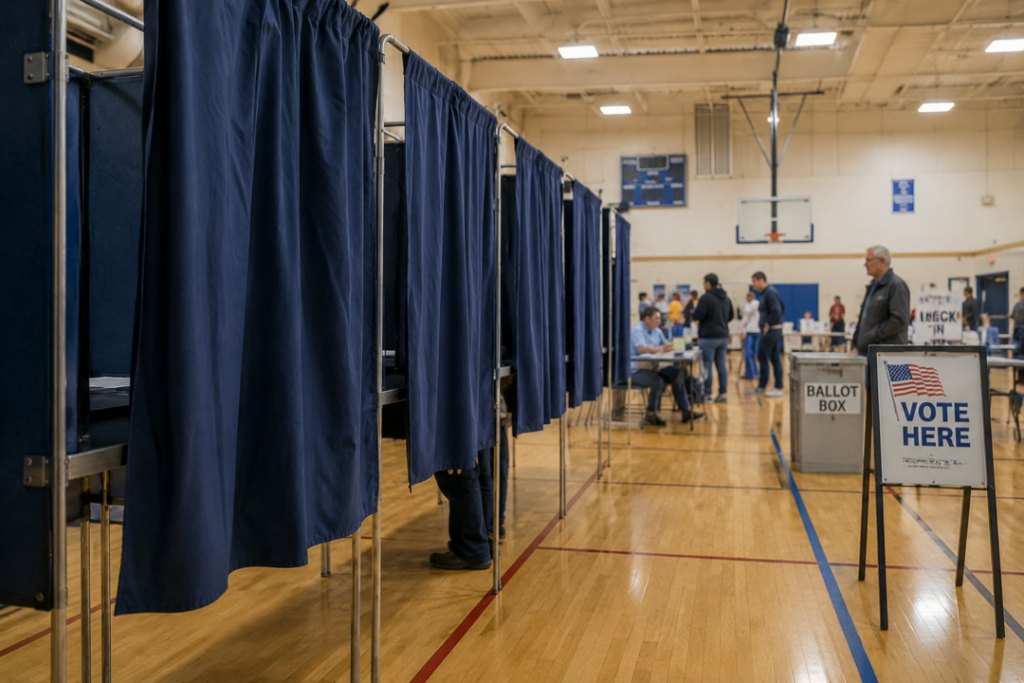
(Kamau Bakari) – There’s a scene most of us over 40 remember clearly: walking into a school gymnasium or a church basement, stepping behind a curtain, and marking a ballot that no living soul could see.
No one looking over your shoulder. No one asking who you picked. No one who could reward you – or punish you – for your answer.
That scene is disappearing in Nevada and all across America, and we should be honest about what’s replacing it.
A Reform We Fought Hard to Win
It’s worth remembering that secrecy at the ballot box isn’t how America started. In the early republic, voting was often a public act.
Virginia used “viva voce” voting into the 1860s, where a man walked up to the courthouse steps and announced his choice out loud for the clerk to record.
Elsewhere, parties printed their own distinctively colored tickets, so a poll watcher could tell how you voted just by the color of the paper in your hand.
The result was predictable: bosses watched. Employers pressured. Landlords leaned on tenants.
Vote-buying was so routine that a man handing over cash for a vote could stand at the ballot box and confirm he’d gotten what he paid for.
Elections in that era were, in places, closer to auctions than exercises of free will.
Americans fixed this.
Borrowing an idea pioneered in Australia in the 1850s, states began adopting the “Australian ballot” – a uniform, government-printed ballot marked in a private booth, with no way for anyone else to know your choice.
By the 1890s it had swept the country. It was one of the great, quiet triumphs of American democracy: the moment we decided that how you vote is yours, and yours alone.
Mail-In Voting Undoes That Work
Now ask yourself honestly: when a ballot arrives at a kitchen table, who’s standing there?
Maybe no one.
But maybe a husband who has strong opinions about how his wife should vote.
Maybe an adult child “helping” an elderly parent whose eyesight isn’t what it used to be.
Maybe a union organizer, a campaign canvasser, or a “ballot harvester” who shows up at the door and offers to “make sure it gets turned in” – after watching every mark go down.
Maybe a nursing home aide filling out a stack of ballots for residents who can barely track what’s happening.
None of this requires a conspiracy. It just requires what we already know about human nature.
People are more easily influenced when they’re being watched, and far more easily influenced when the person watching controls something they need – a paycheck, a roof, a caregiver’s patience.
The voting booth wasn’t an accident of architecture. It was a deliberate wall built between a voter’s conscience and every form of pressure the outside world could bring to bear on it.
Mail-in balloting tears that wall down and asks us to trust that nobody on the other side will notice.
Convenience Was Never the Point
Supporters of mail voting will say it’s about access – the elderly, the disabled, the deployed soldier, the shift worker who can’t make it to a polling place on a Tuesday.
Those are real concerns, and Nevada already has good answers for them.
No-excuse early voting over a two-week window, absentee ballots for voters with genuine documented need, and accommodations for the disabled and military at the polling place itself.
What we don’t need is to make private, unsupervised, unverifiable voting the default method for the entire electorate, on the theory that convenience outweighs the century-old lesson that got us the secret ballot in the first place.
Nevada should return mail ballots to what they were always meant to be: a limited accommodation for voters who genuinely cannot get to a polling place – not the default method for an entire state.
Bring back the era when casting a ballot meant stepping behind a curtain, alone, where no one – not a boss, not a spouse, not a stranger at the door – could see how you voted or lean on you for the “right” answer.
We didn’t win the secret ballot by accident. We shouldn’t give it up by accident either.
Kamau Bakari writes on Nevada politics and civic policy. The opinions expressed by contributors are their own and do not necessarily represent the views of Nevada News & Views. Digital technology may have been used in the research, writing, or production of this article. Please verify information and consult additional sources as needed.