The RDA has come forward with a 4-part plan that has the potential to fix Reno's downtown problem and make it a place that people want to go to.
(Michael Leonard) – For years, downtown Reno’s revitalization strategy has focused on aesthetics: new plazas, upgraded sidewalks, decorative lighting, public art, and placemaking projects. They haven’t fixed the problem.
A recent Redevelopment Agency presentation acknowledges something more significant: The core problem on Virginia Street is not simply appearance — it is economic dysfunction.
In a May 2026 presentation titled “Vacant Storefront Activation,” the Reno Redevelopment Agency openly recognized that downtown Reno’s retail vacancy problem is undermining the city’s broader redevelopment efforts.
And notably, the agency is now considering a more aggressive role in downtown real estate intervention.
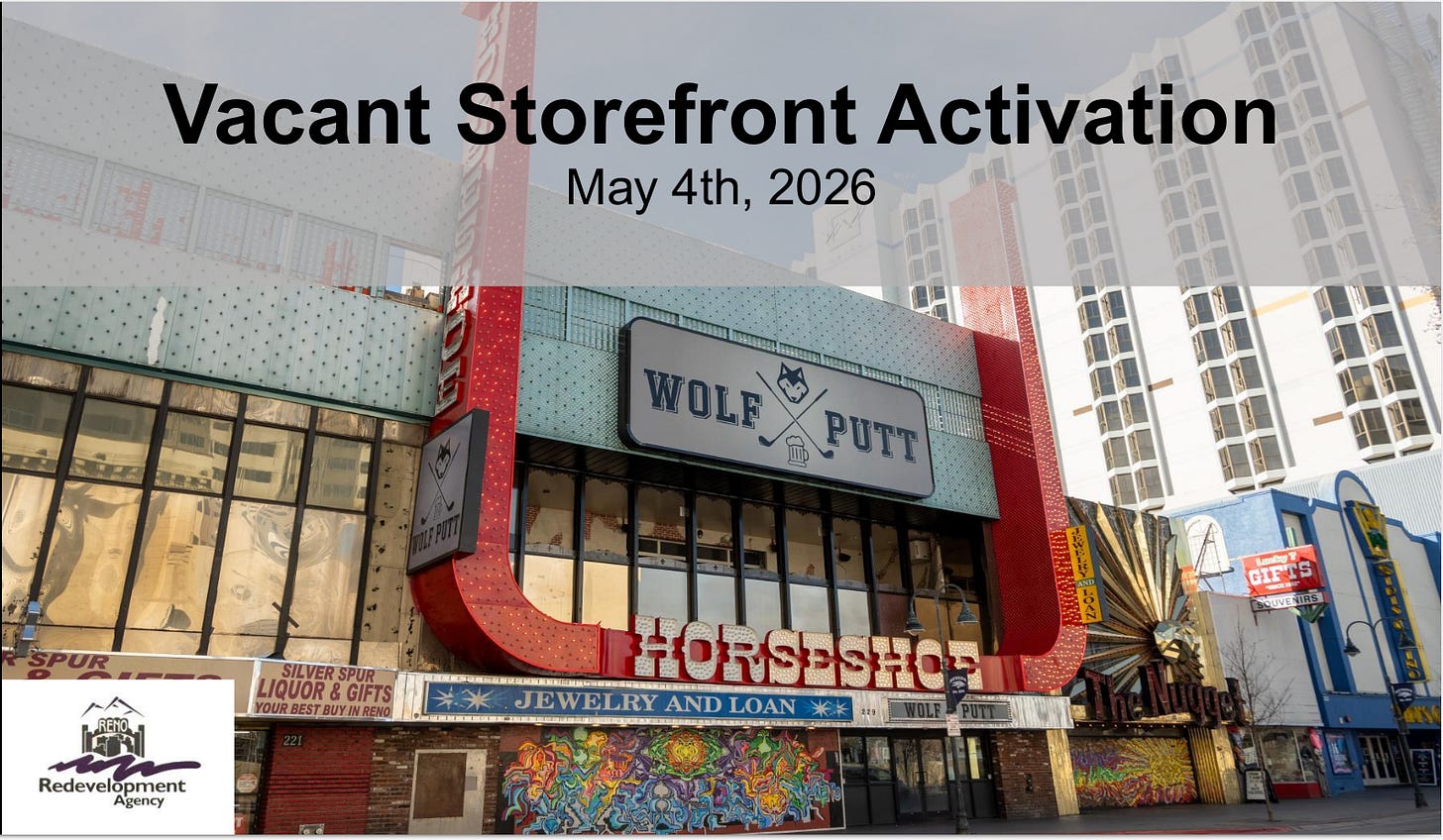
Click the image to view the RDA’s Vacant Storefront Activation presentation.
The RDA’s Diagnosis: The Problem Is Structural
The presentation begins with a blunt assessment of the Virginia Street corridor: “A concentration of vacant and blighted storefronts along the Virginia Street corridor continues to undermine downtown Reno’s revitalization efforts.”
The document identifies several underlying causes:
- disengaged property owners,
- limited broker activity,
- oversized ground-floor retail spaces,
- and failure of market-driven absorption.
This is important because it signals a shift in how city officials are framing downtown Reno’s struggles. For years, much of the public discussion centered around cosmetic improvements: better lighting, new sidewalks, landscaping, decorative features, and activation events.
But the presentation explicitly states: “This issue is not simply aesthetic — it is economic and strategic.” That may be the most revealing line in the proposal.
One-time events and masking empty facades isn’t enough to save downtown Reno.
Virginia Street’s Problem: There Is Nowhere To Go
The agency’s presentation repeatedly returns to one core issue:
The vacancy itself destroys pedestrian energy. According to the RDA, vacant storefronts:
- reduce pedestrian activity,
- limit opportunities for local entrepreneurs,
- weaken investor confidence,
- and erode downtown’s “sense of place.”
This reflects a growing recognition among planners and economic development officials that downtown vitality depends less on physical infrastructure and more on destination density. People walk where there are things to do. A successful urban corridor creates momentum:
Restaurants lead to bars,
bars lead to retail,
retail leads to entertainment,
and entertainment leads to foot traffic.
But long stretches of empty storefronts interrupt that flow. Even expensive public improvements can’t overcome the psychological effect of visible vacancy. The RDA appears increasingly aware of this dynamic.
Downtown Reno currently lacks an identity, even though it was a place to go for decades.
Four Different Intervention Strategies
The presentation outlines four escalating policy options for dealing with vacant storefronts. Each represents a different level of government intervention in the private real estate market.
Option 1: Master Lease / Sublease Pilot
Under this approach, the RDA would effectively become a market participant itself.
The agency would:
- identify high-visibility vacant spaces,
- sign master leases with property owners,
- subdivide or improve spaces,
- Then sublease them to small businesses.
The proposal specifically discusses:
- intentional tenant mix,
- incubating local businesses,
- and creating proof-of-concept activation projects.
This is a significant departure from traditional redevelopment incentives. Instead of simply offering grants or facade improvements, the city would actively shape the retail environment itself.
The RDA acknowledges the risks:
- lease liability,
- property management burdens,
- and financial exposure.
But the appeal is clear: It bypasses disengaged landlords and gives the city immediate control over activation outcomes.
San Francisco used a blight tax to improve tenancy in empty properties.
Option 2: Broker Incentives and Market Facilitation
This is the least aggressive option.
The RDA would:
- incentivize commercial brokers,
- improve downtown marketing,
- conduct outreach to prospective tenants,
- and increase transparency around lease rates and vacancy.
This strategy relies heavily on private-sector cooperation.
The downside, according to the presentation, is that it does not directly solve the oversized storefront problem and may produce slower results.
Option 3: Pop-Up and Temporary Activation
This model focuses on temporary retail activation.
The RDA would fund:
- basic tenant improvements,
- short-term leases,
- pop-up retail,
- art installations,
- and local maker spaces.
The goal would be rapid activation and the creation of a pipeline for permanent tenants. This approach mirrors programs launched in places like San Francisco and Seattle.
The agency cites a San Francisco program in which more than half of temporary pop-ups eventually converted to long-term leases.
Still, the RDA acknowledges the risks: Temporary activation can create churn if businesses fail to stabilize into permanent tenancy.
Option 4: Strategic Property Acquisition
This is the most aggressive proposal — and perhaps the most consequential. Under this strategy, the RDA would directly purchase chronically vacant properties.
The presentation proposes:
- subdividing oversized retail spaces,
- recruiting curated tenants,
- stabilizing buildings,
- and potentially holding or reselling properties later.
The RDA lists the major advantage plainly:
“Maximum control over tenant mix, lease rates, and space configuration.”
This is essentially an acknowledgment that parts of Virginia Street may no longer function properly as a typical private retail market.
It also reflects a growing belief that some downtown property owners may be unwilling or unable to reposition their buildings for modern retail realities.
Taylor understands the need for taking action, while Lorton favors landlords.
Oversized Storefronts: An Underappreciated Problem
One of the most important observations in the presentation involves building scale. The RDA repeatedly references “oversized footprints” and the need to “right-size” spaces for smaller businesses.
Many downtown buildings were designed decades ago for:
- department stores,
- casino retail,
- or large-format tenants.
But today’s local entrepreneurs often need:
- smaller footprints,
- lower startup costs,
- flexible lease terms,
- and lower overhead.
Large vacant storefronts can become economically unusable for independent operators. The RDA now appears to recognize that the physical structure of downtown retail may itself be contributing to long-term vacancy.
Meanwhile, Reno Is Proposing a $20 Million Sidewalk Project
The storefront presentation arrives at the same time the RDA is considering a separate $20 million Virginia Street sidewalk reconstruction proposal.
That project includes:
- new sidewalks,
- trees,
- lighting,
- irrigation,
- electrical systems,
- and public seating.
Critics may see a contradiction: If the storefronts remain empty, will new sidewalks change downtown activity? The storefront presentation may unintentionally answer that question.
Repeatedly, the document argues that vacancy — not merely aesthetics — is what undermines downtown vitality. I agree with the RDA.
A Quiet Shift in Redevelopment Philosophy
Perhaps the most important takeaway is philosophical. The RDA appears to be moving away from a beautification-based model of redevelopment and toward a more interventionist economic development strategy. I think it makes sense.
Instead of simply improving public spaces, the agency is now openly considering:
- direct leasing,
- curated tenant recruitment,
- temporary retail incubation,
- and property acquisition.
In effect, the RDA is acknowledging that downtown Reno’s problems may not be solved by cosmetic improvements. The question now is whether Reno is prepared to accept the financial and political risks that come with deeper intervention in the downtown real estate market. I think that we should.
The opinions expressed by contributors are their own and do not necessarily represent the views of Nevada News & Views. This article was originally published via MikesRenoReport.substack.com on 5/15/2026.