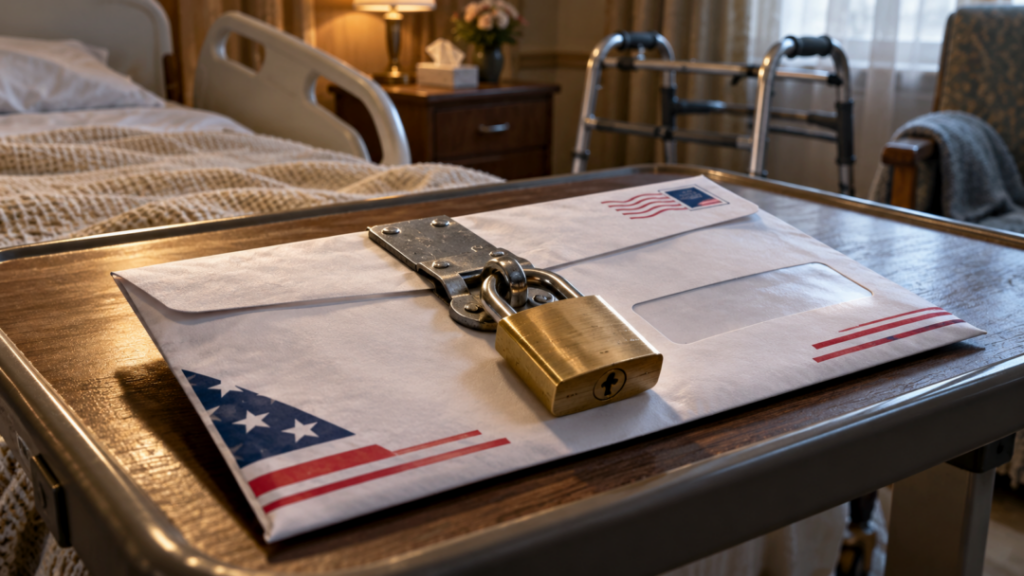
Critics tend to downplay the seriousness of voter fraud. “It never happens,” they say.
Michigan shows us that’s not exactly true.
Cleta Mitchell, founder of the Election Integrity Network, and the group have taken heat for pushing tighter safeguards on how ballots are requested, handled and returned.
She’s pointing critics to a real case with a real conviction.
The forces who want corrupt elections have been on the warpath attacking me and @EIwatchdogs for our campaign to protect vulnerable voters in nursing homes and other residential facilities. “This NEVER happens!” they scream.
Then, this just in:
Michigan nursing home worker gets jail time for voter fraud https://t.co/4vw1yHIvl9
— Cleta Mitchell (@CletaMitchell) October 12, 2026
The case isn’t new, but it’s real and on the record. And it shows exactly where the weak spots are.
In the fall of 2020, Trenae Myesha Rainey worked at Father Murray Nursing Home in Center Line, Michigan.
According to the Michigan Attorney General’s office, she filled out about two dozen absentee ballot applications for residents.
Then she forged their signatures.
They weren’t residents who asked for help. Investigators said they hadn’t told staff they wanted to vote at all.
The Center Line city clerk caught it. The signatures didn’t match what was on file.
In October 2020, the clerk flagged the applications to the state Bureau of Elections, and the AG’s office took it from there.
Rainey first faced six felony charges, each carrying up to five years. In February 2022, she pleaded guilty to three misdemeanor counts of making a false statement on an absentee ballot application.
A Macomb County judge gave her 45 days in jail plus probation.
Here’s the kicker. The attorney general who brought the case was Dana Nessel. She’s a Democrat.
That makes it a lot harder to write voter fraud off as a right-wing conspiracy theory.
And Rainey wasn’t the only one. Michigan charged others for similar crimes, in separate cases, around the same time.
Carless Clark pleaded guilty to a misdemeanor after admitting she forged her grandson’s signature on his absentee ballot envelope.
Nancy Williams was charged with trying to get absentee ballots for several legally incapacitated people under her care, without their knowledge or consent.
“It Didn’t Change Anything”
An Associated Press review found 56 potential voter fraud cases in Michigan in 2020.
In a Presidential election, 56 votes might not mean much for the outcome, but “it didn’t change the outcome” isn’t the same as “it didn’t happen.”
And what a strange standard that is for election security.
It’s not like we’re comfortable taking the locks off our doors because “most people don’t rob houses.”
Fraud tends to show up where the system is weakest.
Nursing homes are one example. So are crowded apartment complexes, group homes, and outdated voter rolls.
Anywhere ballots move through other people’s hands, there’s room for mischief.
A clerk caught Rainey by comparing signatures. Take away that step, and nobody catches anything.
Nevada’s Missing Checkpoint
Michigan made voters apply for an absentee ballot. That application required voters to provide an updated signature, giving the clerk something to check.
Nevada doesn’t have that extra step.
Under AB 321, passed in 2021, Nevada mails a ballot to every active registered voter. No application needed. Nevada law also lets someone else return a voter’s ballot for them.
That leaves one main checkpoint: the signature on the return envelope.
And Michigan just showed us how easy it is for someone with access to fake that.
Question 7 Adds a Deadbolt
Passing Question 7 would add another layer of security in Nevada.
In person, you’d show photo ID to vote. By mail, you’d have to provide the last four digits of your driver’s license or Social Security number.
That means at the polls, you have to show up and match your ID. By mail, whoever fills out the ballot would need to know at least one fairly sensitive number, on top of providing a matching signature.
In Michigan, the clerk did the job exactly the way it’s supposed to be done.
There was a signature to check against, and checking it meant two dozen seniors kept their votes (and the choice of whether or not to vote) their own.
Clerks can only catch what the law lets them check; Question 7 gives clerks in Nevada one more thing to check.
Election security isn’t an accusation against voters. It’s a guarantee that your vote is yours. Vote “YES” on Question 7.
The opinions expressed by contributors are their own and do not necessarily represent the views of Nevada News & Views. Digital technology may have been used in the research, writing, or production of this article. Please verify information and consult additional sources as needed.