(Jeff Carter) – Nevada Democrats are in the fear business. They are so afraid of failure that they will settle for no progress at all. You cannot make society better without the possibility of failure.
If they had been around when Henry Ford and Thomas Edison were remaking the world, they would have regulated both men out of business to protect the buggy-whip makers and the lamplighters.
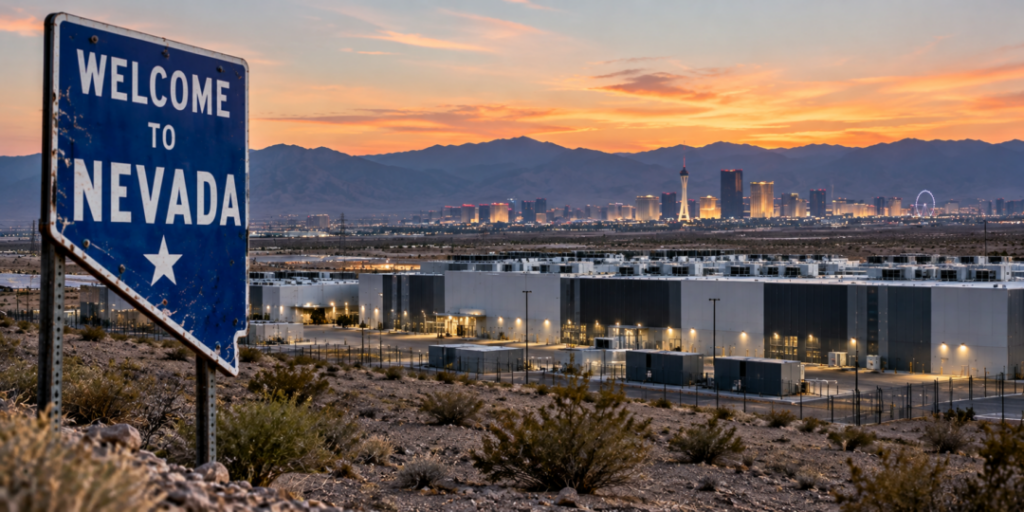
The candidates are different. The song is the same. This cycle, the song is about data centers.
Aaron Ford built the gravy train
Aaron Ford sings lead. In 2015, as a state senator, he co-sponsored the bill that created Nevada’s data center tax abatements. He said at the time that the goal was to help Switch expand in his district.
Now that he is trailing, he wants to end “Lombardo’s gravy train.” Same man, same program, different poll numbers.
His campaign also calls Governor Lombardo a coward for not debating. That is rich coming from a candidate who refused to debate his own primary opponent. Lombardo served in the Army and spent his career in law enforcement, rising to Clark County Sheriff. When he played baseball, he was a second baseman. If you know anything about baseball, second base is not where the cowards play.
Price the risk. Don’t run from it.
Data centers are not free, and nobody in Henderson wants to pay Google’s power bill. That is a real concern, and there is a grown-up answer to it.
Lombardo’s executive order makes data centers that want tax abatements pay the full school support tax, cover their own energy and infrastructure costs, and meet local water standards. That is how you handle risk: you price it, and you manage it. You do not run from it.
Any company that wants to build data centers already understands they have to bring their own power that doesn’t rely on the existing power grid. For what it’s worth, data centers take less water to operate than a solar field set up in the dusty desert.
Dina Titus would rather have a hearing
Dina Titus runs from risk. She can barely get down the stairs. Outside Boulder City, a developer held permits for a 19-megawatt solar farm, which already came with about $24 million in state tax breaks. When the developer wanted to build a data center there instead, Titus went to war.
She tweeted that she’d rather have the solar farm and wrote letters to the BLM, demanded that Lombardo freeze data center abatements, and introduced a federal bill to slow data centers on public land. Subsidized solar panels that use large amounts of freshwater to keep clean are fine with her. The thing that powers the economy is not.
Her opponent, Carrie Buck, wants Congress to make it easier to build the energy and infrastructure America needs, and she opposes a federal moratorium. One of them wants to build. The other wants a hearing.
Fear runs our money too
Economist John Cochrane put it plainly:
Interest-paying electronic money, completely safe without deposit insurance, would be a great thing. For example, Silicon Valley Bank would never have had huge uninsured deposits that ran if there had been an easy safe place for large depositors to put their money.
For decades, regulators have blocked every version of that safe place. That includes narrow banks that park deposits at the Fed, segregated accounts walled off from a bank’s failure, money market funds with fast payments, and a useful interest-paying digital dollar. Stablecoins backed 100 percent by short-term Treasuries are the latest attempt to route around the obstacles.
On September 15, the Clarity Act, the bill to finally write the rules for crypto markets, died in the Senate 49 to 50. The fight that sank it was over whether you can earn a return on stablecoins. The banks lobbied hard against it because they don’t want competition for your deposits. Every Democrat in the chamber voted no, and a few bank-friendly Republicans joined them.
We have seen this movie before. In 1980, bankers told the Senate that money market funds would drain deposits and choke off lending. Money market funds grew into the trillions. Banks are fine. Consumers got paid.
That is fear of competition dressed up as consumer protection.
Energy is the whole game
The knowledge economy runs on cheap, always-on electricity, and Nevada should know that better than anyone. For decades, Nevada Democrats told Nevadans scary stories about nuclear power and Yucca Mountain.
The state walked away instead of negotiating a real deal to store the nation’s waste and build power alongside it. Now Nevada is playing catch-up on generation at exactly the moment demand is exploding.
Nuclear gives you firm, carbon-free power around the clock. Solar does not, at least not without a lot of expensive storage.
The same fear runs down the ballot
For Lieutenant Governor, Stavros Anthony has worked to make Nevada easier for small business owners. His opponent, Assembly Majority Leader Sandra Jauregui, has sponsored or championed bills expanding government regulation of housing, guns, healthcare pricing, and school programs.
I met Democratic attorney general candidate Nicole Cannizzaro while I was campaigning. We had a cordial conversation. I raised the idea of letting citizens and the state of Nevada pay government taxes/fees in stablecoins, which would make everything faster and cheaper. She didn’t understand it, and she was afraid of the idea.
When I raised the same idea with Republican Adriana Guzmán Fralick, she grasped it immediately. She wasn’t for it or against it, but she wasn’t afraid. Cannizzaro has spent her career in government. Guzmán Fralick has built a business. People who build businesses understand risk and reward.
People who have built businesses understand risk. Career politicians, policy wonks, government watchdogs, and bureaucrats do not understand risk. They shout brickbats after the fact from the peanut gallery while the business builders climb into the arena.
Susie Lee talks about costs for the little guy while trading stocks like she works on Wall Street, not in Washington. Her opponent, Marty O’Donnell, built a career creating companies and earned his own money.
Steve Horsford lives in the 1850s, not 2026. His opponent, Cody Whipple, is a fourth-generation Nevadan and a rancher, which means he takes on risk every single year. He also understands that cheap electricity is what powers an on-demand economy.
In the 2nd District, David Flippo spent 24 years in the Air Force and spent 10 years with British Petroleum. Oil people understand risk. His opponent, Teresa Benitez-Thompson, was Aaron Ford’s chief of staff. You know where she will land on data centers.
Allison Schrager made the broader point in a good piece at The Free Press: “We have gone too far in removing risk from our citizens’ lives.” She argues that the drive for safety gave us longer, more comfortable lives and now holds us back. It also explains why people feel the economy is broken in the richest society in history.
The Democratic platform is built on removing risk from every choice you make. That means removing your chance to get ahead.
Here is what the upside looks like now.
After taking years and a lot of employees to build YCharts, my friend Shawn Carpenter built Stock Alarm (attention, Susie Lee) in a few weeks, sitting at home, with AI agents. It is already generating revenue. One person, one laptop, a real business. That only happens because somebody built the data centers.
Look west again
Data centers are today’s version of looking west. Nevada was never about getting rid of every risk. Ranchers took risk and opened the frontier. Miners followed them.
For nearly half a century, Nevada was the only state that allowed casinos, until other states decided they wanted a little risk too. I spent more than 25 years on a trading floor, the last bastion of true capitalism, and I know that ethos well: you manage risk; you don’t hide from it.
Nevada Republicans get that. Nevada Democrats are selling fear. Don’t buy it.
This article was originally published via JeffreyCarter.substack.com on 9/23/2026. The opinions expressed by contributors are their own and do not necessarily represent the views of Nevada News & Views. Digital technology may have been used in the research, writing, or production of this article. Please verify information and consult additional sources as needed.