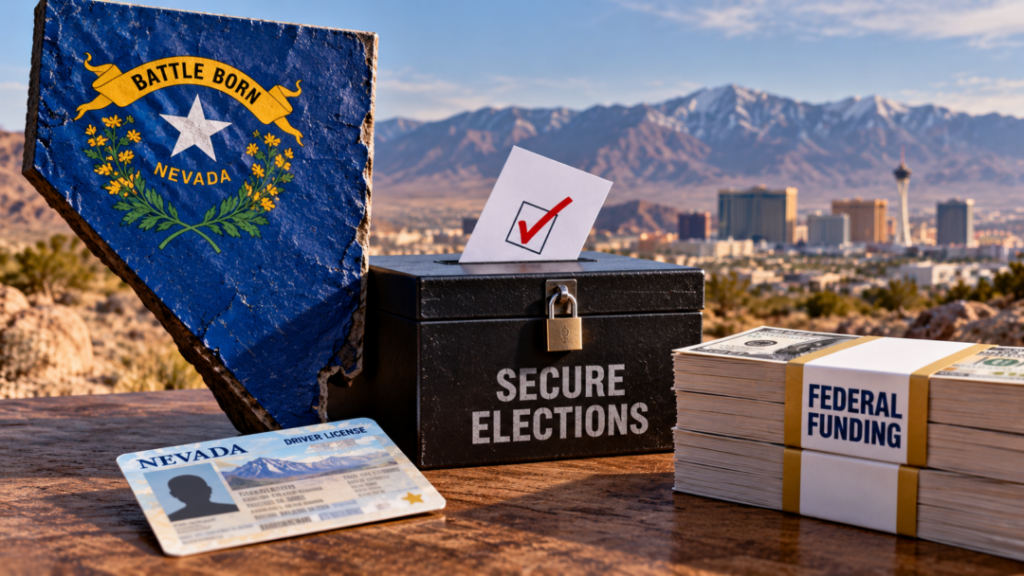
For years, Americans have been told that election integrity and voter access are mutually exclusive. They are not.
A secure election system is not an obstacle to democracy – it is a prerequisite for it.
That is why Congress’s effort to include the SAVE Act in a budget reconciliation package could become one of the most significant election reforms in modern American history.
If Republicans are successful, states that strengthen election security may soon find themselves not only improving public confidence but also positioning themselves to receive federal assistance for implementing those reforms.
That is particularly important for states like Nevada, where voters will once again decide whether to amend the state Constitution to require photo identification for voting.
The timing could not be more significant.
Nevada voters overwhelmingly approved Question 7 in 2024, the first step toward establishing a constitutional voter ID requirement.
Because constitutional initiatives in Nevada must pass in two consecutive general elections, voters will decide the issue again during the 2026 midterm election.
If approved a second time, Nevada would join the growing majority of states requiring voters to verify their identity before casting a ballot.
At the federal level, Republicans are pursuing a similar goal.
The SAVE Act would require documentary proof of U.S. citizenship when registering to vote in federal elections while also strengthening voter identification requirements.
Critics portray these provisions as barriers, but supporters see them as common-sense safeguards that simply verify what federal law already requires – that only American citizens vote in federal elections.
The reconciliation proposal goes even further.
Rather than simply mandating reforms, House Republicans have proposed approximately $10 billion in grants over the next decade to encourage states to adopt portions of the SAVE Act.
In other words, states that modernize their election systems and implement stronger security standards could become eligible for federal assistance to help pay for those improvements.
That creates a tremendous opportunity for Nevada.
If Question 7 passes this November, Nevada would already be moving toward compliance with many of the election security principles Congress is attempting to encourage nationally.
Federal funding could help counties upgrade election technology, improve voter verification systems, train election workers, strengthen cybersecurity, and reduce the financial burden on taxpayers. Rural counties like Nye, Esmeralda, Lincoln, and White Pine often struggle with limited election budgets.
Federal grants tied to election security could provide much-needed resources while improving public confidence in election administration.
The Trump Administration has also signaled that election funding may increasingly be tied to states’ willingness to adopt stronger election security measures.
While the exact details remain subject to congressional action and legal review, the direction is unmistakable: Washington is considering using financial incentives to encourage states to strengthen election integrity.
Opponents argue that voter fraud is too rare to justify these reforms. But that argument misses the larger point.
The objective is not merely to catch fraud after it happens. The objective is to build a system so secure that fraud is difficult to commit in the first place and so transparent that voters have confidence in every election outcome.
Americans already prove their identity when boarding an airplane, purchasing a firearm, cashing a check, applying for government benefits, or obtaining a driver’s license. Few people view those requirements as voter suppression or an infringement on personal liberty.
Instead, they recognize that important activities require verification.
Voting deserves the same level of confidence.
Nevada’s proposed constitutional amendment reflects exactly that philosophy. It does not prevent eligible citizens from voting.
It simply requires voters to verify who they are before receiving a ballot while providing verification procedures for mail-in voting as well.
Those are reasonable expectations that most Nevadans already support.
The broader political implications could be equally significant.
Should Nevada adopt voter ID while Congress advances the SAVE Act, the Silver State could become one of the first battleground states positioned to take advantage of new federal election security funding.
Instead of spending years debating election reforms after every close election, Nevada could become a model for secure, transparent, and trusted elections.
Election integrity should never be a partisan issue.
Every legal vote deserves to count.
Every illegal vote diminishes the voice of a lawful voter.
The SAVE Act and Nevada’s Question 7 represent an opportunity to strengthen both the security of our elections and the public’s faith in them.
If Congress follows through with funding incentives, states that embrace election integrity will not simply be doing the right thing – they may also be making one of the smartest financial decisions they can for their election systems.
Nevada voters have a chance this November to lead by example. Washington appears ready to reward states that do.
The opinions expressed by contributors are their own and do not necessarily represent the views of Nevada News & Views. Digital technology may have been used in the research, writing, or production of this article. Please verify information and consult additional sources as needed.